
My basket0 items
Which Sony Alpha camera should you choose in 2026? Complete guide

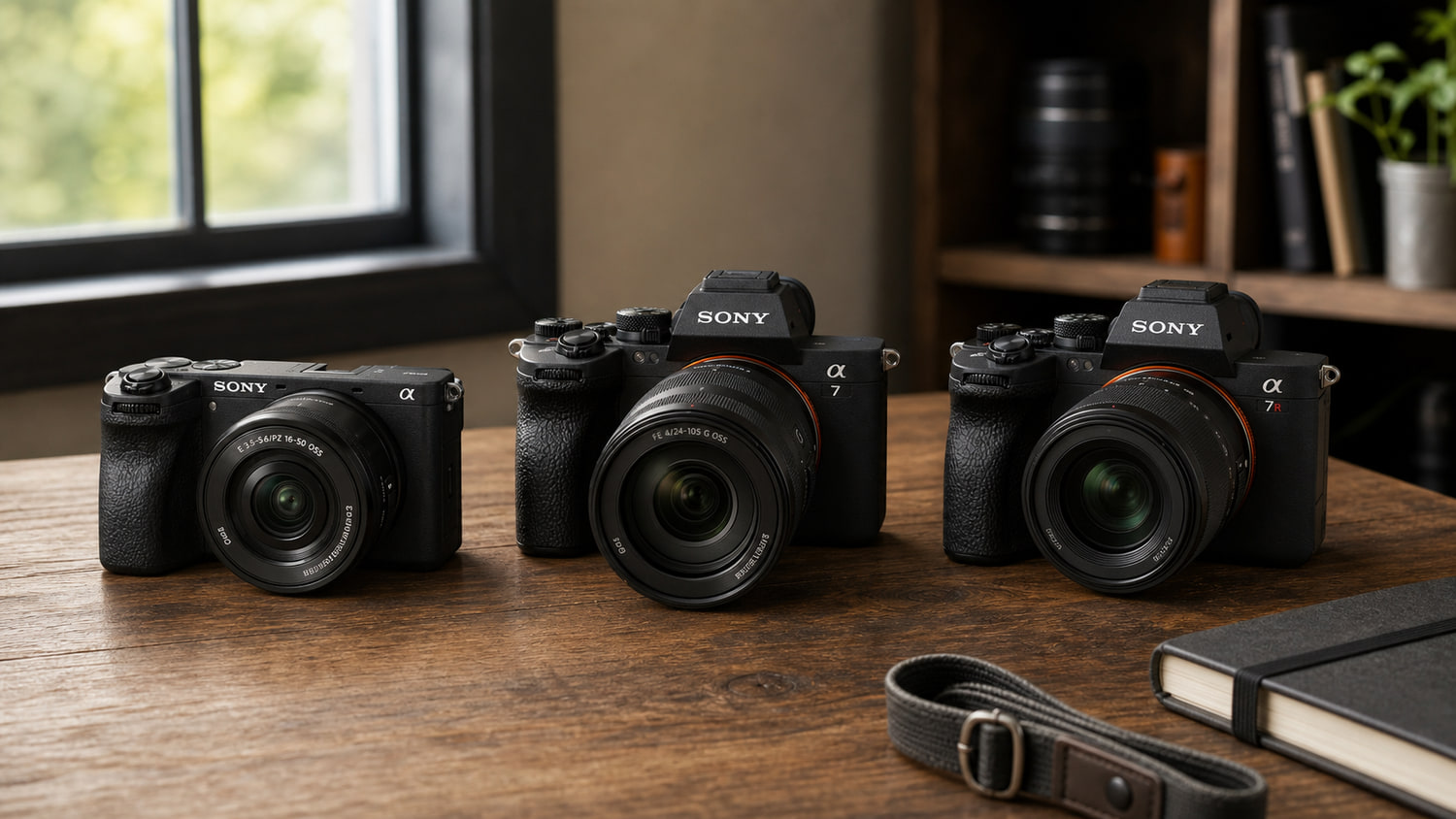
Choose a Sony Alpha from the pictures you want to make, the lens you need and the weight you will genuinely carry.
You may want a camera for family photographs now, yet also hope to shoot a football match, film a trip or print a wide landscape later. That is why the Sony Alpha range can feel confusing: several bodies appear to do everything. You do not need to memorise every model. Start with the pictures you actually want to make, the weight you are happy to carry and the lens those pictures require.
Which Sony Alpha should you choose? The short answer
For a small first camera, the A6700 is the most rounded current APS-C choice. The A6400 still makes sense when size and simplicity matter more than in-body stabilisation. The A7 V is the current all-round full-frame body for photographers who regularly mix stills and video. The A7 IV and A7 III remain useful when their older autofocus and video features already cover your needs. The A7C II gives travellers a smaller full-frame body.
Look at the A7R VI, A7R V or A7CR when fine detail, large prints and cropping matter. The A7S III is for someone who mainly shoots video. The A9 III is a specialist professional sports camera, while the Alpha 1 II combines high resolution, speed and advanced video. There is no universal winner. Each camera removes a particular obstacle and brings a different compromise.
| Main use | Start with | What it makes easier | Trade-off to accept |
|---|---|---|---|
| Learning, family and light travel | A6700 | A compact, stabilised APS-C kit for both photographs and video. | APS-C framing differs from full frame, and 4K/120p uses a crop. |
| A simple small first camera | A6400 | Learning and travelling without a heavy bag. | No in-body stabilisation and older controls. |
| General stills and video | A7 V | Portraits, events, action and video in one full-frame body. | Fast modes need suitable cards and create many files. |
| Compact full-frame travel | A7C II | 33 MP and stabilisation in a small body. | A corner viewfinder, tighter controls and balance to check with larger lenses. |
| Landscape, studio and detail | A7R VI / A7R V | More room to crop and prepare large prints. | Large files, demanding lenses and more storage. |
| Video and low light | A7S III | Reliable 4K production and a fast-reading sensor. | 12.1 MP leaves less freedom for a heavy crop in a still photograph. |
| Professional sport | A9 III | Very fast sequences without rolling-shutter distortion. | Highly specialised tools and 24.6 MP resolution. |
| Action, detail and production | Alpha 1 II | 50.1 MP, up to 30 fps and 8K/30p in one body. | The lenses, cards and workflow need a genuine professional reason. |
Understanding A7, R, S and C without learning the whole catalogue
The name tells you what a camera puts first. The regular A7 line is Sony’s general-purpose full-frame family. R stands for the high-resolution branch, aimed at photographers who need fine detail. S marks the model designed chiefly for video and low light. C identifies a more compact body.
The A9 is built around professional action. The Alpha 1 tries to combine speed, resolution and demanding video work. The A6700 and A6400 use an APS-C sensor, which is smaller than full frame. This often allows a lighter camera-and-lens combination, particularly when you use lenses made for that format.
Roman numerals such as III, IV and V show the generation. A newer generation will usually offer more recent subject recognition, menus or video modes. It does not make an older camera incapable of good work. On a quiet landscape at base ISO, the difference may matter far less than it would in a dim room with a child running towards you.
Choose a camera and lens together
A compact body does not guarantee a light bag. Pair an A7C II with a large fast zoom and much of its size advantage disappears. An A6700 with a small zoom may stay on your shoulder all day. A camera that is ready when the moment arrives often gives you more useful photographs than a feature you left at home.
Every body in this guide uses the Sony E mount, the physical and electronic connection between camera and lens. A lens labelled FE covers a full-frame sensor and also works on an APS-C body, where the field of view becomes narrower. An APS-C E lens can be fitted to a full-frame camera, but the camera will normally use a smaller sensor area and record fewer pixels.
Focal length, written in millimetres, controls the angle of view. A lower number includes more of the surroundings; a higher number frames more tightly. Aperture, shown as f/1.8 or f/4, controls how much light the lens lets in. A smaller f-number admits more light and can soften the background, although the lens may become larger.
Browse the Sony lens range before comparing real kits in the Sony Alpha camera category. Body-only weight tells only half of the story.
For learning, travel and family photographs
A family day can move from a bright garden to a dim dining room in minutes. You need to find a face quickly, change the framing without a fuss and keep the camera with you. A useful zoom, a spare battery and controls you understand will help more than a headline burst rate.
The Sony A6700 is a reassuring place to start. Its 26 MP APS-C sensor is stabilised. Image stabilisation compensates for some of your own small movements while hand-holding the camera. It can help with a still scene in poor light, but it cannot freeze a child who is moving. Subject recognition and a fully moving screen make awkward angles and solo video easier.
The Sony A6400 remains a capable 24.2 MP learning and travel camera. It tracks faces well and records 4K video. Its practical limitation is the lack of in-body stabilisation. With a long lens or low light, you will rely on a stabilised lens, a faster shutter speed or physical support.

For portraits, street photography and events
For a portrait, begin with working distance and the lens. A bright 50 mm or 85 mm lens makes a soft background easier, but it cannot choose the light or expression for you. Full frame gives you more flexibility to create that look at a comparable angle of view, although full-frame lenses are often larger.
The Sony A7 V is the broadest current A7 choice. Its 33 MP files leave sensible room for cropping. Stabilisation is rated by Sony at up to 7.5 stops in the centre, and autofocus recognises people, animals, birds, insects and vehicles. That stabilisation figure is a laboratory maximum under Sony’s conditions. It does not promise a sharp photograph of a moving person in every dark room.
The A7C II fits 33 MP and stabilisation into a smaller body. It suits street, portrait and travel photographers who enjoy a corner viewfinder. Try the controls and your intended lens together: a small body feels good only when the complete setup balances naturally.
For an event that cannot be repeated, also check card slots. Recording the same photograph to two cards gives you an immediate backup. That safety matters for paid work; it is optional for a relaxed weekend walk.
For sport and wildlife
A fast burst helps only if the camera keeps the subject in focus and you anticipate the moment. A burst is a rapid sequence of photographs. Autofocus is the system that finds and follows the subject. For birds or sport, the lens, available light and your position remain just as important as the maximum number of frames per second.
The A6700 is a manageable starting point with an APS-C telephoto lens. Its narrower field of view helps a distant subject fill the frame, but it does not physically bring you closer. The A7 V offers a useful balance of 33 MP and up to 30 fps with the electronic shutter, depending on Sony’s selected format and settings.
The Sony A9 III solves a specialist problem. A global shutter exposes the whole sensor at once, reducing the bent shapes that can appear during a very fast movement. It can shoot at up to 120 fps with autofocus and exposure tracking under Sony’s stated conditions. Those sequences need fast cards, disciplined timing and a serious editing routine.
The Alpha 1 II combines 50.1 MP with up to 30 fps. It is for a professional who may need a detailed portrait, fast action and advanced video during the same assignment. For an occasional school match, an A6700 or A7 V paired with the right telephoto lens will usually be easier to use well.

For landscape, architecture and studio work
A high-resolution file gives you more freedom to crop and print large. It also reveals a missed focus point, camera movement and a weak lens more clearly. Before choosing 61 or 66.8 MP, decide where the image will be seen and whether your computer can handle the files comfortably.
The Alpha 7R VI combines a 66.8 MP stacked full-frame sensor with greater speed. It is aimed at landscape, architecture, studio, fashion and wildlife work where fine detail and quick response must coexist. You gain the most when your lenses, shooting technique and delivery process can use that resolution.
The A7R V provides 61 MP, advanced stabilisation and modern subject recognition. The A7R IV keeps the same resolution in an older generation. The A7CR puts 61 MP in a compact body. It travels well with a small lens, but its size advantage becomes less useful with a heavy fast zoom.
If your photographs are mainly viewed on screens and you rarely crop, 24 or 33 MP may already be plenty. A well-chosen lens, steady support and good light will often change the result more than a larger file.
For video and solo content creation
For an interview, travel film or piece to camera, check the screen, sound, battery life and lens first. 8K looks impressive on a specification sheet, but clean sound and well-exposed 4K are more useful to most viewers. Include editing time and storage in the decision.
The A6700 is a compact solo-creator camera and records up to 4K/120p with a crop. The higher frame rate can produce smooth slow motion, but needs more light and storage. The A7 V goes further as a hybrid camera with 4K up to 120p in the relevant modes. Check the actual field of view before buying a wide-angle lens for those settings.
The A7S III remains video-led. Its 12.1 MP sensor limits still-image cropping, but supports fast sensor readout and demanding 4K/120p production. It suits a filmmaker who also takes photographs, rather than a landscape photographer who occasionally records a clip.
The Alpha 1 II adds 8K/30p and 4K/120p to its stills performance. These modes are worthwhile when a production has a reason and the post-production equipment to use them. A good microphone, simple light and reliable backup process will do more for a beginner.
Sony A7 V, A7 IV or A7 III?
All three are general-purpose full-frame cameras. The A7 V is the newest and fastest, with more recent autofocus, stabilisation and video tools. The A7 IV keeps 33 MP, up to 10 fps and 4K/60p with a Super 35 crop. Super 35 uses a smaller area of the sensor, so the lens shows a narrower view.
The A7 III belongs to an older 24.2 MP generation. It can still make excellent portraits, travel photographs and event work. Its autofocus, menus, rear screen and video options are less modern. Choose it because those limits fit your work, not because an older number sounds simpler.
The A7 V makes sense for regular action and advanced hybrid production. The A7 IV is enough for many photographers who do not need 30 fps or 4K/120p. The A7 III remains viable for mostly still and measured work. With any of them, leave room for the lens that creates the view you need.
Sony A7R VI, A7R V or A7CR?
Choose the A7R VI when resolution and speed must work together, such as fashion, wildlife or demanding commercial production. Choose the A7R V when 61 MP, its stabilisation and autofocus already cover landscape, studio or portrait work without the VI’s extra speed.
The A7CR is the option for someone who wants high resolution in a discreet bag. Compact does not automatically mean a light system: a fast full-frame zoom is still large. With a small lens, the A7CR suits travel, street work and architecture. With a large telephoto, the deeper A7R V or VI body may feel more secure.

What matters now, and what can wait
During your first year, put lens choice, total weight, handling, suitable autofocus, battery and cards at the top. Then consider stabilisation, dual card slots and video modes that solve a known problem. A feature is valuable only when it removes a difficulty you genuinely face.
| Essential from the start | Useful for specific work | Often optional for a beginner |
|---|---|---|
| Lens, kit weight, controls, autofocus, battery, card and backup. | Stabilisation, dual cards, moving screen, 4K/60p or 120p and high resolution. | 8K, 120 fps stills, global shutter and professional transmission tools. |
Ask five questions: what do you photograph every week? In what light? What will you carry all day? What will you do with the files? Which lens needs to be on the camera in the first month? Honest answers quickly remove attractive but unnecessary features.
Body only or a lens kit?
A kit is convenient when the included lens covers your first real subject, such as family, travel or general video. You can start learning without making another purchase decision immediately. A body-only option is sensible when you already own a compatible lens or know exactly which focal length you need.
Do not choose a bundle simply because it contains more items. Check the exact lens name, its view on your sensor, aperture, weight and any optical stabilisation. A small prime lens may be more useful than a long zoom if you mainly photograph indoors. Wildlife and sport will need a different answer.
MCZ DIRECT verdict
For learning, family and light travel, choose the A6700 when you want a current stabilised APS-C camera. Choose the A6400 when simple handling and low weight matter more, provided you accept the lack of in-body stabilisation. For an all-round first full-frame camera, the A7 V has the widest scope. The A7 IV remains a sensible choice when its speed and video are enough. The A7C II suits a photographer who values a small body and reasonably compact lenses.
For landscape and studio work, the A7R VI, A7R V and A7CR make sense only when you will use their high-resolution files. The A7S III puts 4K video and low-light work first. The A9 III is for specialist professional speed, while the Alpha 1 II serves someone who also needs detail and advanced video.
Compare complete camera-and-lens options in the MCZ DIRECT Sony Alpha range. Do not look for the body with the longest specification list. Choose the one that helps with your normal subjects and leaves enough space for the lens, bag and way you actually shoot.
Frequently asked questions about choosing a Sony Alpha
Which Sony Alpha is best for a beginner in 2026?
The A6700 is the most rounded starting point if you want a compact, stabilised and current APS-C system. The A6400 is still useful for learning and light travel, but has no in-body stabilisation. For full frame, look at the compact A7C II or the traditionally shaped A7 IV and A7 V.
Which Sony Alpha should I choose for travel?
The A6700 can make a light kit with a compact APS-C lens. The A7C II brings full frame to a small body, provided the chosen lens does not unbalance it. Total camera-and-lens weight and the focal length you need matter more than body size alone.
What is the difference between Sony A7, A7R, A7S and A7C?
A7 is the general-purpose full-frame family. A7R prioritises resolution and fine detail. A7S is designed chiefly for video and low light. A7C puts full-frame features in a more compact body. The letters describe a priority, not an absolute quality ranking.
Should I choose the Sony A7 V or A7 IV?
Choose the A7 V if you often shoot fast subjects or will use its newer autofocus, electronic burst and 4K/120p video. The 33 MP A7 IV remains a capable hybrid when up to 10 fps and cropped 4K/60p meet your needs. Include a suitable lens and cards in the decision.
Which Sony Alpha is suitable for portraits?
The A7C II, A7 IV and A7 V are strong portrait choices with 33 MP full-frame sensors and eye detection. A7R models provide more detail for studio work and large prints, but produce larger files. Lens choice, light and distance to the subject matter more than pixel count alone.
Which Sony should I choose for sport or wildlife?
The A6700 is a manageable starting point with an APS-C telephoto lens. The A7 V balances resolution and speed. The A9 III targets professional sport with a global shutter and up to 120 fps, while the Alpha 1 II combines 50.1 MP and up to 30 fps. These rates are maxima in specific modes.
Does a Sony FE lens work on an APS-C camera?
Yes. FE lenses cover full frame and also work on the A6700 and A6400, where the view becomes narrower. An APS-C E lens can be mounted on a full-frame body, but the camera will normally use a smaller sensor area and record fewer pixels.
Should I buy a Sony Alpha body only or a lens kit?
A kit is convenient when the supplied lens covers your first subjects, such as family and travel. Body only is sensible when you own a compatible lens or know the exact focal length you need. Always check the lens name, field of view, aperture, weight and any stabilisation.
Sources and editorial verification
Sources reviewed and checks completed before publication.
MCZ DIRECT editorial analysis checked on 28 July 2026 against official Sony specifications and the public MCZDIRECT catalogue. No absolute ranking or laboratory comparison is claimed. Burst rates and stabilisation levels are manufacturer maxima under stated Sony conditions.
- Sony official range — Interchangeable-lens cameras
- Sony official specifications — Alpha 1 II
- Sony official product page — A9 III
- Sony official specifications — A7S III
- Sony official specifications — Alpha 7R VI
- Sony official specifications — A7R V
- Sony official specifications — A7R IV
- Sony official specifications — A7 V
- Sony official specifications — A7 IV
- Sony official specifications — A7C II
- Sony official product page — A6700
- Sony official specifications — A6400
- Sony official support — E and FE lens compatibility
Leave a comment