
Shopping Cart
APS-C or full frame: how should you choose?

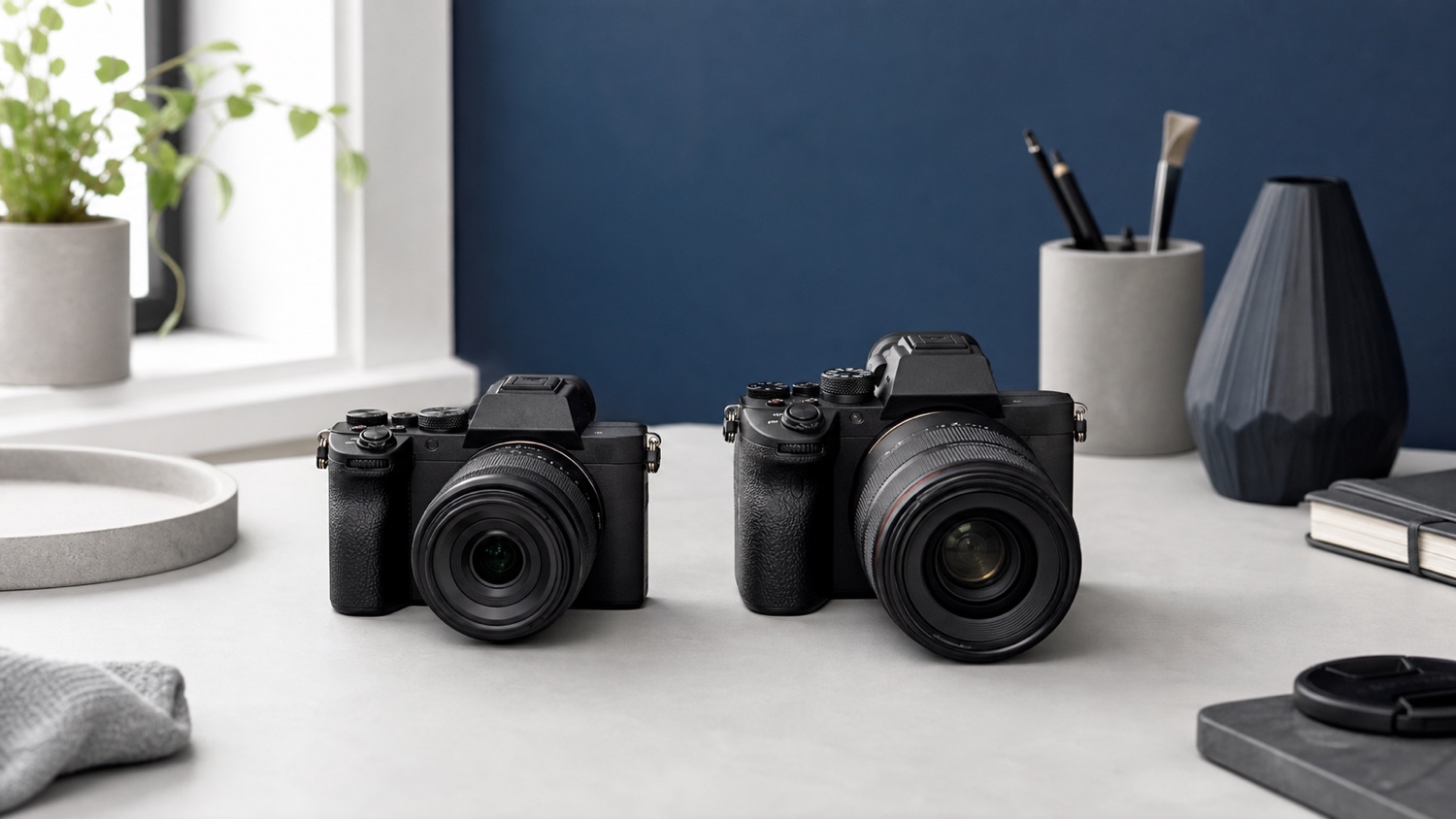
APS-C or full frame? This MCZ DIRECT guide compares framing, depth of field, low-light headroom, lenses and the size of the complete camera kit.
Last factual review: 25 July 2026. This guide compares APS-C and full-frame formats using official documentation and a ZEISS technical paper. Actual performance depends on the camera, lens, firmware, settings and shooting conditions.
To choose between APS-C and full frame, compare two body-and-lens combinations that deliver the framing you need. APS-C often makes sense when mobility, greater depth of field at equivalent framing and f-number, or a tighter angle of view with telephoto lenses helps your work. Full frame makes shallow depth of field easier and can provide more low-light headroom when cameras of a similar generation are compared. Neither format is automatically superior. The right choice depends on the available lenses, the size of the complete kit, your subjects and the result you want to create.
This article expands on one decision in our guide to choosing a mirrorless camera in 2026. Here we isolate sensor format to clear up three common misconceptions: crop factor does not change focal length, full frame is not a compulsory upgrade, and body weight alone does not describe the equipment you will carry.
APS-C or full frame: the short answer
| Main priority | Often the logical starting point | What still needs checking |
|---|---|---|
| A light travel kit | APS-C, if suitable compact lenses exist | Ready-to-shoot weight, including the main lens and accessories |
| Very blurred backgrounds at the same framing | Full frame | Available focal length, aperture and working distance |
| Sport or wildlife at long range | Either, depending on lens and pixel density | Pixels on the subject, AF, shutter speed, burst and handling |
| Moving subjects in low light | Full frame, when technology is comparable | Lens, resolution, shutter speed and the exact camera’s output |
| Video and content creation | Either format | Crop, sensor readout, rolling shutter, heat, AF and audio |
| Keeping existing lenses | The format that uses them as intended | Mount, image circle, crop mode and retained functions |
Treat this table as a direction rather than a verdict. A well-matched APS-C kit can be more useful than a full-frame body paired with the wrong lens, and the reverse is equally true.
1. What do APS-C and full frame mean?
Full frame refers to a sensor measuring approximately 36 × 24 mm. APS-C is smaller, at roughly 24 × 16 mm, although its exact dimensions vary between manufacturers. The smaller sensor records a narrower part of the image projected by the lens.
The lens itself does not change. A 50 mm lens remains a 50 mm lens on both formats. What changes is the recorded angle of view. When both photographs are displayed at the same size, the APS-C image appears more tightly framed because it came from a smaller central area of the lens’s image circle.

2. What crop factor changes, and what it does not
Crop factor is a way to compare the angle of view of a camera-and-lens combination with a full-frame reference. It is about 1.5× for many APS-C cameras and approximately 1.6× for Canon APS-C models. A 50 mm lens on a 1.5× APS-C camera therefore frames like roughly a 75 mm lens on full frame. With a 1.6× factor, the reference is about 80 mm.
| Focal length on the lens | On full frame | 1.5× APS-C equivalent | 1.6× APS-C equivalent |
|---|---|---|---|
| 16 mm | 16 mm | 24 mm | About 26 mm |
| 23 mm | 23 mm | About 35 mm | About 37 mm |
| 35 mm | 35 mm | About 53 mm | 56 mm |
| 50 mm | 50 mm | 75 mm | 80 mm |
| 200 mm | 200 mm | 300 mm | 320 mm |
Equivalent is the key word. These figures compare framing. APS-C does not create optical magnification, extra light or detail that was not captured.
A tighter angle of view can be useful for distant subjects, but the recorded detail also depends on sensor resolution and pixel density, lens quality, focus and motion blur. A high-resolution full-frame file cropped to APS-C may place as many pixels on the subject as some APS-C cameras; another APS-C body may place more. Compare the actual cameras rather than drawing a conclusion from format alone.
3. Compare the same framing, not the same focal length
A practical comparison keeps the intended picture constant. From the same position, a 35 mm lens on 1.5× APS-C frames approximately like a 50 mm lens on full frame. Putting a 50 mm lens on both cameras asks a different question because APS-C will show a narrower part of the scene.
Start with the view you need. Find the corresponding focal length for each format, then compare aperture, minimum focus distance, weight and relevant lens functions. Only after that should you compare the bodies. This order stops a focal-length difference from being mistaken for a sensor advantage.
4. Depth of field: full frame makes stronger separation easier
With a comparable angle of view, camera position and f-number, APS-C uses a shorter focal length and gives greater depth of field. Full frame therefore makes a very blurred background easier to achieve while preserving the same framing.
That can help isolate a portrait subject, but sensor format does not determine the quality of the blur. Subject distance, background distance, lens design and aperture shape all influence the result. A bright APS-C lens can still create strong separation, particularly when the subject is close and the background is well behind it.
More depth of field can be useful. Groups, street work, reportage, landscape and some close-ups may benefit when several planes need to remain readable. Choose the amount of sharpness the photograph needs rather than treating shallower depth of field as automatically better.
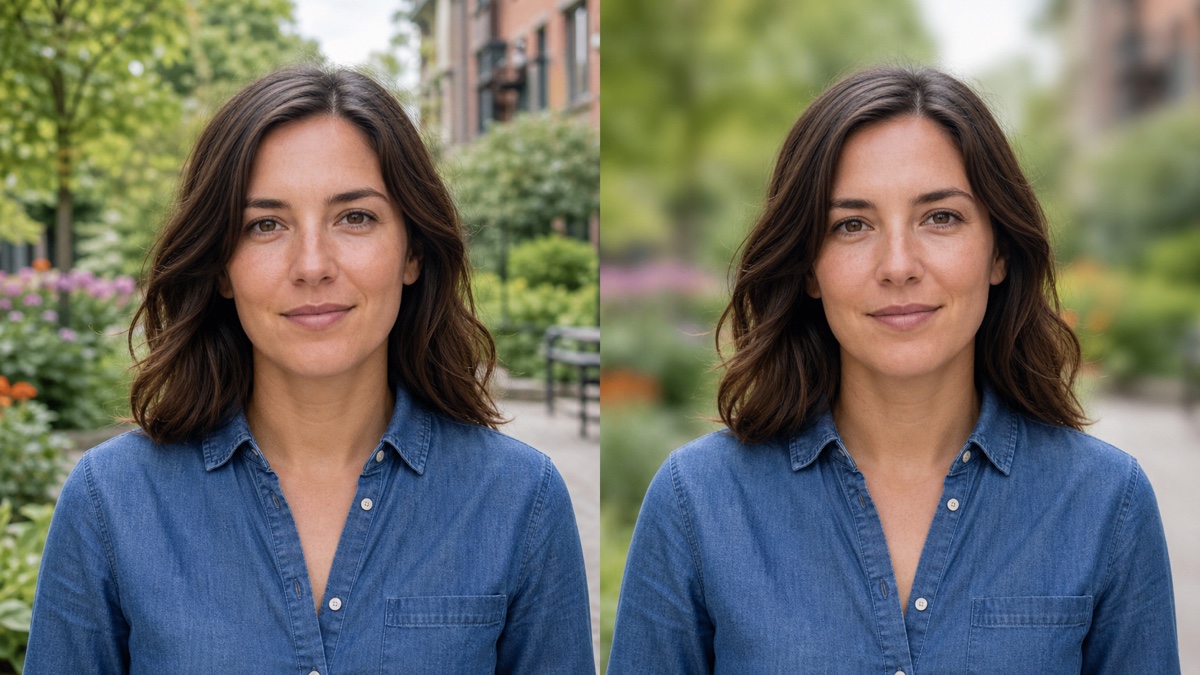
Aperture equivalence needs careful wording. Multiplying the f-number by the format factor provides a useful depth-of-field comparison. For example, f/2 on 1.5× APS-C is close to f/3 on full frame for depth of field at the same angle of view. This does not change the exposure setting: f/2 remains f/2 when calculating light per unit area.
5. Low light: a potential advantage, not a guarantee
A full-frame sensor has a larger surface area. With comparable technology, framing and output, that area can provide more signal-to-noise headroom. It is a genuine format advantage in principle, but it cannot predict the result from two arbitrary cameras.
Sensor generation, resolution, processing, exposure and final display size all affect the comparison. The lens matters too. An APS-C camera with a brighter lens may suit a particular job better than a full-frame body with a slower zoom, depending on the shutter speed and depth of field required.
For a static subject, stabilisation and a slower shutter speed may reduce the need for high sensitivity. For a moving child, athlete or animal, stabilisation cannot replace a shutter speed that freezes the subject. Compare the complete camera-and-lens combination in the mode you will actually use.
6. Resolution, cropping and pixels on the subject
Two sensors of different sizes may have similar total resolution, very different resolution or comparable pixel density. Total megapixels do not tell you how many pixels will cover a bird, face or distant detail after framing.
For sport and wildlife, ask how many pixels remain on the subject at the working distance with the chosen lens. A dense APS-C sensor may record substantial detail in its narrower frame. A high-resolution full-frame body may offer a wider view for locating an erratic subject and still leave room to crop. Lens performance, autofocus and motion blur remain part of the result.
Higher resolution also creates larger files and can make focus, camera shake or optical limitations more obvious at 100% view. It only helps when the rest of the imaging and editing chain can use it.
7. Size and weight: compare the ready-to-use kit
APS-C can enable compact bodies and dedicated lenses, but this is not true of every product. Some full-frame bodies are small, while an APS-C body with a substantial grip and extensive controls may be larger.
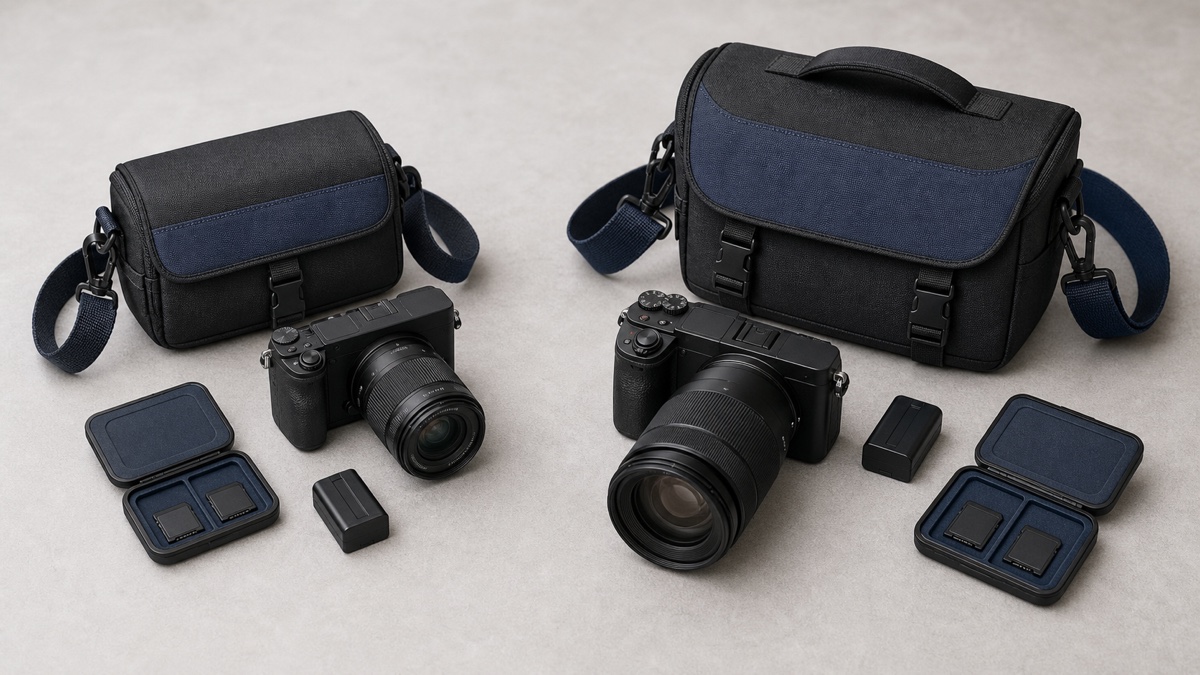
Lenses often determine the practical difference. Compare optics that cover the same angle of view and deliver the aperture you need. Add the battery, hood, filter, handle, microphone or support that travels with the camera. A light body paired with a lens you leave at home is not a mobile system.
8. Which format suits each type of photography?
| Use | APS-C can offer | Full frame can offer | Compare carefully |
|---|---|---|---|
| Travel and family | A compact kit with a dedicated zoom | Low-light headroom and depth-of-field control | Complete weight, wide-angle coverage, battery and simplicity |
| Portraits and events | Strong results with the right focal length and aperture | Easier shallow depth of field and potential low-light margin | Lenses, eye AF, flash, card recording and battery life |
| Sport and wildlife | A tighter view at the same focal length and sometimes favourable pixel density | Low-light margin and a wider view for tracking fast subjects | Telephoto lens, pixels on subject, AF, buffer, shutter and weight |
| Landscape and architecture | Mobility and useful depth of field | Cropping or dynamic-range margin on the specific camera | Available wide angle, actual dynamic range, filters, tripod and files |
| Studio and product | Practical depth of field and ample resolution for many outputs | Rendering flexibility and high resolution on selected models | Lens, lighting, tethering, colour and output size |
| Video and vlogging | Dimensions close to Super 35, although not identical | Shallow depth of field and potential low-light margin | Exact mode, crop, readout, rolling shutter, heat, stabilisation and audio |
9. APS-C lenses on full-frame bodies
Sony E, Nikon Z and Canon RF include bodies and lenses designed for more than one sensor format. A shared mount does not mean that every lens covers the full-frame sensor. An APS-C lens projects a smaller image circle and may cause the full-frame camera to record only a central crop.
Because only part of the sensor is used, fewer pixels are normally available. Behaviour varies with the brand, body, lens and sometimes the video mode, so check the compatibility documentation for the exact combination.
Buying only full-frame lenses for an APS-C body can sound like future-proofing. It is sensible only when those lenses provide the framing, aperture and handling you need now. A possible future body should not make the current kit unnecessarily awkward for years.
10. Do you need to move from APS-C to full frame?
No. Change format when a defined need remains unmet: shallower depth of field at a particular framing, more low-light headroom, a specific resolution requirement, a body feature or access to a decisive lens.
The move is not justified by the idea that serious photographers must use full frame. A better lens, improved lighting, more reliable focusing technique or a different APS-C body may solve the real problem more directly.
Review ten difficult photographs made with your current kit. Name the limiting factor in each one: noise, subject movement, AF, working distance, depth of field, focal length, handling or resolution. If the proposed full-frame body and lens do not address that limit, changing format will not fix it.
The four-step MCZ DIRECT method
- Describe three real situations. Record the subject, distance, light, framing and intended output.
- Build two equivalent kits. Select APS-C and full-frame focal lengths that provide the required angle of view, then check the aperture.
- Compare everything you will carry. Include the body, lens, battery, cards and working accessories. Check AF, video and storage too.
- Choose the compromise you can accept. The better system is the one whose limitations interfere least with your main work.
You can then use the MCZ DIRECT mirrorless camera category to compare bodies within systems that already meet these requirements.
Common buying mistakes
Saying that a lens becomes longer on APS-C. Focal length stays the same. The recorded angle of view becomes narrower.
Comparing the same focal length instead of the same picture. A 50 mm lens does not frame the same scene on APS-C and full frame.
Calling crop factor free reach. Detail depends on pixels on the subject, the lens, focus and motion.
Comparing body weight alone. Sensor format changes the focal lengths and lenses needed, so the complete kit matters.
Assuming full frame always wins in low light. Its area creates potential headroom, but camera generation, lens and settings can alter the outcome.
Treating APS-C as a beginner format. Sensor size is not a skill level. The subject and working method determine what fits.
Ignoring the exact video mode. Two cameras with the same sensor format can have very different readout, crop, frame-rate and thermal behaviour.
Checklist before choosing
- I have defined the framing and working distance for my main subjects.
- I have found the equivalent angle of view in both formats.
- A suitable lens actually exists in each system.
- I have compared the aperture and depth of field I need.
- I have checked low-light output from the exact cameras.
- I have compared pixels on the subject if cropping matters.
- I have assessed ready-to-shoot kit weight.
- I have checked compatibility with my existing lenses.
- I have reviewed the video modes I will use.
- I can state the specific limitation my choice solves.
MCZ DIRECT verdict
Choose APS-C when dedicated lenses create a kit that is easier to carry, when greater depth of field helps or when the tighter angle of view suits long-lens work. Confirm that the wide angles and bright apertures you require are available.
Choose full frame when easier shallow depth of field, potential low-light headroom or a particular lens justifies the system. Accept that choice only after checking the size of the complete kit.
In either case, compare two intended photographs, two lenses that can make them and two systems you will genuinely want to use.
Sources and editorial verification
Sources reviewed and checks completed before publication.
MCZ DIRECT editorial analysis reviewed on 25 July 2026 using official Nikon, Sony and Canon documentation and the ZEISS technical paper on depth of field. No comparative field test or model ranking is claimed. Results depend on the body, lens, firmware and shooting conditions.
Frequently asked questions about APS-C and full frame
Is APS-C or full frame better?
Neither format is better for everyone. APS-C can produce a compact kit and gives more depth of field at matching framing and f-number. Full frame makes very blurred backgrounds easier and can provide more low-light headroom. Compare the lenses you need and the complete ready-to-use system.
Does crop factor change a lens’s focal length?
No. A 50 mm lens remains a 50 mm lens. On a 1.5× APS-C camera it provides an angle of view similar to roughly 75 mm on full frame. Crop factor describes framing; it does not physically change the lens or create optical magnification.
Is full frame always better in low light?
No. Its greater area provides a potential advantage when technology and output are comparable, but sensor generation, resolution, exposure, processing and the lens all matter. Compare the exact cameras in the mode you will use and with the intended lenses.
Can APS-C produce a strongly blurred background?
Yes. Use a sufficiently bright lens, work closer to the subject when the framing allows, and increase the distance between the subject and the background. Full frame makes stronger blur easier at equivalent framing and f-number, but APS-C can still provide shallow depth of field for portraits.
Is APS-C suitable for sport and wildlife?
Yes. Its tighter angle of view at the same focal length can help with distant subjects. Recorded detail still depends on pixel density, the lens, AF, shutter speed and tracking. Crop factor does not add actual focal length or detail by itself.
Should I choose APS-C or full frame for video?
Either can work. APS-C dimensions are close to Super 35, while full frame makes some shallow-depth-of-field looks easier. Check the exact recording mode, crop, sensor readout, rolling shutter, frame rate, heat, AF, stabilisation, audio and editing requirements.
Can an APS-C lens be used on a full-frame camera?
Sometimes, when the mount and manufacturer support it. The camera may record an APS-C area in the centre of the sensor, leaving fewer pixels available. Settings and restrictions vary by body, lens and photo or video mode, so check the exact compatibility documentation.
Do I need full frame to improve my photography?
No. Change format only when the proposed full-frame body and lens solve a specific limitation of your present kit. A more suitable lens, better AF, controlled lighting or improved technique may deliver a more useful gain than changing sensor size.
Leave a comment