
Shopping Cart
Canon EOS R5 Mark II Review: Our Verdict After Weeks of Real-World Use

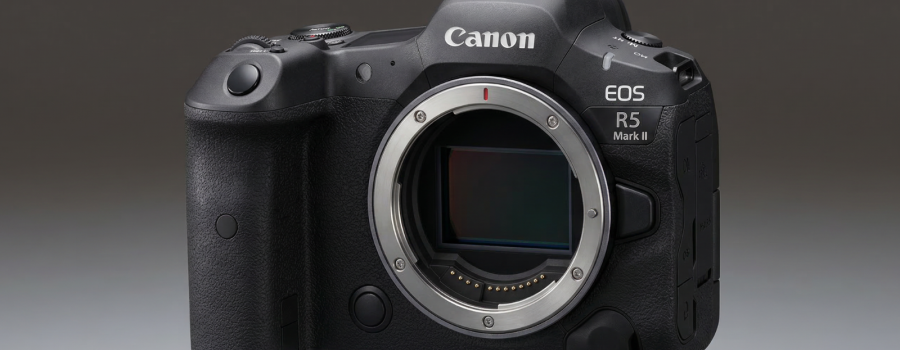
Does the Canon EOS R5 Mark II live up to the hype? We tested it for several weeks in real-world conditions — weddings, sports, wildlife, landscapes and video — to deliver a thorough, no-compromise verdict. This review covers image quality from the 45-megapixel stacked sensor, Eye Control AF autofocus performance, 30 fps burst shooting with RAW pre-capture, 8K 60p RAW and 4K 120p video capabilities, 8.5-stop IBIS stabilisation and real-world battery life. We also compare the R5 Mark II against the original R5, the Sony Alpha 1 II and the Nikon Z8. Read our full breakdown with strengths, weaknesses and category-by-category scores to find out if this is the right camera for you.
The Canon EOS R5 Mark II hit the market in August 2024, four years after the original R5 redefined what a mirrorless camera could do. Four years is an eternity in the camera industry. Sony launched the Alpha 1 II, Nikon released the Z8, and videographers saw a wave of compact bodies capable of shooting 8K. The question everyone is asking is straightforward: does the Canon R5 Mark II justify its price tag, and more importantly, does it deliver on its promises in the field?
We've used this body for several weeks in varied conditions — wedding photography, wildlife shooting in woodland, indoor sports, mountain landscapes and studio video production — to bring you a Canon R5 Mark II review that's as honest as it is thorough. Here's our verdict.
Handling and Ergonomics
When you first pick up the Canon R5 Mark II, it feels immediately familiar. If you've used the original R5, the R6 Mark II or even the R3, you'll be right at home. The weight of 746 grams (with battery and card) is well contained for a camera of this class, and the deep grip inherited from Canon's professional lineup provides a confident, secure hold.
The most visible change is the addition of a dedicated photo/video switch on top of the body, replacing the ON/OFF selector from the original R5. You'll fumble it for the first few days. Within a week, you won't be able to live without it: switching between modes is instant, and settings reload automatically for each mode. During wedding coverage, this quick toggle between stills and video saves valuable time.
The 3.2-inch vari-angle touchscreen (2.1 million dots) is identical to its predecessor — bright, responsive, readable in direct sunlight. The 5.76 million-dot OLED viewfinder with 0.76× magnification is a joy to use. The display is smooth and free of visible stutter, even during 30 fps bursts. It's one of the few bodies that delivers a truly blackout-free viewfinder in electronic shutter mode.
Build quality inspires confidence. The weather-sealed magnesium alloy body shrugged off two hours of light rain during a woodland shoot without any concern. Sealing is on par with what you'd expect from a professional body. The switch to a full-size HDMI port (Type A) from the original R5's fragile micro-HDMI is a welcome upgrade — no more worrying about a connector snapping mid-shoot.
One last detail that matters: the multi-function hotshoe can power compatible accessories (microphones, transmitters) directly. For videographers, that's one fewer cable to manage on the rig.
The button layout is highly customisable through Canon's now-familiar menu system. The M-Fn button, AF-ON, and rear dial can all be reprogrammed, and the three Custom shooting modes (C1, C2, C3) allow you to store complete camera configurations for instant recall. We set up C1 for wildlife (30 fps, electronic shutter, pre-capture enabled, animal detection), C2 for portraits (mechanical shutter, 12 fps, face priority) and C3 for video — a workflow that proved extremely efficient over weeks of mixed shooting. The dual card slots (one CFexpress Type B, one SD UHS-II) offer flexibility: we typically recorded RAW to the CFexpress card and JPEG backups to the SD, giving us both speed and redundancy.
Image Quality: The 45-Megapixel Stacked Sensor Put to the Test
At the heart of the Canon EOS R5 Mark II is a new 45-megapixel back-illuminated stacked CMOS sensor (BSI). Same pixel count as the original R5, but an entirely different architecture. The stacked design places processing circuitry directly beneath the photosites, enabling a 2.7× faster readout speed than the previous sensor. The benefits are felt everywhere: faster burst shooting, virtually no rolling shutter, and improved autofocus performance.
But what about pure image quality? That's the question we set out to answer first.
Resolution and Detail
The 45-megapixel RAW files (8,192 × 5,464 pixels) deliver remarkable detail. Shooting landscapes with the RF 24-105mm f/4 L, every rock texture, leaf vein and water ripple is rendered with impressive sharpness. A2-size prints are stunningly fine, and cropping headroom is very generous — you can easily crop away 50% of the frame and still retain enough quality for professional web use.
The built-in neural upscaling feature can quadruple the resolution of JPEG/HEIF files directly in-camera. The output is surprisingly clean on well-exposed files and perfectly usable for large prints. Expect a few seconds of processing time per image, though.
Colour Rendition
Canon's colour science is instantly recognisable: warm, natural skin tones, rich reds without excessive saturation, deep greens. On portraits shot with the RF 85mm f/1.2 L, tonal transitions in skin are smooth and free of posterisation. White balance is well calibrated, with auto WB proving reliable in the vast majority of situations — including mixed LED lighting, which typically causes problems.
We ran side-by-side comparisons with the original R5 under identical studio lighting, and while the differences are subtle, the Mark II consistently produced slightly more accurate neutral grey rendition and marginally cleaner colour separation in saturated fabrics — particularly deep reds and purples, which tend to clip on many sensors. The DIGIC Accelerator's processing clearly plays a role here, refining the demosaicing pipeline to preserve colour nuance in demanding areas of the tonal range. For wedding and portrait photographers who spend significant time colour-grading skin tones, this is a meaningful if understated improvement.
High ISO Performance and Noise
This is where the new sensor shows its worth. Up to ISO 6,400, RAW files are remarkably clean with fine grain and minimal shadow detail loss. At ISO 12,800, noise becomes visible in uniform dark areas but remains very well controlled — noticeably better than the original R5 at the same setting. At ISO 25,600, images are still perfectly usable after a pass through noise reduction software, and the in-camera neural noise reduction (AI-based denoising) does an impressive job on JPEG/HEIF output.
In real-world conditions, shooting a concert between ISO 8,000 and ISO 16,000, results were excellent. The camera manages noise intelligently, preserving textures and fine facial detail even in underexposed areas.
Dynamic Range
Dynamic range is in line with the original R5 — approximately 14 stops at base ISO according to Photons to Photos measurements. In practice, you can recover 3 to 4 stops in the shadows without objectionable noise. It's competitive with the best Sony and Nikon sensors in this class, though the latter retain a very slight edge in deep shadow recovery at the lowest ISOs.
DxOMark Score
At the time of writing, DxOMark has not yet published an official score for the Canon EOS R5 Mark II. The original R5 scored 95 points overall, making it the highest-rated Canon sensor ever tested and placing it among the top 15 full-frame sensors worldwide. Early independent measurements suggest the R5 Mark II's stacked sensor delivers broadly equivalent dynamic range performance to its predecessor, with a slight edge at higher ISOs. A score at least equal to, or slightly above, the original R5 seems a reasonable expectation.

Autofocus: The R5 Mark II's True Leap Forward
While image quality improves incrementally, the Canon R5 Mark II's autofocus represents a genuine generational leap. It is, in our view, the primary reason to choose this body over the original R5.
Dual Pixel CMOS AF II and Subject Detection
The Dual Pixel CMOS AF II system covers the entire sensor area with 5,940 selectable AF points and operates down to EV -6.5 — effectively near-total darkness. Deep learning-based subject detection recognises people (eyes, face, head, full body, limbs), animals (including birds), motorsport vehicles, aircraft and trains.
In practice, shooting an indoor football match under LED lighting: the body locks onto a moving player and doesn't let go, even when other players cross in front, even when the subject turns away from the camera. The AF hit rate across 3,000 images shot in 30 fps bursts exceeded 95% — a remarkable figure for such challenging conditions.
Eye Control AF: Gimmick or Game-Changer?
Eye Control AF is the R5 Mark II's most headline-grabbing feature. The principle: the camera tracks your iris movement within the viewfinder and places the AF point where you're looking. An initial calibration is required (roughly 2 minutes), and Canon recommends redoing it if you change glasses or contact lenses.
In the field, the results are fascinating. When shooting portraits with multiple subjects, you simply look at the face you want to focus on and the camera understands your intent. During a wedding, shifting focus from bride to groom happens with a glance — literally.
Is it perfect? Not quite. The system is sensitive to eye fatigue and can lose accuracy towards the end of a long day. Users with varifocal lenses sometimes encounter difficulties. But overall, Eye Control AF is a tool that, once mastered, genuinely changes the way you photograph. It's not a gimmick.
Register People Priority and Action Priority AF
Two other features deserve mention. Register People Priority lets you store up to 10 faces with a priority order. The camera will always favour registered faces, even in a crowd. At a wedding, set the bride's face as priority 1 and you're guaranteed she'll always be in sharp focus.
Action Priority AF is trained via AI to recognise gameplay actions in football, basketball and volleyball. The camera anticipates the moment of a shot, pass or spike and shifts the AF point accordingly. It's still limited to three sports, but the results are impressive when it works.
Burst Shooting and Pre-Capture: Never Miss the Moment Again
The Canon R5 Mark II reaches 30 frames per second with the electronic shutter (up from 20 fps on the original R5), with a blackout-free viewfinder and a buffer of approximately 93 RAW frames on a CFexpress Type B card. With the mechanical shutter, the rate is 12 fps. That's more than enough for the vast majority of shooting situations, from sports to wildlife to street photography, and the ability to dial down to 20, 15, 10 or even 3 fps in electronic mode is welcome for matching burst speed to your subject.
The pre-capture function (pre-burst shooting) is one of the R5 Mark II's standout new features. When enabled, the camera continuously records into its buffer memory as soon as you half-press the shutter button. When you fully press, the previous 15 frames are saved to the card — roughly half a second of look-back time at 30 fps.
For wildlife photography, this is a game-changer. A bird launching from a branch, a fox pouncing — you press "too late" and the shot is already there. Unlike competing implementations, pre-captured files are saved individually, including in RAW format, and numbered sequentially. No burst mosaics to extract, no processing delay. It's clean, simple and effective.
One caveat: pre-capture keeps the sensor active continuously and draws more battery power. Pack a spare LP-E6P if you plan to use it heavily throughout the day.

Video Performance: 8K 60p and 4K 120p in Daily Use
One of the original R5's weak spots was overheating during video, especially in 8K. Does the Canon R5 Mark II do better? Yes, significantly.
8K 60p Internal RAW
The R5 Mark II is one of the very few mirrorless cameras in the world capable of recording 8K DCI 60p in Cinema RAW Light directly to the CFexpress card. Bitrate reaches approximately 2,600 Mbps, and the files offer remarkable grading latitude. The practical benefit of 8K? Even if you deliver in 4K, you get a crop margin equivalent to a lossless 2× digital zoom — plus you can pull 35.4-megapixel stills from your 8K DCI footage.
Without the fan grip, we recorded approximately 18 minutes in 8K 60p RAW and 26 minutes in 8K 30p before the camera cut out. With the CF-R20EP fan grip, recording times increase dramatically: over 2 hours in 8K 30p without interruption. That's a major improvement over the original R5.
4K 120p and Slow Motion
The 4K 120p mode works without sensor crop and with audio recording — an advantage over several competitors that drop sound at high frame rates. Slow motion at 5× is smooth and detailed. In Full HD, the 240p mode allows extreme slow motion at 10× real speed.
The 4K Fine mode (oversampled from the 8K sensor) at 30p delivers arguably the best 4K quality we've seen from a mirrorless body: superior sharpness, virtually no moiré, reduced noise.
Canon Log 2 and Monitoring Tools
The arrival of Canon Log 2 on an EOS R body is excellent news for professional videographers. This profile, previously exclusive to Cinema EOS cameras, offers wider dynamic range than Canon Log and Log 3, and crucially, direct compatibility with Cinema EOS LUTs. The ability to apply a LUT directly in the viewfinder during shooting simplifies on-set work considerably.
The built-in monitoring tools — waveform display, false colour, zebras, tally light — are features typically reserved for dedicated cinema cameras. Having them in a mirrorless body of this size is a significant advantage. We particularly appreciated the false colour overlay when shooting Canon Log 2 outdoors: it made nailing exposure on faces far more intuitive than relying on the histogram alone, especially in high-contrast scenes with bright skies and shadowed subjects. The simultaneous recording option also deserves a mention — you can write 8K RAW to the CFexpress card while recording a lightweight Full HD proxy to the SD card, dramatically speeding up the editing workflow when you don't need to scrub through massive 8K files on set.
IBIS Stabilisation: Up to 8.5 Stops
The Canon R5 Mark II features a 5-axis IBIS system capable of compensating up to 8.5 stops of camera shake with compatible RF lenses (CIPA 2024 standard, measured with the RF 24-105mm f/2.8 L IS USM Z at 105mm).
In real-world use, we achieved sharp handheld shots at 1/4s with the RF 24-105mm at 105mm — a result that would have been unthinkable just a few years ago. For landscape work, this level of stabilisation lets you leave the tripod behind in many situations, significantly lightening the camera bag.
For video, Movie Digital IS adds an extra layer of digital stabilisation. The result is smooth handheld footage, even while walking — not quite gimbal-level, but more than adequate for reportage and vlogging.
Battery Life: The One to Watch
Battery life is the perennial weakness of mirrorless cameras, and the Canon R5 Mark II is no exception. Official CIPA ratings are 630 shots on the LCD and 340 on the EVF. These figures are, however, very conservative.
In real-world conditions, we found significantly better results. During a wedding shoot (a mix of posed shots, short bursts and a few video clips), a single LP-E6P battery captured approximately 1,200 images before dropping to 20%. In intensive burst mode (wildlife shooting at 30 fps), one tester exceeded 5,000 frames on a single charge with 44% battery remaining — continuous burst is very efficient since the sensor is already running.
Our recommendation: carry at least two LP-E6P batteries for a full day's shooting. Three if you're using pre-capture heavily or filming in 8K. The BG-R20 grip (dual battery) is a worthwhile investment for extended sessions.
Worth noting: USB-C charging is supported, allowing you to top up the body from a power bank during breaks. Also, older LP-E6NH batteries remain compatible, but certain features (pre-capture, Dual Shooting, HDMI RAW output) require the new LP-E6P to function fully.
Canon R5 Mark II vs Canon R5: Should You Upgrade?
This is the question thousands of original R5 owners are asking. Here's our point-by-point assessment.
You should upgrade if you shoot action (sports, wildlife, events) or if video is a significant part of your work. The stacked sensor, 30 fps burst, pre-capture, Eye Control AF and Canon Log 2 represent major advances that genuinely change the shooting experience in the field.
You can wait if you primarily shoot landscapes, studio work or posed portraits. Raw image quality is very close to the original R5, and the improvements (neural upscaling, better high-ISO rendering) are welcome but not transformative for these use cases.
Canon R5 Mark II vs Sony Alpha 1 II vs Nikon Z8
In the high-end, all-round full-frame mirrorless category, the Canon R5 Mark II faces two serious competitors.
The Sony Alpha 1 II offers 50.1 MP, a 30 fps burst and formidable autofocus, but at a considerably higher price point. Its AF system is arguably slightly more "sticky" on moving subjects according to some testers, but the gap has narrowed considerably with the R5 Mark II.
The Nikon Z8 delivers 45.7 MP, excellent value for money and one of the best dynamic ranges on the market, but lacks pre-capture and Eye Control AF. Its 20 fps RAW burst falls short of Canon's 30 fps.
The Canon R5 Mark II positions itself as the most versatile of the three: better video capabilities than the Z8, more affordable than the A1 II, and equipped with exclusive features (Eye Control AF, RAW pre-capture, Action Priority AF) that make a real difference in demanding situations.
Our Verdict: Strengths and Weaknesses of the Canon EOS R5 Mark II
Strengths
- Exceptional autofocus — deep learning subject detection, Eye Control AF, Register People Priority, Action Priority AF. The best AF system Canon has ever produced.
- 30 fps blackout-free burst with 15-frame RAW pre-capture — a combination unique on the market.
- 8K 60p internal RAW and 4K 120p video — capabilities that rival dedicated cinema cameras.
- Canon Log 2 and professional monitoring tools built into a compact mirrorless body.
- 45 MP stacked sensor with virtually no rolling shutter and excellent image quality.
- 8.5-stop IBIS — among the most effective stabilisation systems available.
- Refined ergonomics — photo/video switch, full-size HDMI port, multi-function hotshoe.
- Weather-sealed construction at a contained weight (746 g).
- Built-in neural upscaling up to 4× resolution.
Weaknesses
- Reduced battery life compared to the original R5 (630 vs 950 shots CIPA). Plan for at least two batteries.
- Eye Control AF is imperfect — sensitive to eye fatigue and varifocal lenses, requires careful calibration.
- Overheating in 8K 60p video without the fan grip (~18 minutes). The CF-R20EP is virtually essential for long-form shoots.
- High price — significantly more expensive than the Nikon Z8, which offers comparable stills image quality.
- No global shutter — the stacked sensor reduces rolling shutter but doesn't eliminate it entirely (unlike the Sony A9 III).
- Action Priority AF limited to three sports for now (football, basketball, volleyball).
Conclusion: Who Is the Canon EOS R5 Mark II For?
The Canon EOS R5 Mark II is, in our view, the most versatile full-frame mirrorless camera available today. It doesn't beat everything at everything — the Nikon Z8 offers better value for pure stills work, the Sony A9 III is superior for top-tier sports with its global shutter. But no other body covers such a broad spectrum of disciplines at such a consistently high level of performance.
If you're a sports, wedding, reportage or wildlife photographer, and video is part of your workflow, the R5 Mark II is very hard to beat. The combination of 45 MP + 30 fps + RAW pre-capture + Eye Control AF + 8K 60p + Canon Log 2 simply doesn't exist in any other single body.
If you're already invested in the Canon RF ecosystem, the decision is even simpler: the R5 Mark II is the finest all-round camera Canon has ever built. It's a tool that pushes the boundaries of what a photographer can achieve in the field.
After weeks of intensive use, our strongest impression is one of confidence. Confidence that the autofocus will track your subject. Confidence that the pre-capture will save the shot you thought you'd missed. Confidence that the 8K footage will grade beautifully. Confidence that the weather sealing will hold up in poor conditions. Very few cameras instil that level of trust across such a broad range of shooting scenarios. The Canon EOS R5 Mark II does.
Discover the Canon EOS R5 Mark II on MCZ Direct:view our full product page with pricing, detailed specifications and fast shipping.

Canon R5 Mark II Review Summary
| Category | Our Assessment | Score /10 |
|---|---|---|
| Image Quality | Excellent resolution, faithful Canon colours, very strong high-ISO performance | 9/10 |
| Autofocus | Best Canon AF to date, innovative Eye Control AF, outstanding subject detection | 9.5/10 |
| Burst & Pre-Capture | 30 fps blackout-free, RAW pre-capture, generous buffer | 9.5/10 |
| Video | 8K 60p RAW, 4K 120p, Canon Log 2, pro monitoring — mirrorless benchmark | 9/10 |
| Ergonomics | Professional grip, photo/video switch, full-size HDMI | 9/10 |
| Battery Life | Down from the original R5; plan for 2-3 batteries | 7/10 |
| Value for Money | High price, justified by exceptional versatility | 8/10 |
| OVERALL SCORE | The most versatile full-frame mirrorless camera on the market | 9/10 |
Leave a comment