Shopping Cart
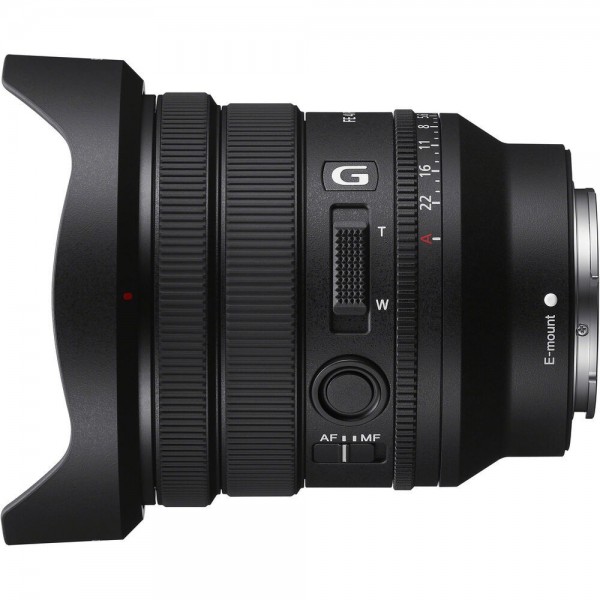
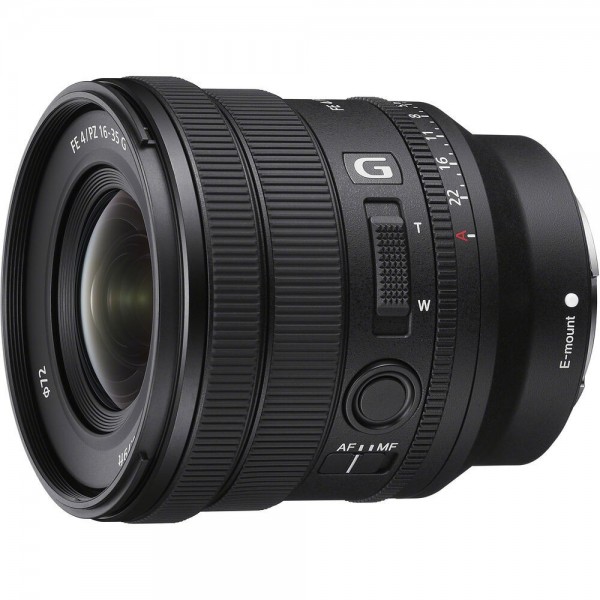
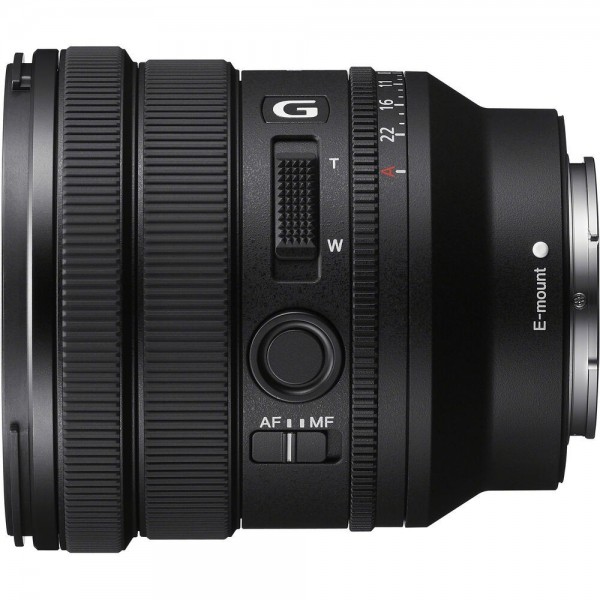


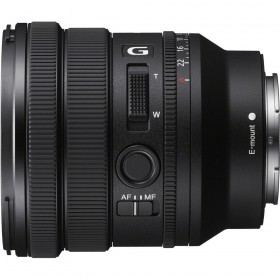
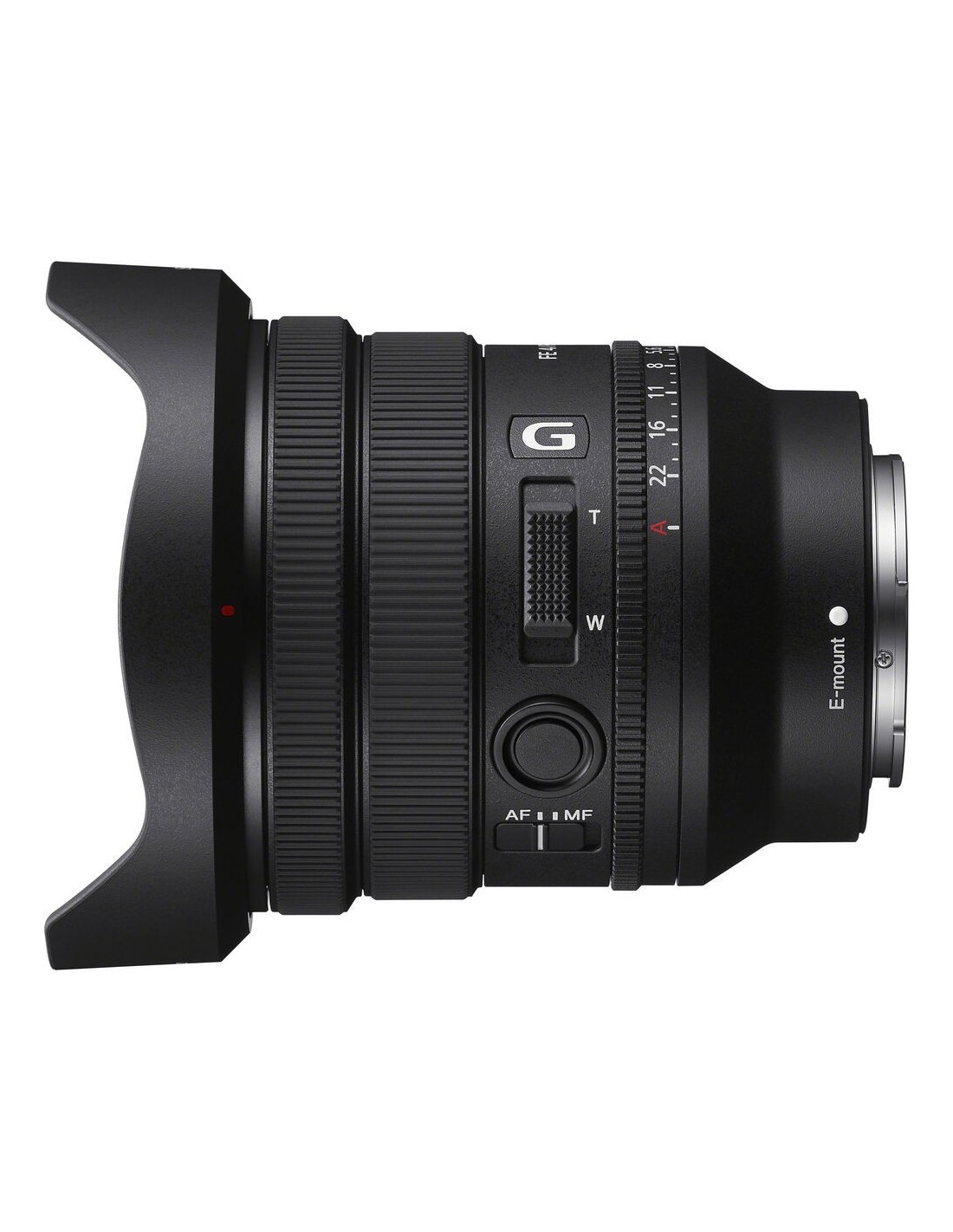
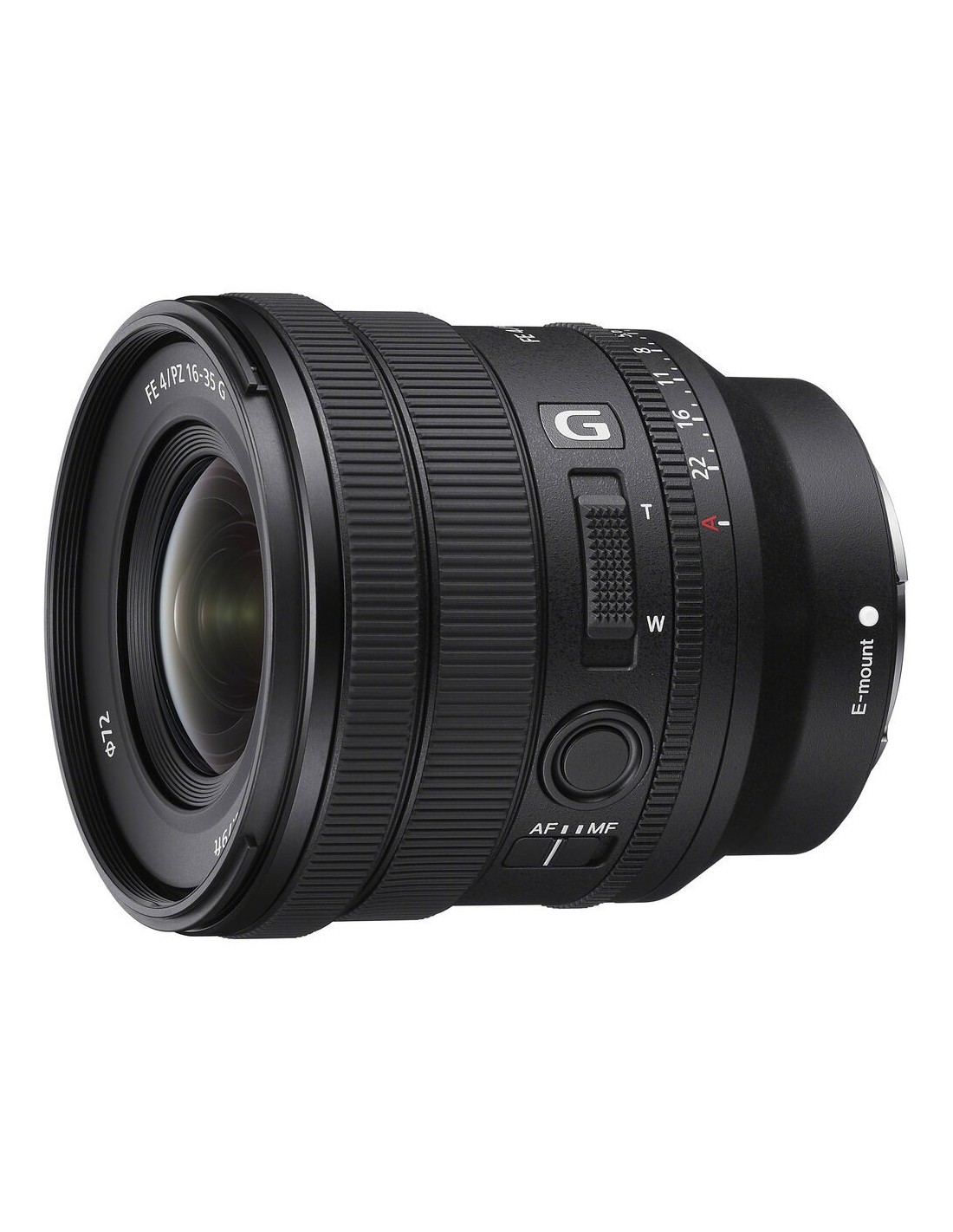
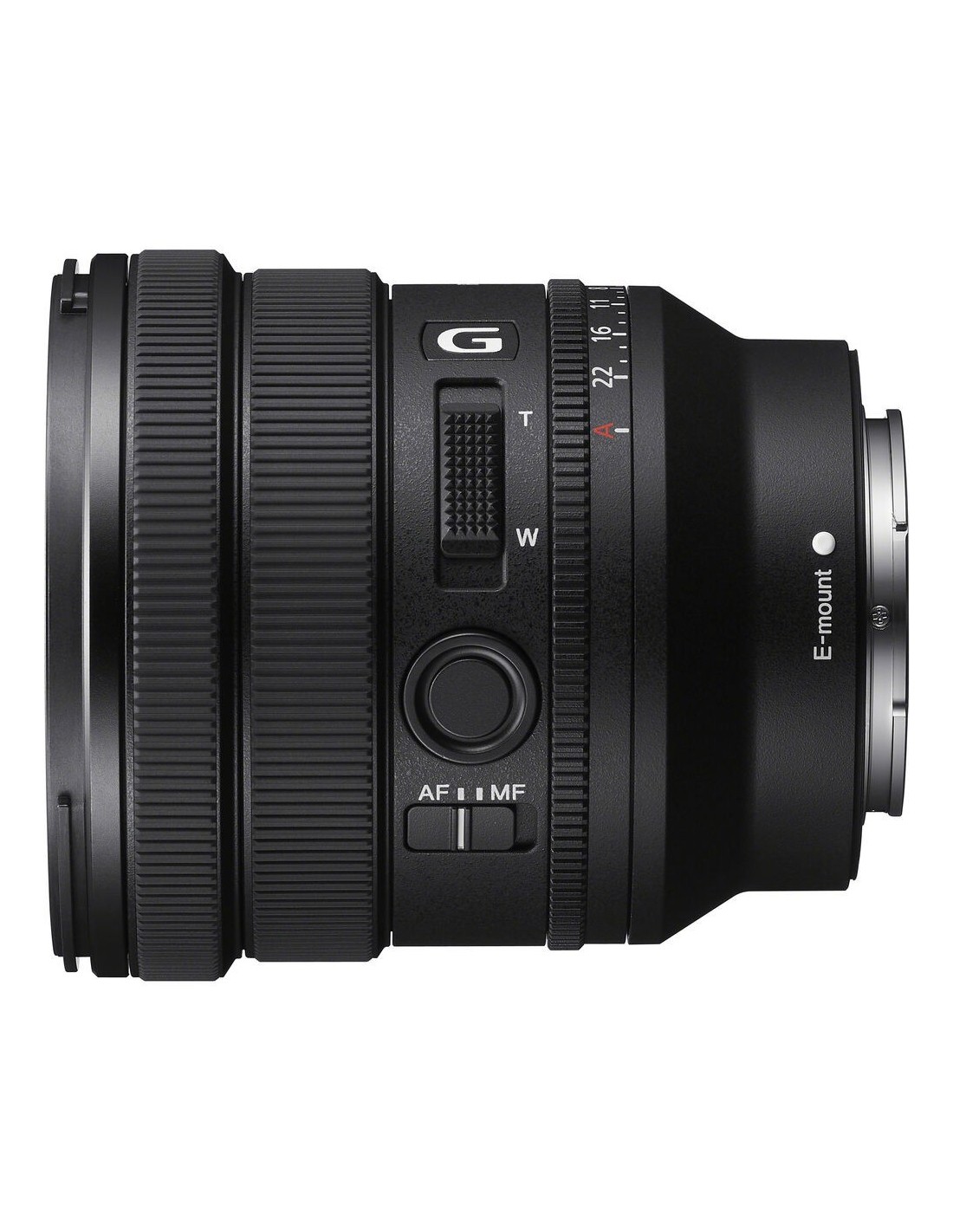
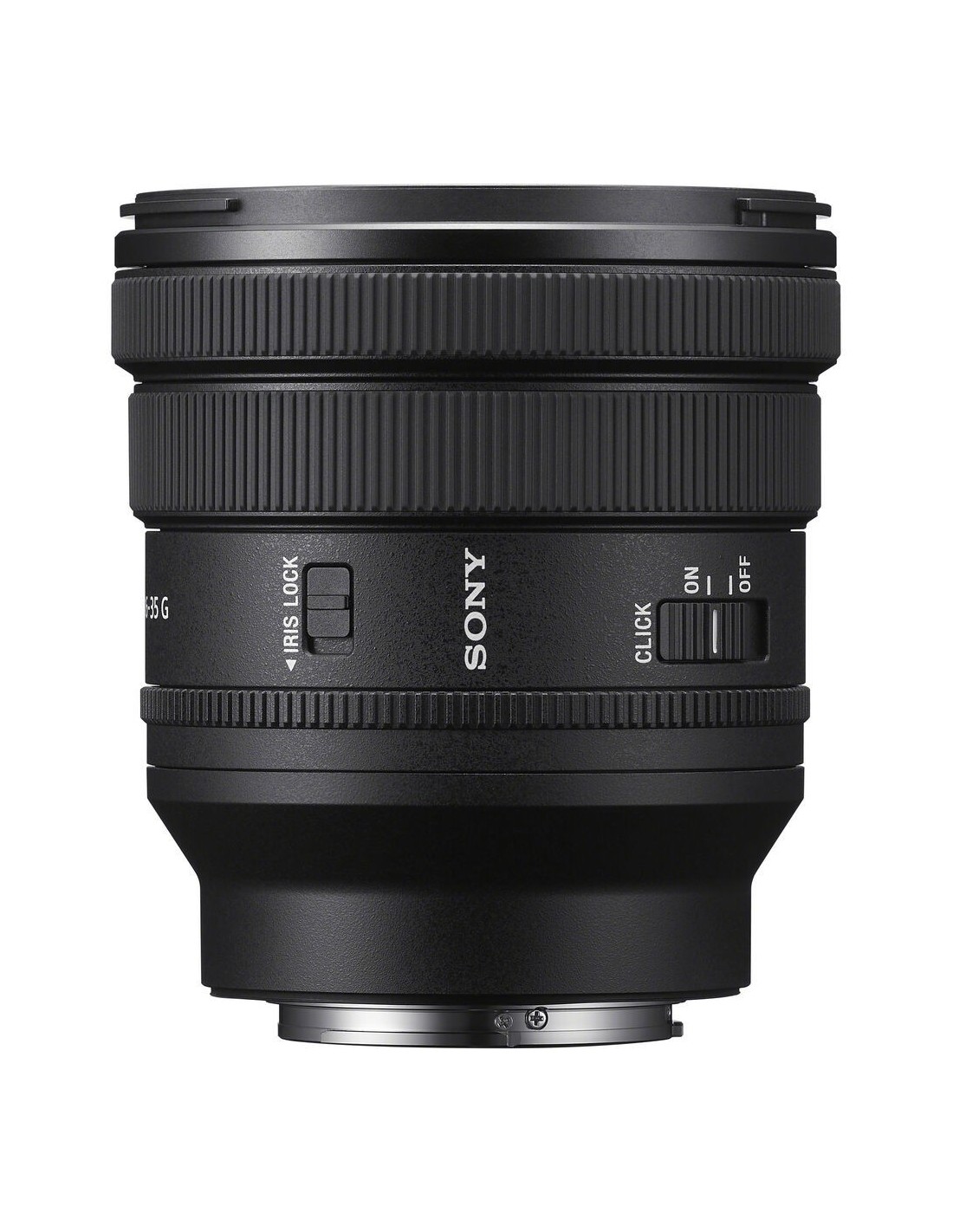

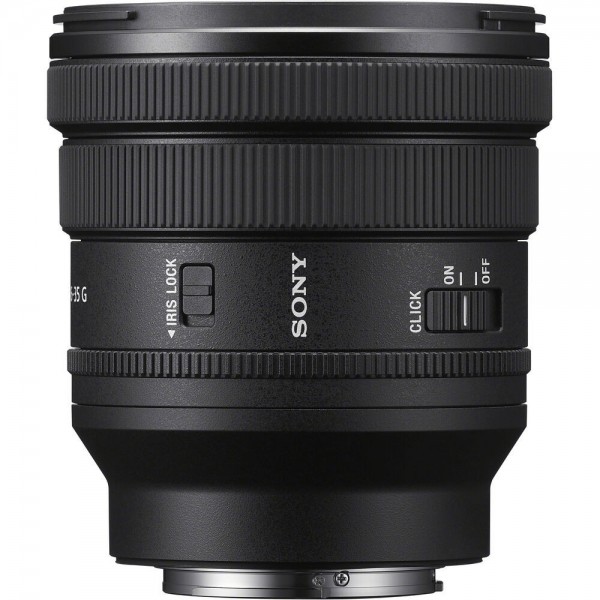
The Sony FE PZ 16-35mm F4 G is a full-frame wide-angle zoom for Sony E photographers and filmmakers who want to move from a broad establishing view to a tighter frame without carrying a heavy kit. It suits travel, architecture, documentary work, vlogging and video when one lens needs to cover several kinds of scene. Its compact, constant-length design makes focal-length changes easier to work into a shoot. The F4 aperture remains available from 16 to 35mm, helping keep exposure consistent during a take. For stills, it covers interiors and environmental portraits as naturally as it does wide views. There is no optical stabilisation in the lens; any stabilisation comes from a compatible camera body or support. It is a sensible choice when a lighter kit matters more than F2.8.
Combine compatible accessories and save. The more items you add, the bigger the discount.
memory card

warranty extension
The Sony FE PZ 16-35mm F4 G, model SELP1635G, is for Sony full-frame photographers and filmmakers who want a versatile wide-angle lens without adding much weight to the bag. Its 16-35mm range covers landscape, interiors, travel footage, street documentary work and environmental portraits. The zoom lever lets you alter focal length with a measured transition from the lens or a compatible remote control. The barrel stays the same length while zooming and focusing, which suits handheld, supported and stabiliser-based setups. F4 is the trade-off in lower light; this lens favours mobility and framing control over the extra light of an F2.8 wide zoom.
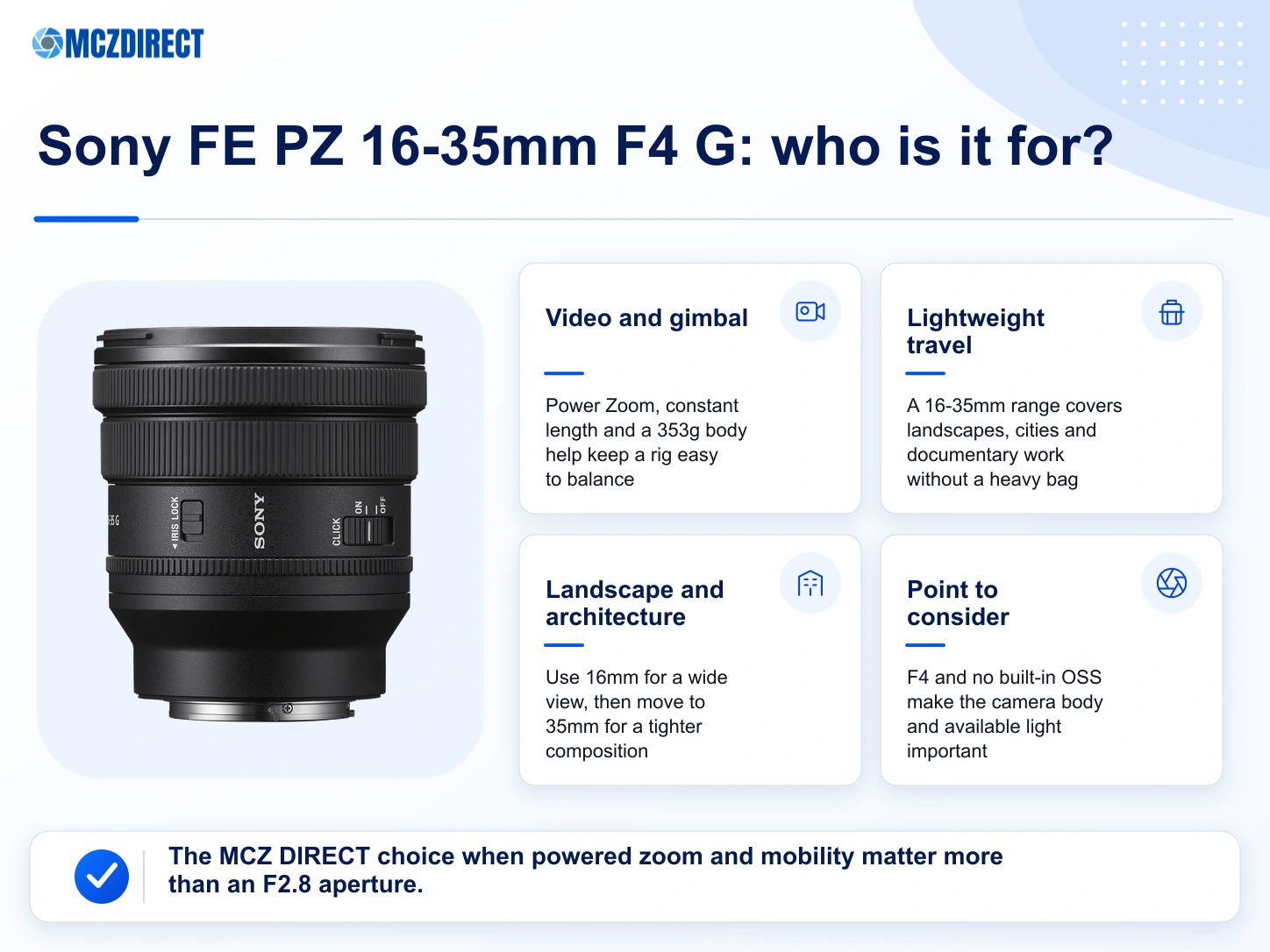
The Sony FE PZ 16-35mm F4 G is made for the person who moves between stills and video and does not want to choose between a specialist ultra-wide prime and a large standard zoom. At 16mm, it gives a room, building or landscape room to breathe. Around 20 and 24mm, the setting stays visible while perspective becomes less dramatic. At 28 and 35mm, it suits a walk through a city, a documentary sequence or an environmental portrait. That progression matters more than the 16-35mm label itself: it lets you change the relationship between subject and place without swapping lenses.
Its name sits close to several Sony wide zooms, but its role is specific. PZ means Power Zoom, a motorised zoom system. The lens lever lets you vary the speed of the transition, and a compatible camera or accessory can control zoom remotely. In video, that gives a more measured way to change angle of view than twisting a manual ring. In stills, it can still be useful when you need to refine a frame without losing your position.
The compromise is the constant F4 aperture. It is helpful because the maximum aperture does not change through the range, particularly while recording, but it gathers half as much light as F2.8 at comparable settings. In daylight, on a tripod, while travelling or with a stabilised body, that is often a fair exchange. In a dim church, a low-lit performance or a situation where background separation is the priority, an F2.8 zoom is the more comfortable choice. Pick the PZ for what it makes practical: a light full-frame 16-35mm that is easy to carry and balance.
| Feature | Practical benefit | What to consider |
|---|---|---|
| Power Zoom | Change framing with a more controlled focal-length transition in video. | The movement still needs to suit the shot; it does not replace camera movement. |
| 353g and constant barrel | Keep a lighter kit and a more stable starting point for balancing on a stabiliser. | Final balance also depends on the body, cage, microphone and filter. |
| Constant F4 | Keep the same maximum aperture from 16 to 35mm. | F4 gathers half as much light as F2.8. |
| Six XD motors | Support motorised zoom and focusing intended to respond as subject distance changes. | Tracking also depends on the camera body, subject and AF settings. |
| No OSS | Pair a compact wide zoom with a compatible body's stabilisation or external support. | A non-stabilised body or demanding handheld shot needs more care. |
| 0.28 / 0.24m close focus | Move close to a detail while retaining the setting around it. | 0.23x maximum magnification is not a dedicated macro capability. |
A motorised zoom does not automatically make a shot cinematic. What it does provide is a more repeatable tool when focal length needs to change during recording. The SELP1635G zoom lever allows a slower or quicker transition according to the shot. In a travel vlog, you might begin with the setting at 16mm and tighten towards 35mm. In an interior walk-through, you can refine the field of view without moving the whole camera. With a moving subject, zoom is mainly a way of changing the balance between the person and their surroundings.
Its low weight and constant barrel length have a tangible effect on a motorised stabiliser. The lens does not grow while zooming or focusing, so its centre of gravity moves less. That makes a camera-and-stabiliser setup easier to prepare and makes focal-length changes less disruptive to its balance. You still need to check the payload and settings of the stabiliser you use: compatibility depends on the entire camera, cage, microphone and accessory package, not on the lens alone.
Sony specifies four XD linear motors for zoom and two for focusing. That split is intended to support motorised zooming and responsive focus when subject distance changes. The barrel also remains the same length while focusing. For an interview, product sequence or a subject walking towards camera, those details help keep the setup compact. They do not replace camera autofocus settings: tracking still depends on the subject, AF area and available light.
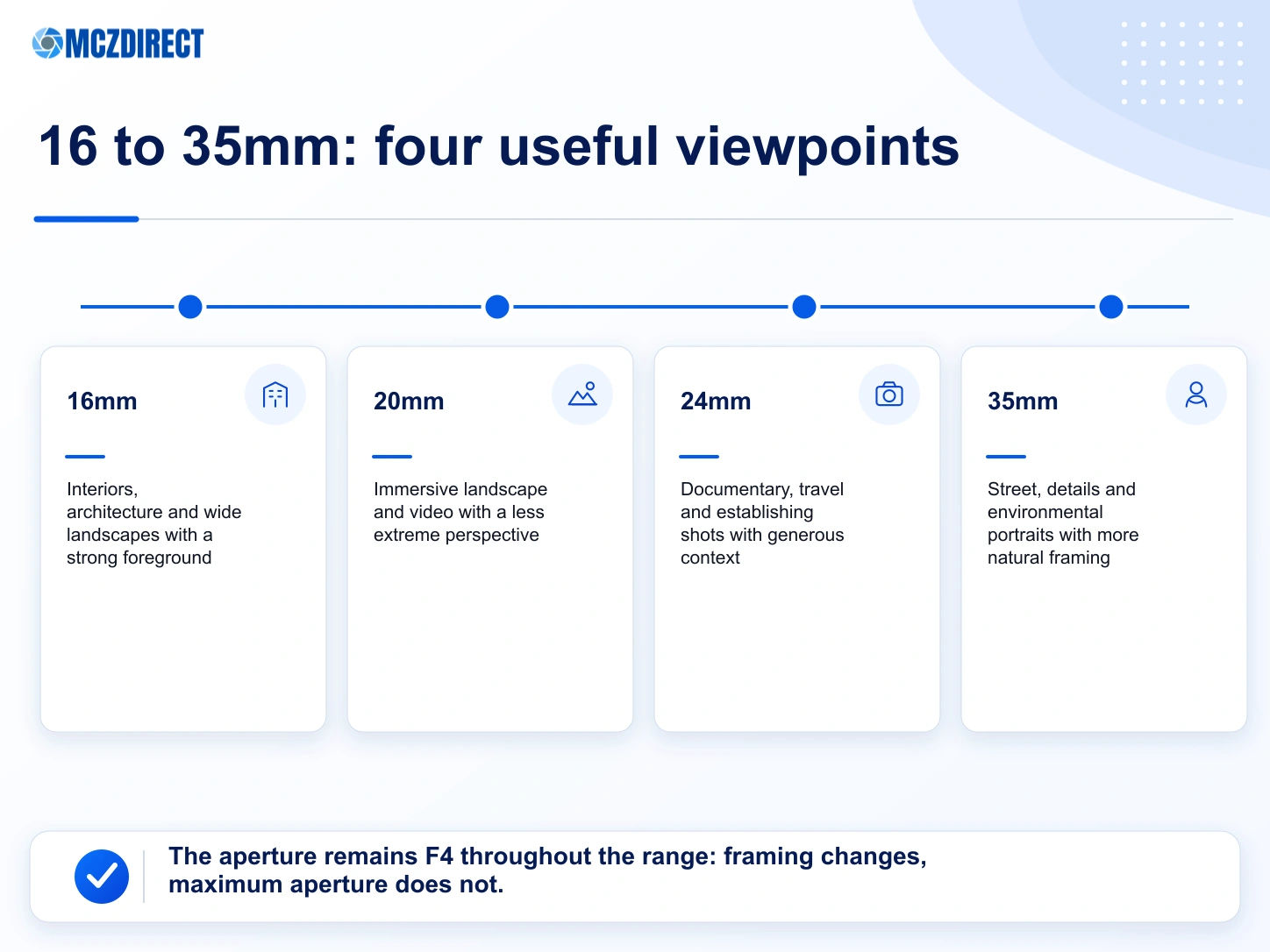
At 16mm, the field of view is genuinely broad. It helps show a kitchen, room, lobby, facade or the line of a landscape. It also works well for handheld vlogging because there is space around a face. That width comes with a responsibility to watch the edges. A person near a corner or a vertical line placed carelessly can look stretched. In architecture, keeping the camera level is often more valuable than relying entirely on software correction later.
Twenty and 24mm are especially useful transition points. The surroundings remain important, but a person is easier to place without exaggerating perspective. For documentary work, that lets you show an action and the reason it is happening there. For travel, 24mm handles a street, terrace, market or building without the strongly wide look of 16mm. It is a sensible choice for someone searching for a lightweight Sony wide-angle lens for travel rather than an ultra-wide-only tool.
At 28mm, the picture settles down. It is a strong position for walking with one lens, filming a conversation or taking an everyday scene. At 35mm, the lens reaches a more contained view for an environmental portrait, travel detail or video cutaway. It does not replace an 85mm for a distant, isolated face, but it preserves the connection between a person and place. Its maximum 0.23x magnification enables close detail shots; it does not make the SELP1635G a macro lens.
Minimum focus distance is 0.28m at 16mm and 0.24m at 35mm. Close up, the chosen focal length strongly changes how the foreground behaves. Use 16mm when an object belongs in a larger story; use 35mm when you want that detail to take more of the frame without losing all context.
| Focal length | Concrete use | What the frame conveys |
|---|---|---|
| 16mm | Interior, architecture, landscape, vlog and establishing shot. | The place takes as much space as the subject; watch the edges and vertical lines. |
| 20mm | Landscape, broad documentary coverage, less confined interiors and travel video. | The setting remains strong with less stretched perspective than 16mm. |
| 24mm | Street, travel, groups, architecture and documentary work. | Still wide, but more forgiving when a person should look natural in frame. |
| 28mm | Everyday scenes, walking coverage, wide interview framing and general use. | The subject gains importance while retaining a relationship with the surroundings. |
| 35mm | Environmental portrait, detail, cutaway and tabletop scene. | The view tightens while staying wide enough to explain context. |
A constant F4 aperture is easier to work with than an aperture that changes as you zoom. In video, it helps keep exposure more consistent between 16 and 35mm. In photography, it is well suited to landscape, architecture, travel and many documentary scenes when light is available. It does not give the same margin as F2.8 when shutter speed has to stay high for a moving subject. For a dark wedding venue, show or night scene, the camera's high-ISO performance and F4 both need to be part of the decision.
This lens has no optical OSS stabilisation. On a Sony body with in-body stabilisation, sensor movement may help compensate for the photographer's movement in some situations. It does not freeze a child, athlete or walking person, and it does not replace an appropriate shutter speed or a stabiliser for a moving shot. On a non-stabilised body, the absence of OSS deserves more attention in handheld video and at slower shutter speeds. This difference is worth understanding before purchase, especially if you are moving from a Sony lens with optical stabilisation.
Dust and moisture resistance and the fluorine-coated front element are helpful for travel and outdoor work. Sony does not provide an IP rating or describe the lens as fully waterproof. Suitable protection still makes sense in prolonged rain, near salt water or in heavy dust. The 72mm thread lets you add an ND filter for video or a polariser for landscape work, while remembering that filters also affect the balance of the complete kit.
The FE PZ 16-35mm F4 G is compatible with Sony APS-C cameras. The angle of view becomes roughly equivalent to 24-52.5mm on full frame. That can be very useful for an APS-C video, travel or documentary camera: it runs from a reasonably wide view to a short normal view. The motorised zoom and lens controls retain the same purpose; the difference is the field of view, not the operation of the motorisation.
You do need to accept that the 16mm full-frame ultra-wide effect no longer remains on APS-C. For filming yourself at arm's length, covering a very small room or making a broad architecture shot, a 24mm-equivalent view may need more working distance. On an A6700, FX30 or another APS-C body, this lens is therefore a versatile photo-and-video zoom rather than an ultra-wide specialist. Knowing that before purchase avoids a disappointing mismatch of expectations.
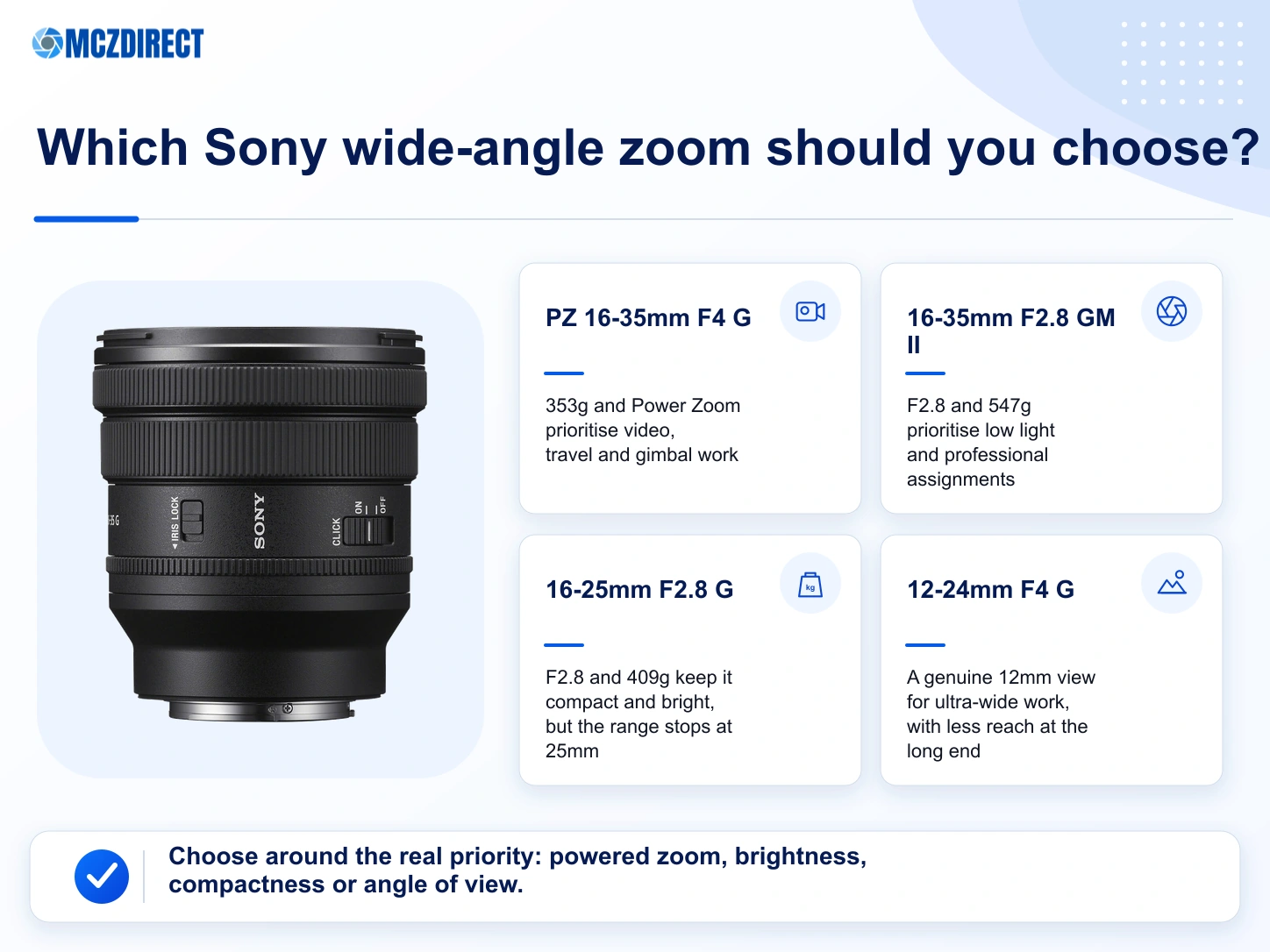
| Lens | Choose it when | Trade-off to accept |
|---|---|---|
| FE PZ 16-35mm F4 G | You want motorised zoom, 353g, a constant barrel and 35mm for video or travel. | F4 is less suitable for dark scenes and pronounced background separation. |
| FE 16-35mm F2.8 GM II | You need F2.8 throughout the range for events, lower light or more demanding stills work. | The extra light comes with a larger kit and a manual zoom design. |
| FE 16-25mm F2.8 G | You want a compact F2.8 wide zoom and work mainly from 16 to 25mm. | It stops at 25mm and does not offer the PZ lens's reach to 35mm. |
At MCZ DIRECT, we would point this lens towards photographers and filmmakers who move through a scene, alternate broad views with tighter framing, and do not want the size of a larger bright zoom. Within our full-frame Sony lenses, its clearest distinction is the motorised lever, useful when reframing needs to happen during a take.
Against the FE 16-35mm F2.8 GM II, we recommend it when low weight, video, stabiliser work and controlled zooming matter more than gaining one stop in low light. Against the FE 16-25mm F2.8 G, it is more versatile when 28 and 35mm are part of how you frame. The 16-25 F2.8 G makes more sense when brightness takes priority and you spend most of your time wide.
Its honest limitation is F4 and the absence of OSS. If you frequently shoot handheld on a non-stabilised body or work in dark interiors, weigh that carefully. With a stabilised body or suitable support, it is a strong fit for travel, documentary video and wide-angle work where a lighter kit genuinely changes what you will carry.
Choose the Sony FE PZ 16-35mm F4 G when you want to cover wide views through 35mm with a lightweight motorised zoom, and this aperture fits the light you normally work in.

Power Zoom is a motorised zoom system. The lens lever changes focal length at a variable transition speed, and compatible cameras or accessories can also control it remotely.
No. The SELP1635G has no in-lens optical OSS. Stabilisation comes from a compatible Sony camera body or from external support.
Its compact weight and constant barrel length can make balancing easier. Check the payload and compatibility of the complete camera, accessory and stabiliser setup.
The GM II has an F2.8 aperture and suits low light or situations where a larger aperture matters most. The PZ F4 G prioritises motorised zoom and a more mobile video or travel kit.
The PZ F4 G reaches 35mm and provides motorised zoom. The 16-25 F2.8 G prioritises an F2.8 aperture over a shorter range, useful when you work mainly wide and in lower light.
On a Sony APS-C body, its angle of view is roughly equivalent to 24-52.5mm on full frame. It becomes a versatile short standard zoom.
Yes. The 16-24mm range is useful for landscape, facades and interiors. At 16mm, compose vertical lines and subjects near the frame edges with care.
It focuses from 0.28m at 16mm and 0.24m at 35mm. Maximum magnification is 0.23x.
Yes. The lens accepts 72mm screw-in filters, including an ND filter for video or a polariser for landscape work.
Yes. The barrel stays the same length while zooming and focusing, which helps keep the setup compact and easier to balance on a stabiliser.
No. Its close focus lets you make contextual detail shots, but its 0.23x maximum magnification is not a dedicated macro capability.
Sony describes a dust- and moisture-resistant design with a fluorine-coated front element. There is no IP rating or claim of complete waterproofing.