
Shopping Cart
Nikon DX or FX: which should you choose in 2026?

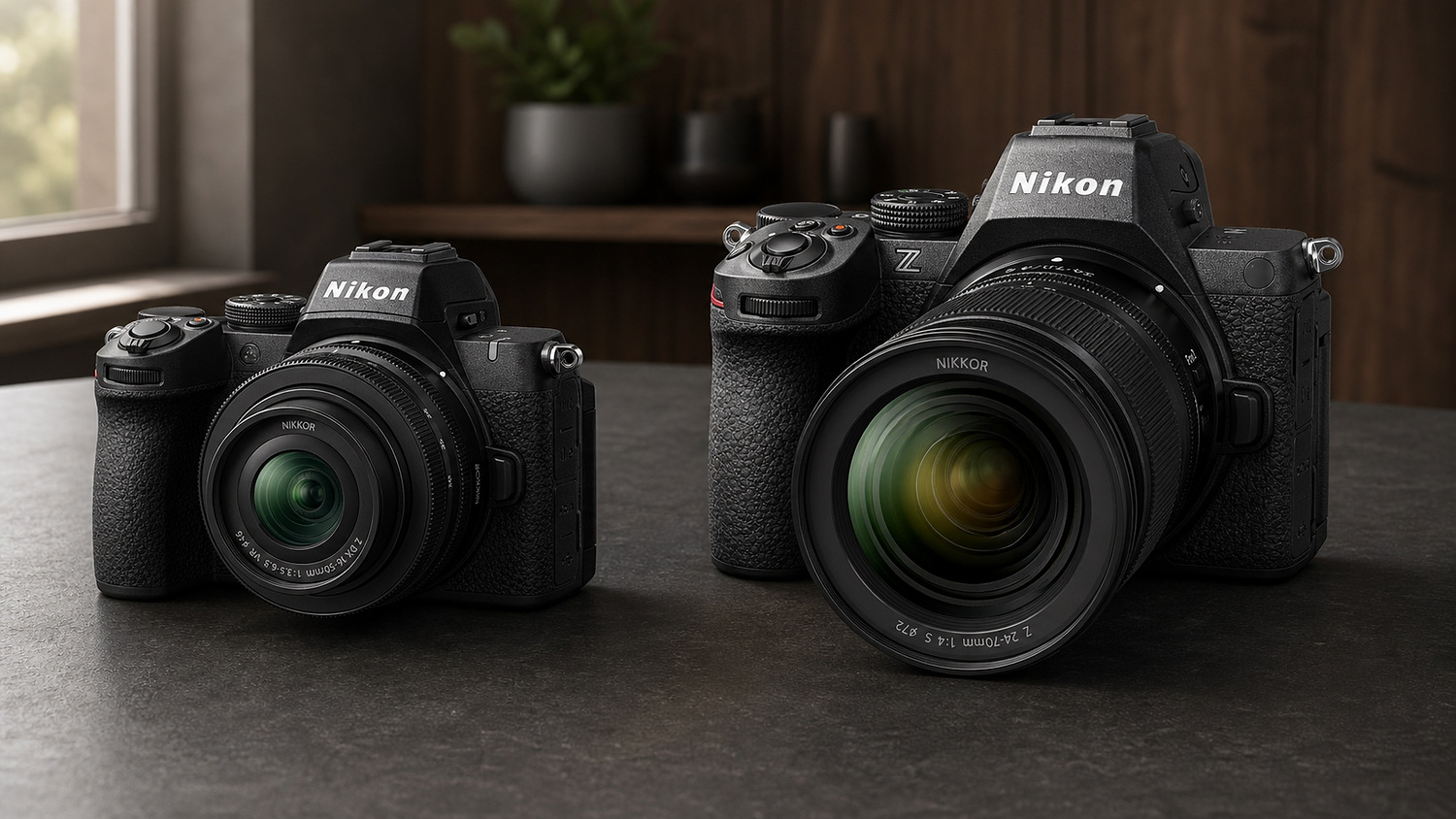
Choose Nikon DX or FX for your pictures, lenses, framing and the kit you will actually carry.
With the same 50mm lens, Nikon DX frames a child more tightly while Nikon FX leaves more room around them. You will notice that difference with a distant bird, a narrow street and a family portrait at home. Neither format wins everywhere. The useful choice starts with your distance, your light and the lens you will actually carry.
Nikon DX or FX: the short answer
Choose DX for a compact first kit, lighter travel or tighter framing with a telephoto lens. Choose FX when a wider view with the same lens, low-light latitude or easier background separation answers a real need. Compare complete kits, not two bare bodies. Sensor format does not decide photographic skill or guarantee a good picture.
| Priority | Format to consider | Nikon example | Honest limit |
|---|---|---|---|
| Family, travel, first light kit | DX | Z50II | Choose lenses with DX framing in mind. |
| Portraits and indoor work | FX | Z5II | FX lenses can make the bag larger. |
| Action and advanced hybrid work | Depends on the kit | Z50II, Z6III or Z8 | Fast modes still need lenses, cards and technique. |
What DX and FX mean
The sensor is the light-sensitive surface that records the image. Nikon calls its APS-C format DX and its full-frame format FX. DX is around 24 × 16mm; FX is 36 × 24mm. Those measurements are not a quality ranking. They change the area of the scene recorded and can change the size of a useful camera-and-lens kit.
Z50II is a DX example; Z5II, Z6III and Z8 are FX examples. Both can handle family pictures, travel, portraits and landscapes. Ask which framing you need and which lens will stay on the camera most often.
The 1.5× factor changes framing, not the lens
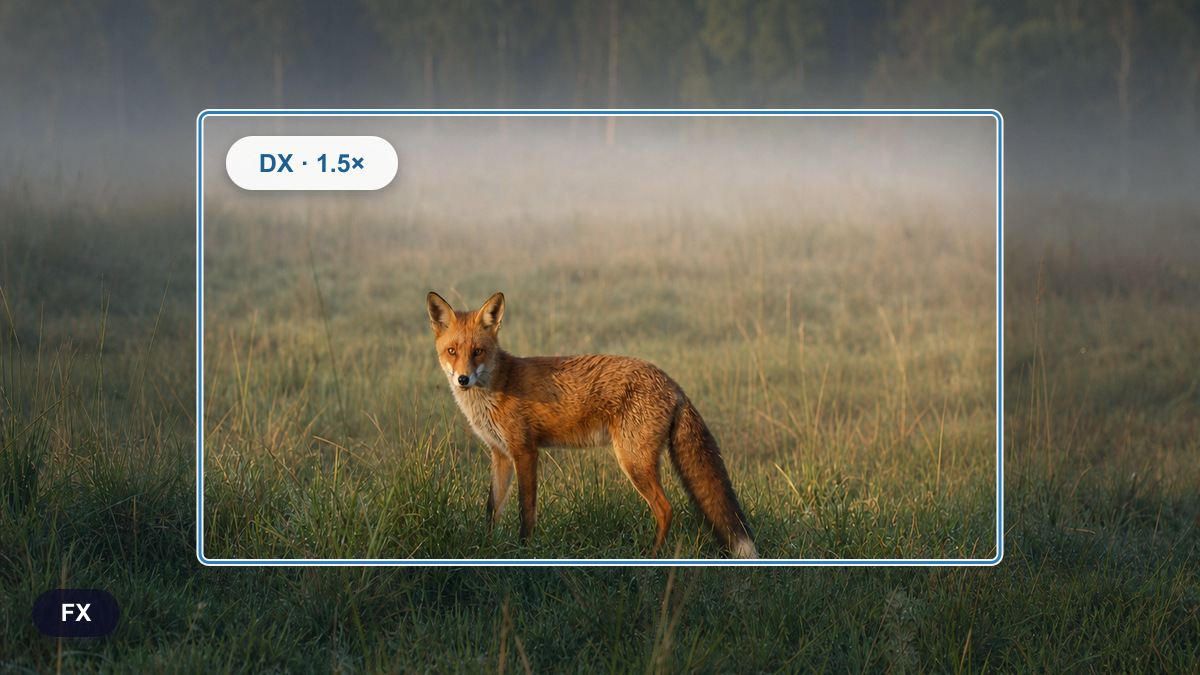
The crop factor is a comparison guide for angle of view, the part of a scene that appears in the picture. From the same position with the same lens, DX records a narrower area. A 35mm lens on DX frames roughly like 52.5mm on FX, and a 50mm lens like 75mm.
The 50mm lens remains physically 50mm. DX does not turn it into a teleconverter or move you closer. Tighter framing can be useful for distant wildlife and sport. FX makes a wider view easier with the same focal length, which can help in a small room, architecture or a broad landscape.
Compare the bag, not just the bodies
A camera comes with a main lens, battery, card and sometimes a microphone or telephoto lens. A small FX body can become a demanding kit with a large lens. A brighter lens can make FX worthwhile for indoor portraits, while adding weight. Picture the kit during a full day of travel, not only on a specification sheet.
The Nikon Z mount connects lens and camera. NIKKOR Z FX lenses cover full frame and can be used on DX, where the framing becomes tighter. NIKKOR Z DX lenses are designed for DX. Check the Nikon lenses that match your real pictures before deciding.
For a family outing, a general-purpose zoom may be more valuable than extra resolution because it avoids lens changes. For a match, a telephoto you can hold comfortably matters more than a prestigious body. Essential now: lens, weight, handling and battery. Useful for some work: stabilisation, dual slots and advanced video. Optional at first: buying every future lens.
Try the same mental packing list for both formats. A weekend away may mean one zoom, a small spare battery and a compact charger. A day at a child’s tournament may mean a longer lens, a second card and a strap that stays comfortable after an hour. The FX kit is worthwhile only if its specific benefit still matters after those items are in the bag. Conversely, do not choose DX on weight alone if its available lens leaves you unable to make the wider indoor photograph you care about.
Z50II DX or Z5II FX for a first camera and travel?
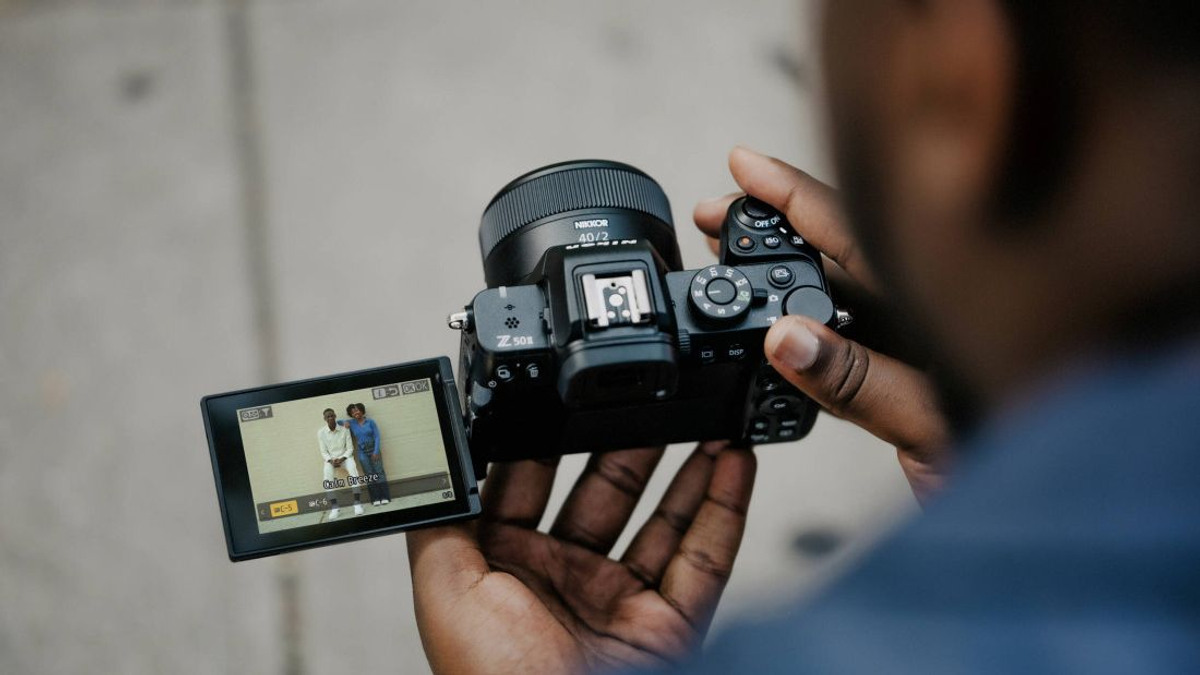
The Nikon Z50II is a compact DX route into learning, travel and family photographs. Its 20.9-megapixel sensor, nine subject types, vari-angle screen and 4K/60p crop support varied use. Its highest burst settings depend on modes and formats, so they are not a promise that every moving picture will be sharp.
The Z5II offers a 24.5-megapixel FX sensor, in-body stabilisation and two SD UHS-II slots. It makes sense for portraits, indoor family work and travel if the required FX lenses suit you. Its 4K/60p uses a crop. Choose it because the format helps your scenes, not because full frame sounds like the required next step.
At a birthday, the useful camera is the one in your hand before the candles are gone. On a city break, it is the one you still want to carry in the afternoon. DX can answer both needs perfectly.
There is a practical difference in the way these two kits solve a living-room photograph. With the Z50II, a compact DX zoom can be an easy everyday answer, while a faster lens helps when the room is dim. With the Z5II, the wider full-frame view and stabilised body can give more options when you cannot step back. Neither body can stop a child moving through the frame on its own: select a shutter speed that suits the movement, then choose the lens and format around that need.
Sport and wildlife: does DX really bring the subject closer?
No. It frames the subject more tightly with the same lens. That can be helpful for a bird, distant animal or player from the sideline. Z50II is a light start with a telephoto. But lens quality, the pixels that fall on the subject, light and your tracking remain as important as the format.
Autofocus is the automatic focusing system. A burst records a sequence quickly. Both can help, but neither fixes poor distance or unpredictable movement. Shutter speed, the time the image is recorded, must also be short enough to stop the action.
The Z6III is an FX option for more advanced photo-video work. The Z8 adds 45.7 megapixels, fast autofocus and more demanding files. Their extra capacity matters when your workflow uses it; otherwise a lighter DX kit may lead to more opportunities.
In practice, begin with the distance. If a fox is on the far side of a field, DX framing can make a given telephoto easier to use. If a runner suddenly enters the frame at close range, the wider FX view can make it easier to find them before tracking. High-resolution FX files may leave cropping room afterwards, but they also expose missed focus, motion blur and weak lens performance. No format removes the need to follow the subject smoothly and give the camera enough light.
Portraits and indoors: when FX gives useful room
Depth of field is the area that appears sharp in front of and behind the focus point. With comparable framing, FX generally makes a thinner sharp zone and softer background easier. That can help a portrait, but it is neither automatic nor always desirable. A family group often needs more of the scene sharp.
Aperture, written as f/1.8 or f/4, controls how much light enters the lens. Your distance from the person and the gap behind them also change the look. Moving a person away from a wall can improve the background without changing cameras. DX remains capable of strong portraits when lens and composition suit the space.
FX often offers more low-light latitude, but exposure, lens, sensor generation and final use still matter. Do not choose a format to “win at night”; choose the kit that handles your actual rooms.
Imagine a family portrait in a small lounge. A wide view may be more valuable than maximum blur because everyone needs to fit and remain recognisable. Move the group towards a window, keep the background a little farther away and use the widest aperture that still keeps the faces sharp. FX gives more flexibility for some versions of that picture, especially when the room is dim. DX can be the more relaxed choice when you want enough depth of field for two rows of people without carrying a larger lens.
Landscape, street and travel: wider view or lighter bag?
Wide angle helps when you cannot step back or want to include a strong foreground. FX makes it easier to reach a wide field of view with the same focal length. Yet a landscape does not have to be wide to work. A longer lens can simplify a mountain, street or façade.
For travel and street work, a discreet kit encourages you to photograph. DX works well when you walk all day or want a manageable telephoto. FX can suit frequent indoor work, wide-angle preferences or a particular portrait look. Neither format replaces paying attention before you press the shutter.
Video: sensor format does not decide everything
For video, start with the actual framing. At arm’s length, a lens can become too tight depending on format and recording mode. A 4K/60p crop can remove the width needed in a room. Z50II offers cropped 4K/60p and 10-bit N-Log. Z5II has full-frame 4K/30p and cropped 4K/60p. Z6III is aimed at a more demanding photo-video workflow.
N-Log is a video profile that retains more room for colour adjustment in editing. It helps if you grade footage; it does not improve a simple clip without that work. Sound, autofocus, stabilisation, heat, cards and computer can matter more than sensor size.
For a self-recorded explanation in a kitchen or hotel room, test the lens at the recording mode you will actually use. A crop can make a comfortable talking-head focal length feel too tight, while a wider lens may show more of a messy room. The Z50II is sensible when a light, uncomplicated creator kit is the priority. The Z5II brings full-frame 4K/30p and body stabilisation, but its cropped 4K/60p still needs the same framing check. The Z6III is a better fit when higher-end video options and their file handling are part of a routine, rather than an occasional experiment.
FX lens on DX, DX lens on FX: what happens?
An FX lens on a DX body covers the sensor fully and gives tighter DX framing. A DX lens can mount on an FX body, but the camera uses a DX crop to avoid dark corners. Only part of the FX sensor is then recorded, with less available resolution than full FX mode.
| Combination | Result | Check |
|---|---|---|
| FX lens on DX body | Full coverage, tighter DX view. | Equivalent framing, weight and balance. |
| DX lens on FX body | DX crop of the sensor. | Available resolution and long-term purpose. |
| F-mount lens with FTZ II | Compatibility may be possible. | Exact lens, autofocus and retained functions. |
FTZ II can adapt many F-mount lenses, but not every lens keeps the same functions. Check the exact reference before building a system around an older lens.
The common Z mount makes it possible to build gradually, but it does not make every combination equally sensible. An FX lens on DX can be a good way to keep a favourite focal length for a future body, provided its size still suits the smaller camera. A DX lens on FX can be perfectly useful as a temporary travel or backup option, yet the DX crop gives up part of the resolution and the wider FX view. Treat compatibility as a practical choice about framing and balance, not just a box tick.
Moving from DX to FX: must every lens be replaced?
No. Start with an inventory: which focal lengths do you use, which photographs are missing, and which NIKKOR Z lenses do you already own? An FX lens can move from DX to FX. A DX lens can remain useful temporarily, but it does not use the full FX sensor.
Do not replace everything as insurance for a future you may not need. If a DX zoom is what lets you travel light now, it still has value. Replace the lens that limits a real photograph first: too narrow at home, too short for wildlife or too heavy for a hike.
A useful order is to keep the lenses that already make your most frequent pictures, then identify the first gap after changing format. It may be a genuinely wide lens for a small flat, a portrait lens with the aperture you need, or simply a lighter general zoom. Sell or replace equipment only when that gap is clear. This protects the budget and prevents a move to FX from becoming a bag of lenses chosen for their labels rather than their photographs.
Five ideas to leave behind
FX means professional. No: it serves some framing and lighting needs. DX means beginner. No: its tighter framing can help action and nature. 1.5× is free zoom. No: it describes framing, not optical magnification.
FX always wins in low light. It often gives room, but lens and exposure still matter. FX alone creates blur. Background distance, aperture and camera position remain important.
The MCZ DIRECT method
Begin with the scene that returns every week, not the one you may make once in the future. A parent who mainly photographs children may value a zoom, spare battery and simple handling. A walker looking for birds should consider working distance and the telephoto lens they will genuinely carry. Someone making indoor portraits should consider room size, aperture and the space behind the person. Those answers can point to different formats without making one more ambitious than the other.
Think about the files after the picture too. A photograph shared on a phone, a large print and graded video do not need the same resolution or computer. More resolution gives cropping room, while increasing cards, storage and sorting time. Keep that margin when it solves a real expectation. A system can grow: it is better to start with a coherent kit and note what genuinely limits you.
Take one ordinary outing as a test case. Put the intended body, lens, battery and card in the bag, then imagine a family meal, a street scene after sunset and a distant subject. If one of those pictures becomes awkward, identify why. It may be focal length, light, weight or recording mode rather than DX or FX. This small exercise prevents a format label from carrying more importance than it deserves.
Answer these questions honestly: what do you photograph most, from what distance, in which light, with how much background or blur, at what all-day weight, and with which existing lenses? If you film, add cards, sound and computer to the answer.
Hiking, family scenes and distant subjects point naturally towards DX. Indoor portraits, wider views and frequent low-light work can point to FX. When answers are mixed, choose the kit that makes your most frequent scene easier and add to the system later.
MCZ DIRECT verdict
Choose DX for lighter travel, a simple first system or tighter sport and wildlife framing. Accept that wide-angle work and lenses must be considered through DX framing. Z50II is the clearest Nikon reference for that route.
Choose FX when wider views, portraits, indoor work and low-light latitude justify a usually larger kit. Z5II is a versatile entry; Z6III and Z8 answer more advanced action or file needs. If you still hesitate, read our Nikon Z guide and compare complete kits in the Nikon mirrorless category.
Sources and editorial verification
Sources reviewed and checks completed before publication.
MCZ DIRECT editorial analysis verified on 26 July 2026 against official Nikon documentation and the public MCZDIRECT catalogue. No comparative field test or absolute ranking is claimed. Framing, low-light results and depth of field also depend on the lens, distance, exposure and sensor generation.
- Official Nikon guide — Moving from DX to FX
- Official Nikon guide — DX and FX crop factor
- Official Nikon guide — Nikon DX and FX formats
- Official Nikon lens catalogue — NIKKOR Z lenses
- Official Nikon product page — FTZ II mount adapter
- Official Nikon product page — Nikon Z50II
- Official Nikon product page — Nikon Z5II
- Official Nikon product page — Nikon Z6III
- Official Nikon product page — Nikon Z8
- Official Nikon range guide — Nikon Z range explained
- Official Nikon lens guide — How many lenses do you need?
- Official Nikon guide — DX NIKKOR lenses
Nikon DX and FX FAQs
Nikon DX or FX for a beginner?
DX is often the more comfortable first step because a Nikon Z DX kit can stay light for family photographs, travel and learning with interchangeable lenses. Choose FX only when you already know that its wider view, portrait background control or indoor flexibility will be useful. Neither format is a measure of skill; the lens and kit you carry matter just as much.
Should you choose the Z50II or Z5II?
What is 35mm on DX?
A 35mm lens remains physically 35mm on a Nikon DX camera. Its field of view, meaning the portion of the scene recorded, is roughly comparable to a 52.5mm lens on FX at the same position. This 1.5× comparison describes framing only. It does not create optical zoom, move the subject closer or change the lens aperture.
Can you use an FX lens on a DX camera?
Yes. A NIKKOR Z FX lens covers a Nikon DX sensor fully. The smaller DX sensor records a tighter central area, so the image frames more narrowly than on FX with the same lens. This can be useful for distant sport or wildlife, but check the lens’s weight and balance: a large FX lens can make a small DX body less comfortable to carry.
Can you use a DX lens on an FX camera?
A NIKKOR Z DX lens can mount on a compatible Nikon FX body, but the camera uses a DX crop to avoid dark corners. It records only part of the full-frame sensor, which normally leaves less resolution than full FX mode. This can be a practical temporary solution, yet it is not the same as using an FX lens across the whole sensor.
Is Nikon DX a good choice for wildlife?
DX can be very useful for wildlife because the same telephoto lens gives a tighter field of view, helping when birds or animals remain distant. It does not provide free magnification or guarantee detail. Sharp results still rely on lens quality, focus, shutter speed, light and tracking. A lighter DX kit may also be easier to carry on a long walk or hide session.
Is FX always better in low light?
No. FX often offers more low-light latitude when comparable cameras, lenses and output are considered, but it is not an automatic win. Sensor generation, aperture, exposure and the final image size all affect the result. For a moving child or animal, the shutter speed needed to stop motion can matter more than stabilisation or sensor format alone.
Must all lenses be replaced?
No. Start by listing the focal lengths and photographs you actually use. NIKKOR Z FX lenses work on both DX and FX bodies, while DX lenses use crop mode on FX. Keep a DX lens if it still makes the pictures you need, then replace only the lens that creates a real gap. Compare suitable options in the Nikon lens range.
Leave a comment