

Shopping Cart


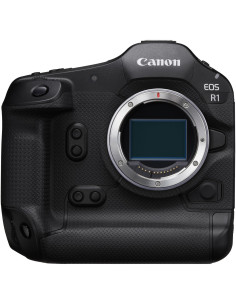
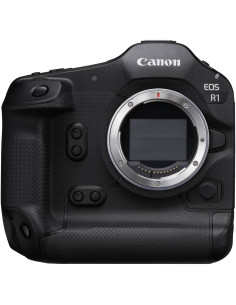
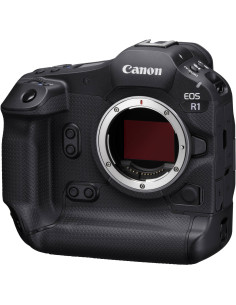
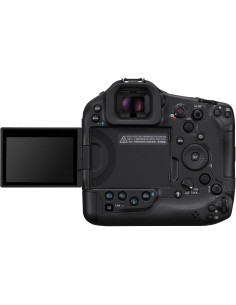
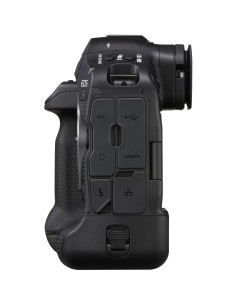
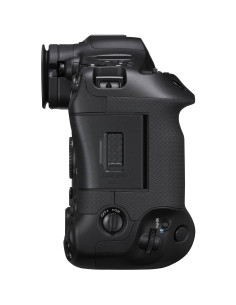
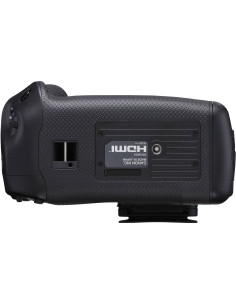
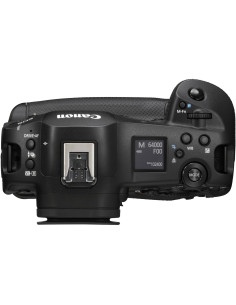
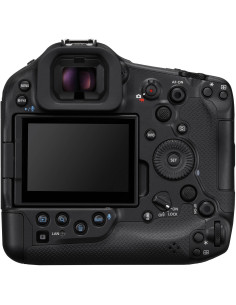
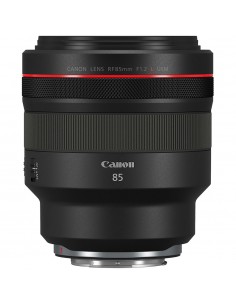
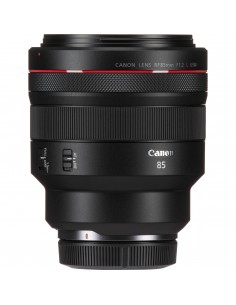
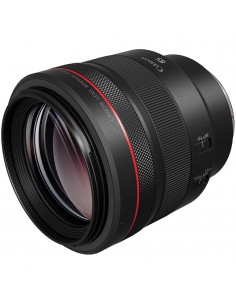


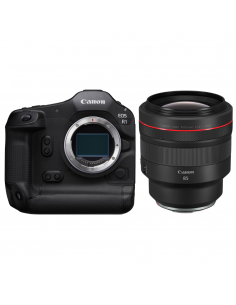

The Canon EOS R1 with RF 85mm F1.2 L USM is a professional full-frame kit recommended for portrait, wedding, fashion and stage photographers who need fast autofocus, flattering perspective and pronounced background separation. Its 24.2 MP stacked sensor and electronic burst rate of up to 40 fps help retain a fleeting expression or decisive gesture without creating unnecessarily large files. The lens opens to F1.2, making available-light work easier and producing very shallow depth of field, provided focus is placed carefully. This pairing is best suited to directed sessions and events where rendering matters more than low weight. It is a sound choice when 85mm already matches the way you frame and the distance at which you prefer to work.
Combine compatible accessories and save. The more items you add, the bigger the discount.

Accessory
Accessory
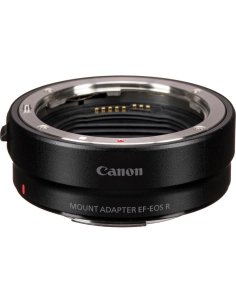
Accessory

warranty extension
This pairing combines a professional camera built to capture very short moments with a portrait prime capable of strong subject separation. The EOS R1 supplies fast readout, dependable subject tracking and uninterrupted viewing during electronic bursts. The RF 85mm F1.2 L USM shapes perspective and depth of field. Together they suit pictures in which the face, gesture or expression must command attention while the setting remains soft but recognisable.
It is primarily for a photographer who already understands the space an 85mm lens requires. In portraiture, weddings, fashion or stage photography, it allows more distance than a 50mm without the stronger compression and longer working range of a 135mm. That distance can help a sitter relax, but it becomes restrictive in a small room. The Canon EOS R1 body is the more flexible starting point when different lenses are needed for each assignment.
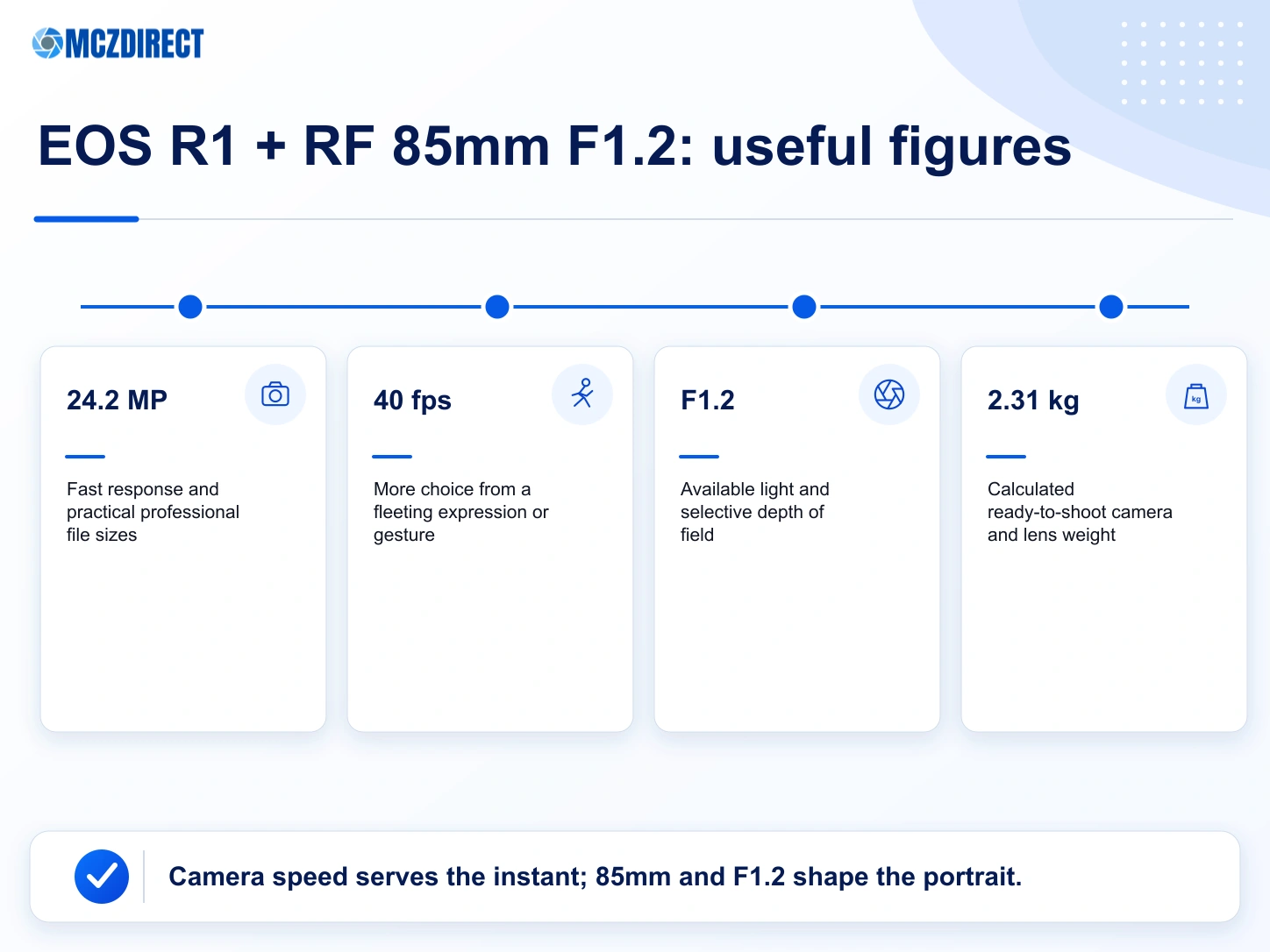
The 24.2 MP full-frame stacked sensor strikes a useful balance for event work. It provides enough detail for sensible cropping while avoiding the storage burden of a very high-resolution body. Fast sensor readout helps the camera reach up to 40 frames per second with its electronic shutter. In practice, that rate is valuable for a changing expression, a moving veil, a stage gesture or a brief exchange between people. It does not replace anticipation or a well-chosen AF area.
The lens complements that speed with an F1.2 maximum aperture. At the same framing, it can permit a lower ISO or faster shutter speed than a slower optic, which matters during ceremonies, indoor performances and evening portraits. The trade-off is extremely shallow focus at close distance. Eye detection helps, but the photographer still needs to watch head angle, subject movement and shutter speed. A perfectly sharp eyelash is not useful if the intended eye has already left the focus plane.
An 85mm lens lets the photographer frame a face without moving uncomfortably close. The extra distance makes it easier to see posture, hands and background relationships, and it tends to preserve balanced facial proportions in head-and-shoulder work. For an environmental portrait, more room is needed to include the setting. A full-length portrait in a confined interior may simply be impractical, regardless of the camera’s performance.
F1.2 is not the only source of background blur. Subject distance and the gap between the sitter and the background remain decisive. A distant background becomes softer, while a nearby wall retains more structure. Stopping down to F1.8 or F2.8 is often wiser for a couple, a turned face or a portrait in which both eyes must be sharp. The value of the RF 85mm F1.2 is the option to use a highly selective look, not an obligation to shoot every frame wide open.
| Feature | What it brings | Point to plan for |
|---|---|---|
| 24.2 MP stacked sensor | Fast response with manageable professional file sizes | Less cropping latitude than a very high-resolution body |
| Burst rate up to 40 fps | More choice from a fleeting expression or gesture | Greater card use and a heavier editing load |
| RF 85mm at F1.2 | Soft backgrounds and easier available-light shooting | Very shallow focus at close distances |
| In-body stabilisation | Reduces photographer movement with a relatively still subject | Does not freeze the sitter’s movement |
| Approximately 2.31kg combined | Stable professional handling | Fatigue can build during a long assignment |
The EOS R1 uses Dual Pixel Intelligent AF and recognises people, animals and selected vehicles. For portrait work, the practical benefit is continued tracking as a face turns or is briefly obscured. Eye priority helps the photographer specify the intended point of attention when depth of field is narrow. AF case behaviour, tracking sensitivity and area selection still need to match the movement. Automatic recognition is an aid to judgement rather than a substitute for it.
Pre-continuous shooting and fast bursts become useful during laughter, a wedding entrance or a sudden movement on stage. They preserve more steps around the decisive instant, but they also create more files to review. A disciplined workflow reserves the highest rate for genuinely unpredictable moments and uses a slower cadence for directed portraits. Dual CFexpress Type B cards then provide the write speed and redundancy expected from a professional event camera.
The RF 85mm F1.2 L USM has no optical image stabiliser, but it benefits from the EOS R1’s in-body stabilisation. This can reduce camera shake during a posed portrait or a quiet scene when the subject remains comparatively still. It cannot stop a person walking, dancing or turning their head. For movement, a suitable shutter speed remains the priority, even when that means accepting a higher ISO setting.
F1.2 gives useful headroom in low light, yet it does not remove the need to manage contrast, backlighting or mixed colour. During a moving portrait, a slightly noisier sharp file is normally preferable to a clean but blurred one. This kit is at its most convincing when the photographer wants to preserve the atmosphere of existing light and control the background without bringing a large lighting setup to every location.
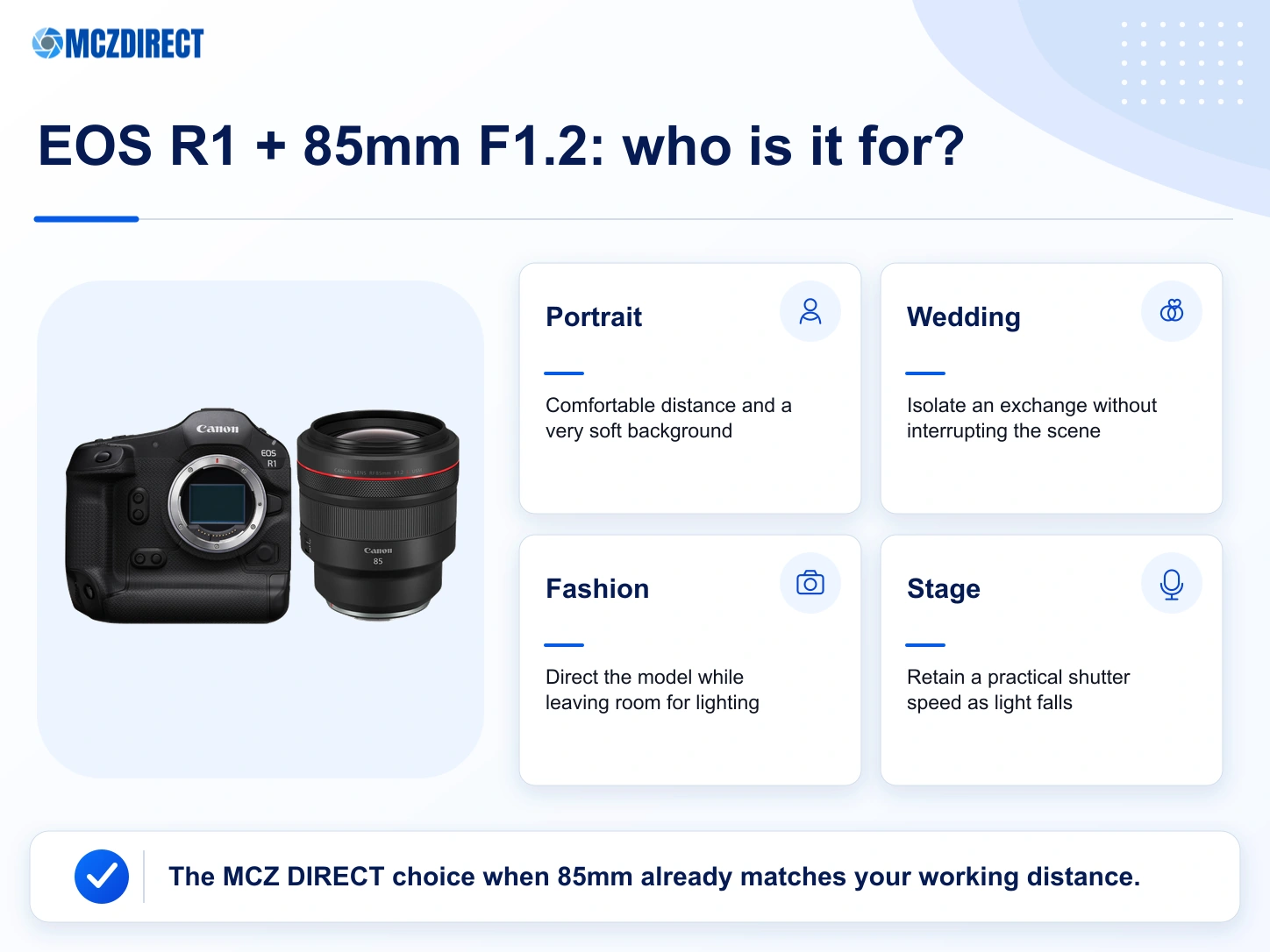
At a wedding, 85mm allows the photographer to remain slightly removed during a ceremony and isolate an exchange without interrupting it. A wider lens is still needed for preparations, groups and confined spaces. In fashion and studio work, the focal length offers a comfortable directing distance and leaves room for lights and modifiers. The EOS R1’s burst rate is useful for moving fabric, a step or the transition between poses rather than only for conventional sports action.
On stage, F1.2 helps preserve a useful shutter speed as illumination falls. Face tracking supports composition, but a fixed focal length requires the photographer to anticipate where the performer will move. For documentary work with constantly changing distances, the Canon EOS R1 with RF 24-70mm F2.8 L IS USM is more adaptable. The 85mm pairing is stronger when rendering and subject separation take priority.
The EOS R1 records internal RAW up to 6K 60p, 4K up to 120p and Full HD up to 240p, depending on mode. The RF 85mm F1.2 can produce an intimate look for a seated interview, portrait sequence or stage detail. Its aperture also helps in available light. At F1.2, however, a movement of only a few centimetres can shift the eye outside the sharp plane, making rehearsal and focus behaviour important.
For frequent video production, lens weight, support and focus transitions deserve careful planning. An 85mm prime suits a prepared frame better than coverage that must jump instantly from wide to tight. The Canon EOS R1 with RF 50mm F1.4 L VCM offers another route when lighter handling and regular hybrid photo-video use matter more than the distinctive F1.2 portrait look.
| Assignment | Relevant strength | Working advice |
|---|---|---|
| Directed portrait | 85mm and F1.2 isolate the eyes | Stop down slightly when both eyes need to remain sharp |
| Wedding | Face tracking and available-light capability | Carry a wider focal length for groups and small rooms |
| Fashion or studio | Comfortable distance and bursts for moving poses | Control the background and focus plane deliberately |
| Stage | Bright aperture and subject tracking | Keep shutter speed high enough despite stabilisation |
| Portrait video | 6K RAW, 4K 120p and selective rendering | Prepare the frame and avoid uncontrolled subject movement |
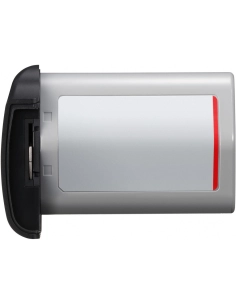
The EOS R1 has two CFexpress Type B slots. These cards support long bursts and high-data-rate video, but they also require a compatible reader and storage sized for sustained production. The LP-E19 battery powers the camera; real endurance varies with viewfinder use, burst frequency, video, temperature and wireless connections. A wedding or long assignment still calls for a deliberate card and battery rotation plan.
Canon lists the camera at about 1,115g with battery and card, while the RF 85mm F1.2 weighs approximately 1,195g. The combination therefore reaches roughly 2.31kg before a strap or accessory is added. That mass can feel reassuring during short sessions, yet it becomes significant over a full day. A supportive strap, sensible bag layout and scheduled breaks are part of using this kit well, not afterthoughts.
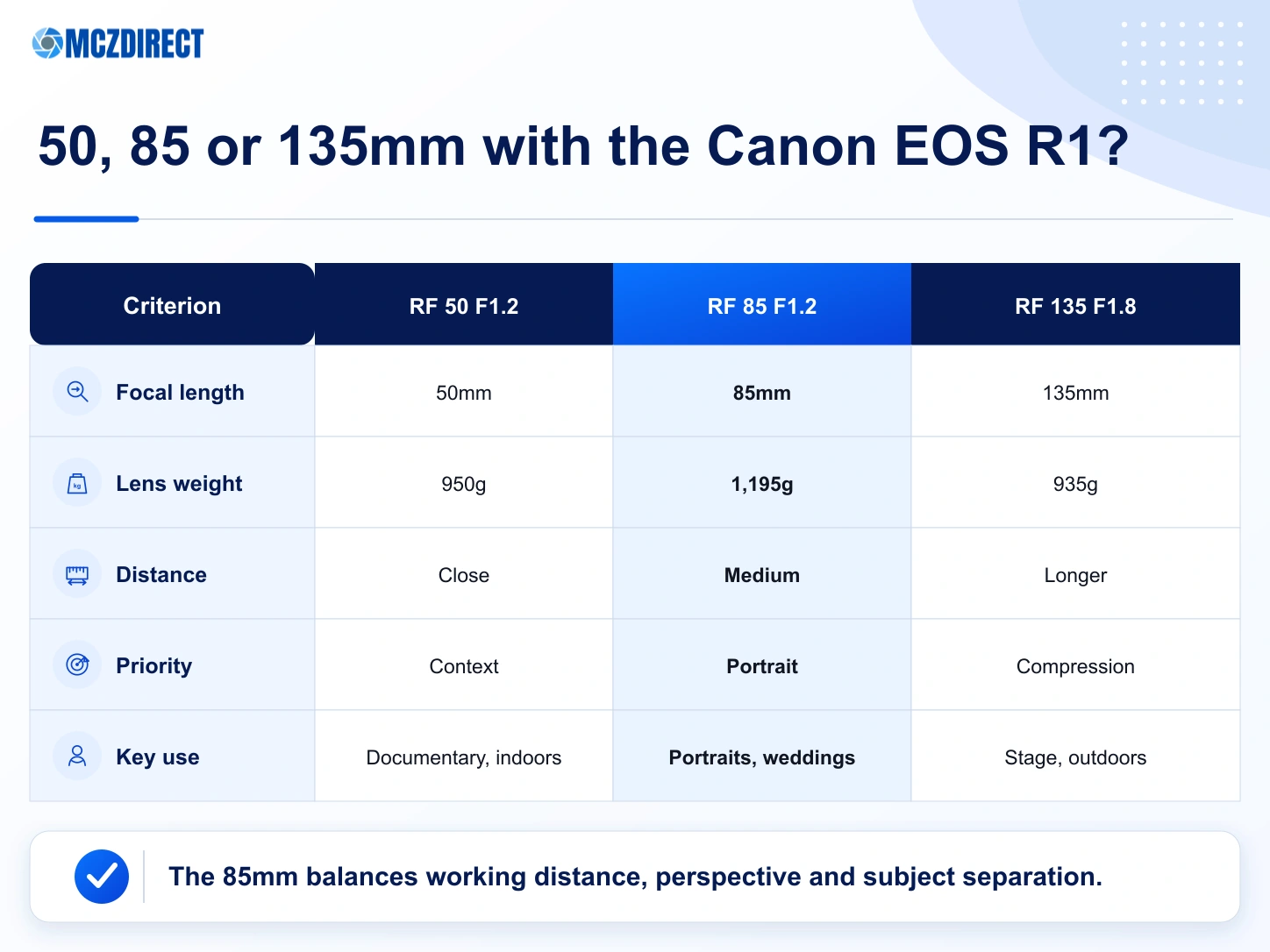
The Canon EOS R1 with RF 50mm F1.2 L USM includes more of the surroundings and requires less working room. It is easier indoors and during close documentary work. The 85mm gives a tighter frame and stronger separation from the same position. Neither is automatically better; the important question is where you naturally stand when making a portrait.
The Canon EOS R1 with RF 135mm F1.8 L IS USM extends working distance and compression, making it useful for outdoor portraits and stage work with ample room. A 24-70mm zoom is the safer choice when framing must change without moving. For a portrait photographer who already reaches for 85mm, this kit is the most direct and coherent of those options.
| Configuration | Main priority | Choose it when |
|---|---|---|
| EOS R1 + RF 50mm F1.2 | Context with a very fast aperture | You often work indoors or close to the subject |
| EOS R1 + RF 85mm F1.2 | Portraits and subject separation | 85mm matches your natural working distance |
| EOS R1 + RF 135mm F1.8 | Compression and more distant subjects | You have room for stage or outdoor portrait work |
| EOS R1 + RF 24-70mm F2.8 | Framing flexibility | Subject distance changes quickly during an assignment |
| EOS R1 body | Freedom to build the system | You already own the RF lenses your work requires |
The first limitation is physical: this is a heavy, sizeable pairing. The second is the focal length. A small room can make a full-length portrait or group difficult. The third is F1.2 itself: shallow depth of field rewards careful placement but exposes small focus errors. The standard RF 85mm F1.2 in this kit should also not be confused with the DS version, whose apodisation treatment changes out-of-focus rendering and reduces effective light transmission at wide apertures.
At MCZ DIRECT, we see this as a specialist choice for portrait, wedding and fashion photographers who want a fast camera and a highly selective lens in one package. We would steer a travel photographer, a confined-space shooter or someone who changes framing constantly towards a lighter or more flexible setup. That is not a weakness in the product; it is the distinction that helps the right photographer choose it with confidence.
At MCZ DIRECT, we position the Canon EOS R1 with RF 85mm F1.2 L USM as a high-end portrait and event kit for photographers who build pictures around distance, expression and depth of field. Compared with the 50mm kit, we recommend it when framing should be tighter and the background less assertive. Compared with the 135mm pairing, it remains easier to use when working room is limited.
Its strongest quality is the link between camera response and lens rendering. Its limitation is equally clear: about 2.31kg to carry and focus that demands discipline at F1.2. If 85mm is already central to the way you photograph portraits, weddings, fashion or stage work, this kit provides a coherent ready-made pairing rather than two unrelated premium components.
Choose this kit when you need the EOS R1’s speed with the framing and rendering of an 85mm F1.2, then add it to your basket once that working distance fits your photography.

It is aimed at professional and advanced portrait, wedding, fashion and stage photographers who already work comfortably at 85mm and value a very large aperture.
Yes. The 85mm focal length gives comfortable distance and F1.2 can isolate a face strongly. Focus placement must be watched carefully when depth of field becomes very shallow.
It works well for ceremonies, portraits and available-light moments. A second, wider lens remains useful for preparations, groups and confined interiors.
The camera is about 1,115g with battery and card and the lens about 1,195g, giving a combined working weight of roughly 2.31kg before a strap or accessories.
The 50mm keeps more context and needs less room. The 85mm frames more tightly and separates the subject more strongly. Choose according to your normal working distance.
The DS version uses an apodisation treatment for smoother out-of-focus edges and transmits less effective light at wide apertures. This kit contains the standard version.
No. It relies on the EOS R1’s in-body stabilisation, which reduces camera movement but cannot freeze a moving subject.
Yes, particularly for a fleeting expression or gesture. The highest rate creates many files, so a slower burst is often sufficient for a directed portrait.
No. Official modes include internal RAW up to 6K 60p, 4K up to 120p and Full HD up to 240p, depending on settings.
It has two CFexpress Type B slots. Suitable high-performance cards and a compatible reader are recommended for long bursts and high-data-rate video.
No. It also creates very shallow depth of field and strong subject separation. In bright conditions, a high shutter speed or suitable filter may be required.
It may become too tight when working space is limited, especially for full-length portraits or groups. A 50mm lens or standard zoom is more flexible in that situation.
