
Shopping Cart
Best Lenses for the Canon EOS R5 Mark II: The Complete Guide by Use Case


Which lens should you pair with your Canon EOS R5 Mark II? This complete guide reviews the best Canon RF lenses by discipline: portrait (RF 85mm f/1.2, RF 50mm f/1.2, RF 135mm f/1.8), landscape (RF 15-35mm f/2.8, RF 14-35mm f/4), sports and wildlife (RF 70-200mm f/2.8, RF 100-500mm, RF 200-800mm), video (RF 24-105mm f/2.8 Z, RF 35mm f/1.4 VCM) and macro (RF 100mm f/2.8 Macro). We also cover third-party alternatives from Sigma, Tamron and Viltrox, the Holy Trinity f/2.8 kit, and every R5 Mark II body-plus-lens kit available on MCZ Direct. Includes a quick-reference summary table and FAQ.
You've just invested in a Canon EOS R5 Mark II — one of the most capable mirrorless cameras on the market. Its 45-megapixel stacked sensor, 30 fps burst rate, Eye Control AF and 8K 60p video capabilities deserve lenses that can keep up. Mounting a mediocre lens on this body is like fitting budget tyres to a sports car: you'll never unlock its true potential.
But with the Canon RF lens catalogue now exceeding 40 options, the choice can feel overwhelming. Which lens for portraits? Landscapes? Sports? Video? Macro? Should you invest in the Holy Trinity f/2.8 zooms or prioritise faster primes?
This guide offers a curated selection of the best RF lenses for the Canon R5 Mark II, organised by shooting discipline, with a clear explanation of why each lens is the right pick for that use case. We also flag the body-plus-lens kits available for those who want to get shooting straight out of the box.
Before you choose: what you need to know about the R5 Mark II and its lenses
The Canon R5 Mark II uses the Canon RF mount, designed specifically for mirrorless bodies. Compared to the older EF mount, the RF mount offers a shorter flange distance (20 mm vs 44 mm) and a wider bayonet diameter (54 mm), which gives optical engineers the freedom to design more ambitious formulas — particularly ultra-fast lenses like the RF 28-70mm f/2 and the RF 85mm f/1.2.
A few important points to keep in mind:
45 megapixels demands optical excellence. The R5 Mark II's sensor is unforgiving with average glass. A lack of sharpness or a decentring issue that would go unnoticed on a 24 MP sensor will be visible here. Prioritise lenses from Canon's L series (professional grade) or the best third-party optics (Sigma Art, Tamron).
Coordinated IBIS + IS stabilisation. The R5 Mark II features 8.5-stop sensor-shift stabilisation (IBIS) that works in coordination with the optical stabilisation (IS) of compatible RF lenses. Stabilised lenses therefore benefit from enhanced effectiveness. For video in particular, a stabilised lens will always be preferable.
EF compatibility. All your existing Canon EF and EF-S lenses work on the R5 Mark II via the Canon EF-EOS R adapter, with no loss of image quality or AF speed. If you already own quality EF glass, there's no need to replace everything immediately.
Third-party lenses. Sigma, Tamron and Viltrox now offer native RF-mount lenses. Some, like the Sigma 24-70mm f/2.8 DG DN Art and the Tamron 35-150mm f/2-2.8 Di III VXD, are excellent alternatives to Canon optics, often at a lower price point.
Best lenses for portraits
Portraiture is one of the disciplines that benefits most from the R5 Mark II's 45 MP sensor: the detail in eyes, skin texture and hair is rendered with extraordinary finesse. Here are our recommendations.
Canon RF 85mm f/1.2 L USM — The portrait king
This is quite simply the finest portrait lens available on the market, regardless of system. The f/1.2 aperture produces bokeh of breathtaking smoothness and beauty, with a transition between sharp and out-of-focus areas of remarkable fluidity. Sharpness at maximum aperture is exceptional — at f/1.2, eyelashes and irises are rendered with surgical precision on the R5 Mark II's 45 MP files.
Autofocus is fast and silent thanks to Nano USM motors. The build is weather-sealed, the barrel is metal, and the focus ring is smooth and precise. It's a heavy lens (1,195 g) and an expensive one, but if portraiture is your primary discipline, it will transform your work.
Canon also offers a RF 85mm f/1.2 L USM DS (Defocus Smoothing) version, featuring a special coating that further softens the bokeh at the cost of a slight reduction in effective light transmission. An option for bokeh purists.
Best for: professional portrait photographers, high-end weddings, fashion.
Canon RF 50mm f/1.2 L USM — The ultimate standard prime
The 50mm is the quintessential all-purpose focal length. The RF 50mm f/1.2 L is the most accomplished version Canon has ever produced: remarkable sharpness from wide open, creamy bokeh, minimal distortion, tank-like build quality. At f/1.2, subject isolation is spectacular — half-length and three-quarter portraits take on a cinematic quality that's hard to achieve with any other lens.
It's also an excellent wedding reportage lens: wide enough to capture the atmosphere of a scene, fast enough to work in dark churches without pushing ISO. The weight (950 g) is substantial but manageable for a full day's shooting.
Best for: wedding photographers, lifestyle portraiture, reportage, artistic creation.
Canon RF 50mm f/1.8 STM — The accessible alternative
If the RF 50mm f/1.2 exceeds your budget, the RF 50mm f/1.8 STM is a remarkable alternative at a fraction of the price. It's compact (160 g), lightweight and delivers surprisingly sharp images from f/2.2. The bokeh doesn't match the f/1.2's silkiness, but it's pleasant and more than adequate for the vast majority of portraits. The STM autofocus is decent if not lightning-fast.
Best for: portrait beginners, lightweight second lens, tight budgets.
Canon RF 135mm f/1.8 L IS USM — The distance portrait specialist
The RF 135mm f/1.8 L IS USM is an exceptional choice for outdoor portraits with generous working distance. The perspective compression at 135mm produces beautifully flattened backgrounds, and the f/1.8 aperture offers unmatched subject isolation at this focal length. Built-in optical stabilisation, coordinated with the R5 Mark II's IBIS, allows confident handheld shooting even in low light.
It's also an excellent lens for outdoor weddings (ceremonies, couple sessions) and events where you need to stay at a distance from your subjects.
Best for: outdoor portraiture, weddings, events, content creators.
Best lenses for landscapes and architecture
In landscape photography, the priorities are edge-to-edge sharpness, low distortion and the ability to use filters (polariser, ND). The R5 Mark II's 45 MP sensor reveals every detail — and every optical flaw.
Canon RF 15-35mm f/2.8 L IS USM — The wide-angle benchmark
This is the first element of the Canon RF "Holy Trinity" (15-35 / 24-70 / 70-200, all f/2.8). The RF 15-35mm f/2.8 L IS USM offers an ideal focal range for landscapes, architecture and astrophotography. Sharpness is excellent across the entire range, including the corners — a critical point at 45 MP. The constant f/2.8 aperture is an asset for astrophotography and dark interiors.
Optical IS, coordinated with the R5 Mark II's IBIS, enables handheld long exposures that would otherwise be impossible. The rear gel filter holder accepts filters, but there's no front filter thread. Budget for a Lee or NiSi filter system if you rely on ND or polarising filters.
Best for: landscapes, architecture, real estate, astrophotography, interiors.
Canon RF 14-35mm f/4 L IS USM — The smart compromise
If the RF 15-35mm f/2.8 is too bulky or expensive for your needs, the RF 14-35mm f/4 L IS USM is a brilliant alternative. More compact, lighter, and fitted with a 77mm front filter thread (a huge advantage for landscape shooters who use screw-on polarisers and ND filters), it delivers impressive sharpness for an f/4 lens. The 14-35mm range is slightly wider than the 15-35mm, which is appreciated in landscape work.
The trade-off is aperture: f/4 rather than f/2.8. This makes it less suited to astrophotography or very low-light situations. But for daytime landscapes and architecture, it's an excellent choice.
Best for: landscapes, travel, architecture, photographers who use screw-on filters.
Canon RF 24-105mm f/4 L IS USM — The landscape/travel all-rounder
This is the lens Canon most commonly sells in a kit with the R5 Mark II, and for good reason: the RF 24-105mm f/4 L IS USM is one of the most versatile zooms on the market. Its focal range covers wide-angle (24mm) to short telephoto (105mm), making it an ideal companion for travel and landscape work when you want to pack light.
Sharpness is very good across the range (excellent from 35 to 70mm), IS stabilisation is effective, and the contained weight (700 g) makes it comfortable to carry all day. The only drawback: constant f/4 is fine outdoors but limiting in low light.
Available as a kit:Canon R5 Mark II + RF 24-105mm f/4 L IS USM
Best for: travel, landscapes, reportage, everyday versatility.
Canon RF 10-20mm f/4 L IS STM — The spectacular ultra-wide
For photographers who want to push immersion even further, the RF 10-20mm f/4 L IS STM is the most impressive ultra-wide-angle lens in Canon's catalogue. At 10mm on a full-frame sensor, the field of view is vertiginous — ideal for sweeping landscapes, interior architecture, real estate and creative photography. Distortion is remarkably well controlled for such a short focal length, and edge-to-edge sharpness is excellent.
Built-in IS stabilisation is a rare asset on an ultra-wide, and the STM motor ensures silent autofocus that's well suited to video. The main drawback: the bulbous front element prevents the use of screw-on filters. You'll need rear gel filters or a dedicated filter system.
Best for: dramatic landscapes, architecture, real estate, astrophotography, creative work.
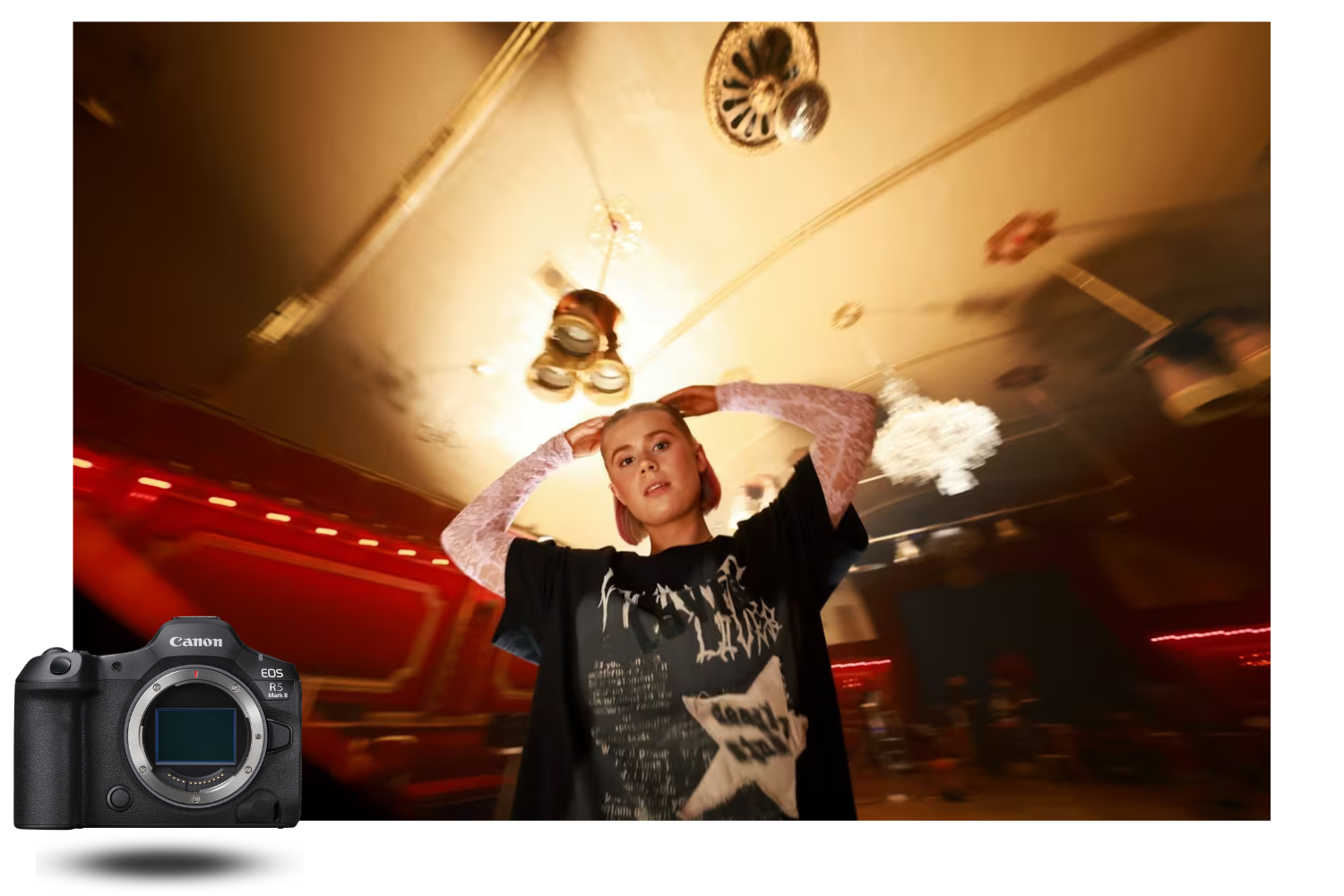
Best lenses for sports and wildlife
The R5 Mark II excels in action photography thanks to its stacked sensor (reduced rolling shutter), 30 fps burst, pre-capture and advanced autofocus with Action Priority AF. To get the most from these capabilities, you need fast, precise telephoto lenses. A slow lens or one with hesitant autofocus will negate the advantages this cutting-edge body offers. The lenses we recommend below are engineered for demanding environments — weather-sealed, with high-performance focus motors and advanced optical stabilisation.
Canon RF 70-200mm f/2.8 L IS USM — The essential all-rounder
The RF 70-200mm f/2.8 L IS USM is a feat of engineering. Canon has managed to pack a 70-200mm f/2.8 into a remarkably compact form factor — it's noticeably shorter and lighter than any DSLR-era 70-200mm f/2.8. Sharpness is excellent throughout the range, Dual Nano USM autofocus is blazingly fast, and IS stabilisation coordinated with the R5 Mark II's IBIS reaches impressive levels of effectiveness.
It's the most versatile telephoto in Canon's RF catalogue: indoor sports, weddings, portraits, medium-distance wildlife, reportage. If you can only have one telephoto lens, this is the one.
Available as a kit:Canon R5 Mark II + RF 70-200mm f/2.8 L IS USM
Best for: sports, weddings, telephoto portraits, reportage, events.
Canon RF 100-500mm f/4.5-7.1 L IS USM — The wildlife king
For wildlife photography and outdoor sports, the RF 100-500mm f/4.5-7.1 L IS USM is the number one choice. Its 100-to-500mm focal range covers the vast majority of field situations — from medium-distance animals to distant perched birds. Autofocus is fast and accurate, IS stabilisation is highly effective, and the weather-sealed build inspires confidence.
The maximum aperture of f/7.1 at 500mm is the main compromise: in low light or overcast conditions, you'll need to push ISO. But the R5 Mark II's sensor handles high sensitivities very well, and the cropping headroom offered by 45 MP more than compensates. The 100-500mm is also compatible with the RF 1.4× and 2× extenders, extending reach to 700mm (f/10) and 1,000mm (f/14) respectively — while retaining autofocus.
Available as a kit:Canon R5 Mark II + RF 100-500mm f/4.5-7.1 L IS USM
Best for: wildlife, birding, outdoor sports, safari.
Canon RF 200-800mm f/6.3-9 IS USM — Extreme reach
For bird and wildlife photographers who need maximum reach, the RF 200-800mm f/6.3-9 IS USM is a unique proposition on the market. No other manufacturer offers a 200-800mm zoom in a native mirrorless mount. Autofocus operates even at f/9, which is remarkable. The weight of 2,050 g is substantial but manageable for a lens of this reach.
The trade-off is the modest aperture: f/9 at 800mm requires working in good daylight or pushing ISO. But combined with the R5 Mark II's capable sensor and its pre-capture function, it's a formidable tool for capturing birds in flight or shy animals at great distance.
Best for: advanced birding, long-distance safari, wildlife observation.
Canon RF 70-200mm f/2.8 L IS USM Z — The next generation
Canon has released an updated version of its 70-200mm f/2.8 bearing the "Z" designation. This new model benefits from ultra-fast, ultra-quiet VCM (Voice Coil Motor) focus motors, improved optical coatings and even more effective IS stabilisation, reaching up to 8.5 stops in coordination with the R5 Mark II's IBIS. It's the benchmark for anyone who wants the best current 70-200mm.
Available in both black and white finishes, the RF 70-200mm f/2.8 L IS USM Z is particularly suited to professional photographers who demand peak performance in focus speed, stabilisation and silent operation — three qualities that also make it ideal for video recording.
Available as a kit:Canon R5 Mark II + RF 70-200mm f/2.8 L IS USM Z
Best for: professional sports, events, weddings, demanding photographers.
Best lenses for video
The R5 Mark II is a genuine cinema camera in a mirrorless body: 8K 60p RAW, 4K 120p, Canon Log 2, waveform monitor. For video, the selection criteria differ from stills: you prioritise silent autofocus (a noisy motor will ruin your audio), smooth focus breathing (the shift in field of view when focusing looks unpleasant on screen), IS stabilisation for fluid handheld results, and constant aperture to maintain consistent exposure during zoom movements. The lenses recommended below meet all of these requirements.
Canon RF 24-105mm f/2.8 L IS USM Z — The ultimate video zoom
This is quite simply the most ambitious zoom lens Canon has ever designed. A 24-105mm with a constant f/2.8 aperture — an optical achievement no one else offers. Sharpness is exceptional across the range, focus breathing is minimal (virtually eliminated by the R5 Mark II's electronic correction), and Nano USM autofocus is silent and precise.
For the videographer, it's the dream lens: a single optic covers everything from wide-angle to portrait, with a constant f/2.8 aperture that maintains pleasing bokeh and stable exposure across the entire zoom range. It's the ideal lens for documentary, wedding filmmaking, corporate work and creative content.
The trade-off: weight (1,330 g) and size are considerable. And the price matches the ambition. But for a professional videographer, it's an investment that pays for itself quickly.
Available as a kit:Canon R5 Mark II + RF 24-105mm f/2.8 L IS USM Z
Best for: professional videographers, documentary filmmakers, hybrid photo/video content creators.
Canon RF 24-70mm f/2.8 L IS USM — The versatile standard
If the 24-105mm f/2.8 is beyond your budget, the RF 24-70mm f/2.8 L IS USM is the go-to alternative. It's the second element of the Holy Trinity, and it excels in both stills and video. The constant f/2.8 aperture, IS stabilisation, silent autofocus and contained focus breathing make it a solid choice for filmmaking.
The 24-70mm range is somewhat more restrictive than the 24-105mm at the telephoto end, but it covers 80% of typical shooting situations (interviews, B-roll, establishing shots, portraits). It's also an excellent stills lens: weddings, reportage, street photography. The L-series optical quality shows in every image.
Available as a kit:Canon R5 Mark II + RF 24-70mm f/2.8 L IS USM
Best for: videographers, weddings, events, corporate.
Canon RF 35mm f/1.4 L VCM — The quintessential cinema focal length
The RF 35mm f/1.4 L VCM is part of Canon's new generation of lenses equipped with VCM (Voice Coil Motor) focus motors, designed for video just as much as for stills. Autofocus is ultra-fast, ultra-silent, and focus breathing is electronically corrected for perfectly stable video output.
The 35mm f/1.4 is a revered focal length in cinema: wide enough for establishing shots, tight enough for close-ups, with a natural perspective that doesn't distort faces. The f/1.4 aperture delivers pronounced cinematic bokeh and strong low-light performance. The build is weather-sealed and robust, as befits the L series.
Available as a kit:Canon R5 Mark II + RF 35mm f/1.4 L VCM
Best for: cinema, documentary, vlogging, content creation, street photography.
Canon RF 50mm f/1.4 L VCM — The pro nifty fifty
In the same vein as the 35mm VCM, the RF 50mm f/1.4 L VCM is a lens built for hybrid creators. Silent VCM motor, minimal focus breathing, f/1.4 aperture for generous bokeh, impressive sharpness from wide open. It's an excellent choice for videographers who want a natural look and broad versatility.
The 50mm is the most natural focal length for the human eye, making it ideal for interviews, vlogs and content where an unforced perspective is desired. More compact and affordable than the RF 50mm f/1.2 L, it strikes the perfect balance between optical performance, operational silence and a reasonable price point for content creators.
Available as a kit:Canon R5 Mark II + RF 50mm f/1.4 L VCM
Best for: videographers, interviews, YouTube content, filmed reportage.
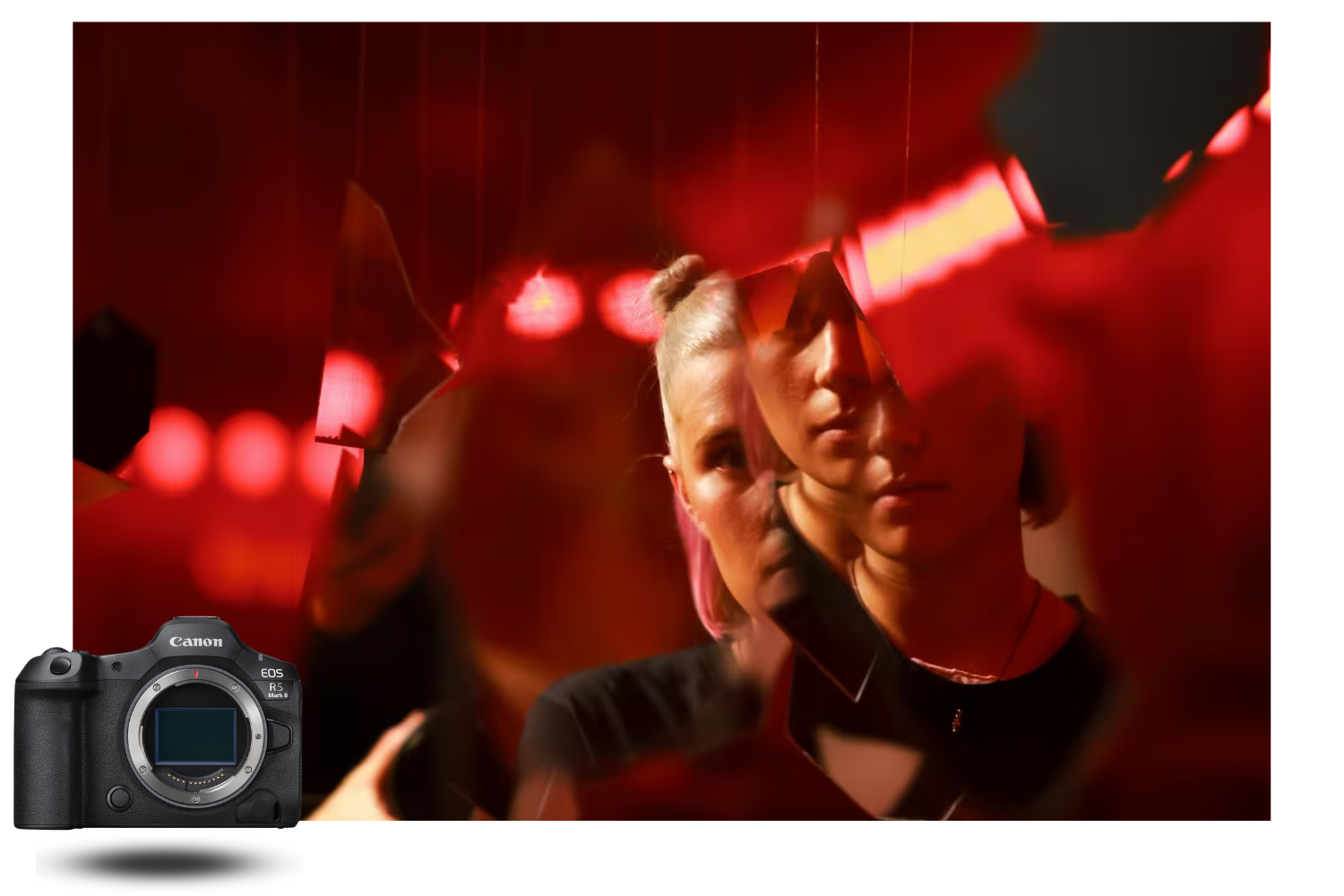
Best lenses for macro
Macro is a discipline where the R5 Mark II's 45 megapixels truly shine: every detail of an insect, a flower or a piece of jewellery is reproduced with astonishing precision. The body's neural upscaling feature can also quadruple image resolution in-camera during post-processing, turning macro files into near-scientific study material. To make the most of this resolution, you need dedicated macro lenses with impeccable optics and stabilisation adapted to close-up work.
Canon RF 100mm f/2.8 L Macro IS USM — The macro benchmark
This is Canon's most advanced macro lens. The RF 100mm f/2.8 L Macro IS USM offers a 1.4× magnification ratio (greater than 1:1 life-size), meaning the subject appears larger than its actual size on the sensor. Sharpness is exceptional even at maximum aperture of f/2.8, and the hybrid IS stabilisation is specifically optimised for macro work (compensating for the forward-backward rocking motion typical of close-up shooting, not just conventional sway).
A unique feature of this lens: the SA (Spherical Aberration) control ring, which lets you progressively alter the character of the bokeh from soft to edgy. It's a creative tool unique to this lens — no other macro optic on the market offers it.
Beyond pure macro, the 100mm f/2.8 also doubles as an excellent portrait lens: the 100mm focal length delivers beautiful perspective compression, and the f/2.8 bokeh is very pleasant for isolating subjects from their background.
Available as a kit:Canon R5 Mark II + RF 100mm f/2.8 L Macro IS USM
Best for: macro photography, product shots, jewellery, insects, creative portraiture.
Canon RF 35mm f/1.8 Macro IS STM — The accessible macro option
For those who want to explore macro without investing in the 100mm L, the RF 35mm f/1.8 Macro IS STM is an excellent entry point. Its 0.5× magnification ratio (half life-size) doesn't allow true macro, but it's sufficient for flowers, food photography and everyday objects. The f/1.8 aperture also makes it a good general-purpose lens for street and daily use. Compact and lightweight (305 g), it's a lens you take everywhere without a second thought.
Built-in IS stabilisation is a welcome bonus for handheld macro work, and the STM motor ensures silent autofocus suited to video. It's not an L-series lens, but the value for money is excellent as an introduction to the macro world.
Best for: casual macro, food photography, everyday objects, street photography, accessible budgets.
The Canon RF Holy Trinity: the complete pro kit
The "Holy Trinity" refers to the three f/2.8 L zooms that together cover the entire useful focal range from 15 to 200mm. It's the benchmark kit for professional photographers:
RF 15-35mm f/2.8 L IS USM — Wide-angle for landscapes, architecture, interiors.
RF 24-70mm f/2.8 L IS USM — Standard for portraits, reportage, weddings, video. Available as a kit with the R5 Mark II.
RF 70-200mm f/2.8 L IS USM — Telephoto for sports, telephoto portraits, events. Available as a kit with the R5 Mark II.
Owning this trinity means being ready for 95% of photographic situations with high-end optical quality and a constant f/2.8 aperture across the entire range. The complete set weighs approximately 2.3 kg (without the body) — a reasonable weight for a professional kit. The constant f/2.8 aperture ensures reliable low-light performance and pleasing bokeh at every focal length.
For videographers, Canon now offers an alternative to the classic trinity with the RF 24-105mm f/2.8 L IS USM Z, which replaces the first two elements (24-70 + 70-105) in a single f/2.8 optic. This cuts down on lens changes during a shoot — a key point for maintaining fluid video workflows. Available as a kit with the R5 Mark II.
Best third-party alternatives in RF mount
Canon kept its RF mount closed to third parties for a long time, but since 2023-2024, Sigma, Tamron and Viltrox have been offering native RF-mount optics of very respectable quality. These alternatives provide access to professional optical quality at more contained prices, or cover focal-length niches that Canon doesn't address directly (such as Tamron's 50-400mm super-zoom). Third-party lenses in native RF mount are fully compatible with all R5 Mark II features, including subject tracking, Eye Control AF and pre-capture. Here are the three options that deserve your attention.
Sigma 24-70mm f/2.8 DG DN II Art (RF mount) — The 24-70 challenger
The Sigma 24-70mm f/2.8 DG DN II Art is one of the sharpest standard zooms available, regardless of brand. Its edge-to-edge resolution rivals Canon's RF 24-70mm f/2.8 L — and sometimes surpasses it in the corners — at a significantly lower price. Autofocus is fast and compatible with the R5 Mark II's subject tracking. The build is solid, weather-sealed, with an alloy barrel. The compromise: it's slightly heavier than the Canon, and there's no built-in IS (you rely solely on the R5 Mark II's IBIS). For photographers who want maximum sharpness at a controlled budget, it's a serious contender.
Best for: sharpness-obsessed photographers, controlled budgets, reportage, landscapes.
Tamron 50-400mm f/4.5-6.3 Di III VC VXD (RF mount) — The clever super-zoom
The Tamron 50-400mm f/4.5-6.3 is an unusual lens that fills a gap in the Canon RF catalogue: the 50-400mm range lets you cover portraits (50-85mm), medium-distance sports (200mm) and accessible wildlife (400mm) with a single lens. Optical quality is surprisingly good for a super-zoom of this amplitude, and the weight of 1,155 g remains reasonable. It's not L-series sharpness, but for the photographer who wants to travel light with one do-everything optic, it's a remarkable choice.
Best for: travel, safari, all-terrain photographers who want a single lens.
Viltrox 85mm f/1.8 RF — The ultra-accessible portrait option
At a fraction of the Canon RF 85mm f/1.2 L's price, the Viltrox 85mm f/1.8 in native RF mount delivers surprisingly strong optical quality. Centre sharpness is excellent from f/1.8, bokeh is pleasant, and autofocus works reliably with the R5 Mark II's subject tracking. Build quality is more modest (no weather sealing), and AF is somewhat slower than a Canon L lens. But for portrait photographers starting out or looking for a lightweight second lens, the value for money is unbeatable.
Best for: budget portrait work, second portrait lens, beginners.
Quick-reference selection by use case
| Use case | Top pick | Alternative |
|---|---|---|
| Pro portrait | RF 85mm f/1.2 L USM | RF 50mm f/1.2 L USM |
| Budget portrait | RF 50mm f/1.8 STM | Viltrox 85mm f/1.8 RF |
| Landscape | RF 15-35mm f/2.8 L IS USM | RF 14-35mm f/4 L IS USM |
| Travel all-rounder | RF 24-105mm f/4 L IS USM | RF 24-240mm f/4-6.3 IS USM |
| Sports / events | RF 70-200mm f/2.8 L IS USM Z | RF 70-200mm f/2.8 L IS USM |
| Wildlife / birding | RF 100-500mm f/4.5-7.1 L IS USM | RF 200-800mm f/6.3-9 IS USM |
| Video (zoom) | RF 24-105mm f/2.8 L IS USM Z | RF 24-70mm f/2.8 L IS USM |
| Video (prime) | RF 35mm f/1.4 L VCM | RF 50mm f/1.4 L VCM |
| Pro macro | RF 100mm f/2.8 L Macro IS USM | RF 35mm f/1.8 Macro IS STM |
| Complete wedding kit | RF 24-70mm f/2.8 + RF 70-200mm f/2.8 | RF 24-105mm f/2.8 L IS USM Z (alone) |
Our recommended kits: R5 Mark II + lens
Buying a body-plus-lens kit often works out cheaper than purchasing separately, and you're ready to shoot straight out of the box. Here are the main Canon R5 Mark II kits available on MCZ Direct:
Versatile kit:R5 Mark II + RF 24-105mm f/4 L IS USM — The most popular choice. A versatile lens covering wide-angle to portrait, ideal for getting started with the R5 Mark II or for travel.
Sports/events kit:R5 Mark II + RF 70-200mm f/2.8 L IS USM — For sports, wedding and event photographers who need reach and speed.
Pro video kit:R5 Mark II + RF 24-105mm f/2.8 L IS USM Z — The ultimate combo for the professional videographer who wants one lens to cover everything.
Macro/portrait kit:R5 Mark II + RF 100mm f/2.8 L Macro IS USM — For photographers specialising in macro, product shots or creative portraiture.
Wildlife kit:R5 Mark II + RF 100-500mm f/4.5-7.1 L IS USM — The dedicated kit for wildlife and bird photography.
Cinema kit:R5 Mark II + RF 35mm f/1.4 L VCM — A cinematic prime ideal for documentary and content creation.
You can also find the Canon EOS R5 Mark II body only if you already own your RF lenses.
Frequently asked questions
Can I use my old Canon EF lenses on the R5 Mark II?
Yes. All Canon EF and EF-S lenses work on the R5 Mark II via the Canon EF-EOS R adapter, with no loss of image quality or autofocus speed. If you already own quality EF glass (especially L-series lenses), you can continue using them while gradually investing in native RF optics.
What's the best first lens for the Canon R5 Mark II?
The RF 24-105mm f/4 L IS USM. It's the most versatile, covers the vast majority of situations (landscapes, portraits, reportage, travel) and is available as a kit with the body at an attractive price. You can then add specialised primes or zooms based on your evolving needs.
Are third-party lenses (Sigma, Tamron) compatible with Eye Control AF and pre-capture on the R5 Mark II?
Yes, third-party lenses in native RF mount are fully compatible with all R5 Mark II features, including Eye Control AF, pre-capture and advanced subject tracking. Third-party EF lenses used via the adapter are also compatible, though autofocus may be slightly slower than with a native RF optic.
Which lens should I choose between the RF 70-200mm f/2.8 and the RF 100-500mm f/4.5-7.1 for wildlife?
The RF 100-500mm if your subject is typically far away (birds, wild animals). The RF 70-200mm f/2.8 if you shoot at medium distance (zoos, pets, sports) and need more light-gathering ability. Many wildlife photographers own both.
Conclusion: which lens should you choose for your Canon R5 Mark II?
The choice of lens depends above all on what you shoot. Here are our final recommendations summarised:
If you can only have one lens: the RF 24-105mm f/4 L IS USM. It's the most versatile, covers the broadest spectrum of situations and is available as a kit at an attractive price.
If you're primarily a videographer: the RF 24-105mm f/2.8 L IS USM Z. Nothing else on the market offers this combination of focal range, constant aperture and optical quality for video.
If you're a portrait photographer: the RF 85mm f/1.2 L USM. It's an investment, but it's the best portrait lens available, full stop.
If you're an action or wildlife photographer: the RF 70-200mm f/2.8 L IS USM for versatility, or the RF 100-500mm f/4.5-7.1 L IS USM for reach.
If you're a landscape photographer: the RF 15-35mm f/2.8 L IS USM or the RF 14-35mm f/4 L IS USM depending on your filter and aperture requirements.
Remember that a good lens is a long-term investment — bodies are renewed every 3-4 years, but a quality lens will serve you for decades. Invest first in the optic that matches your primary discipline, and build out your kit over time. The Canon EOS R5 Mark II is an exceptional camera. Give it the lenses it deserves, and it will repay you many times over in image quality.
Leave a comment