Shopping Cart
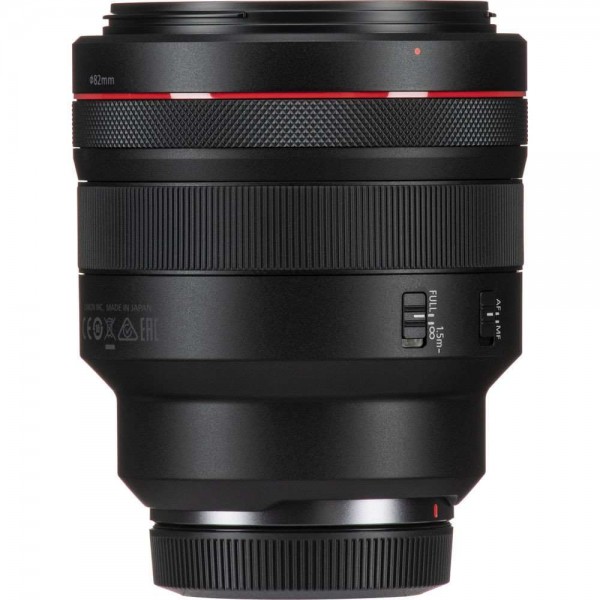
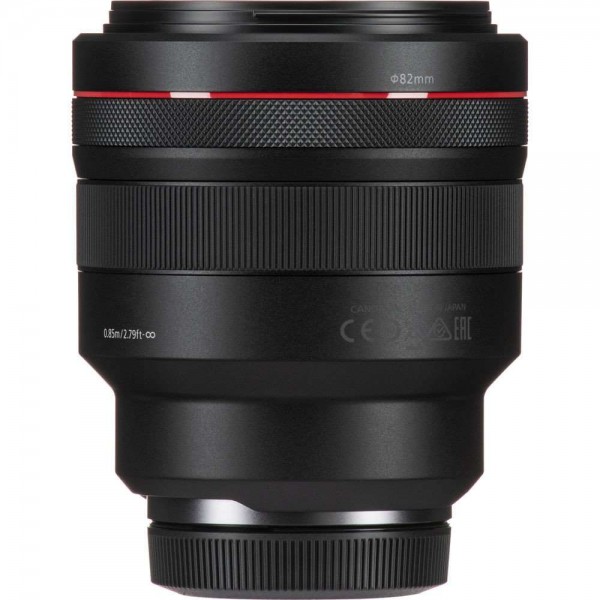
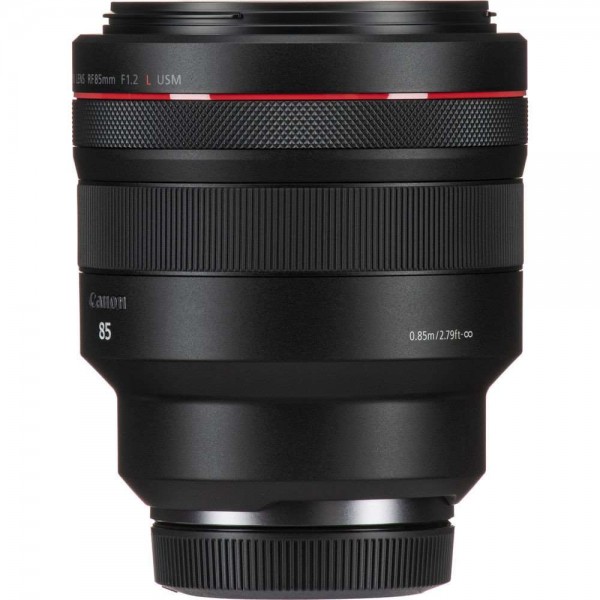
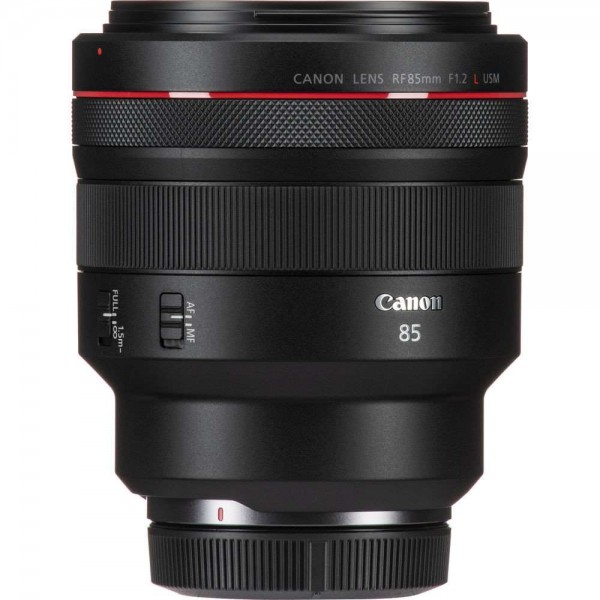
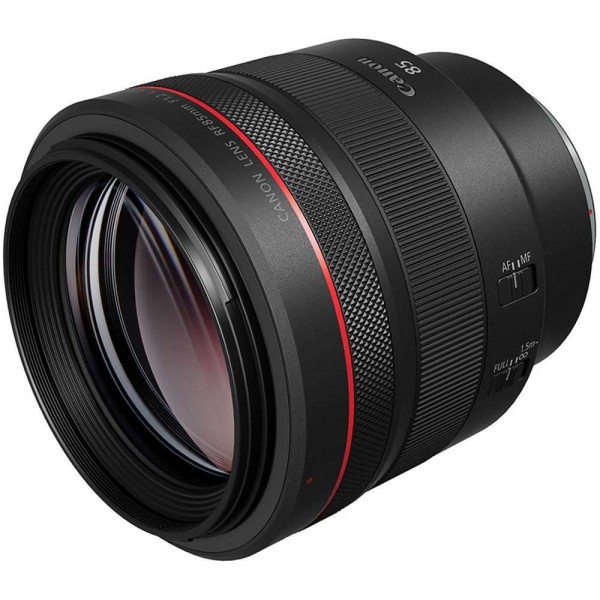
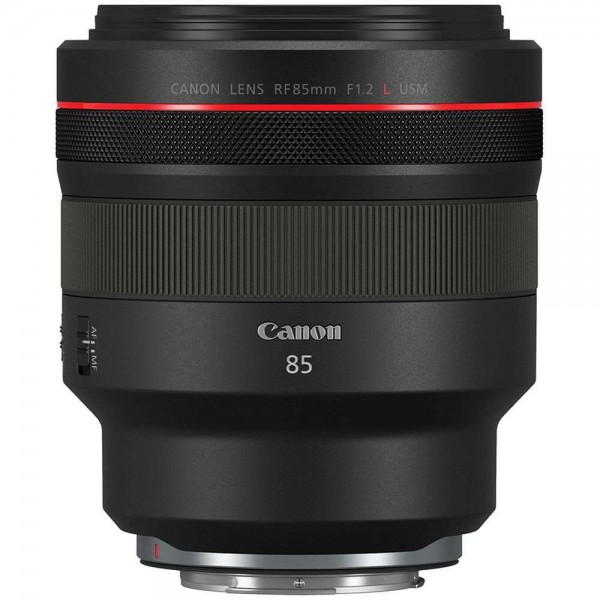
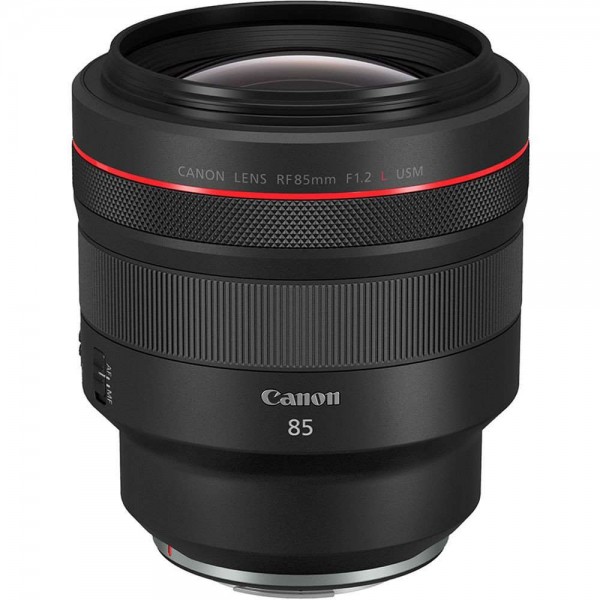
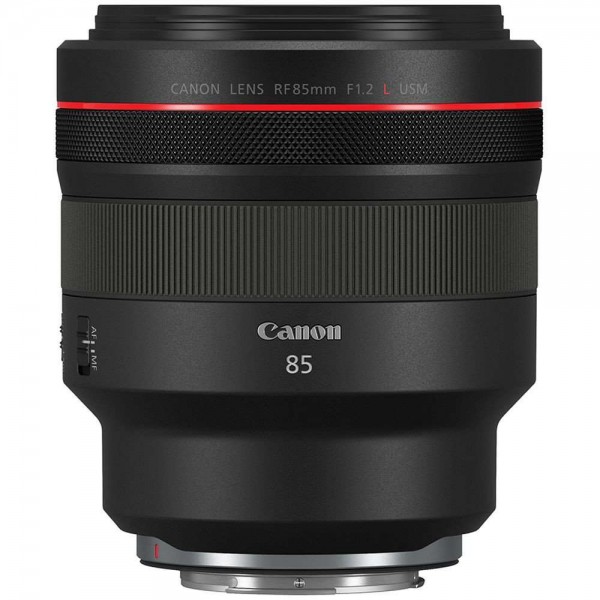


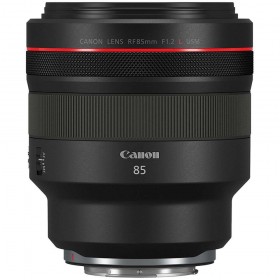



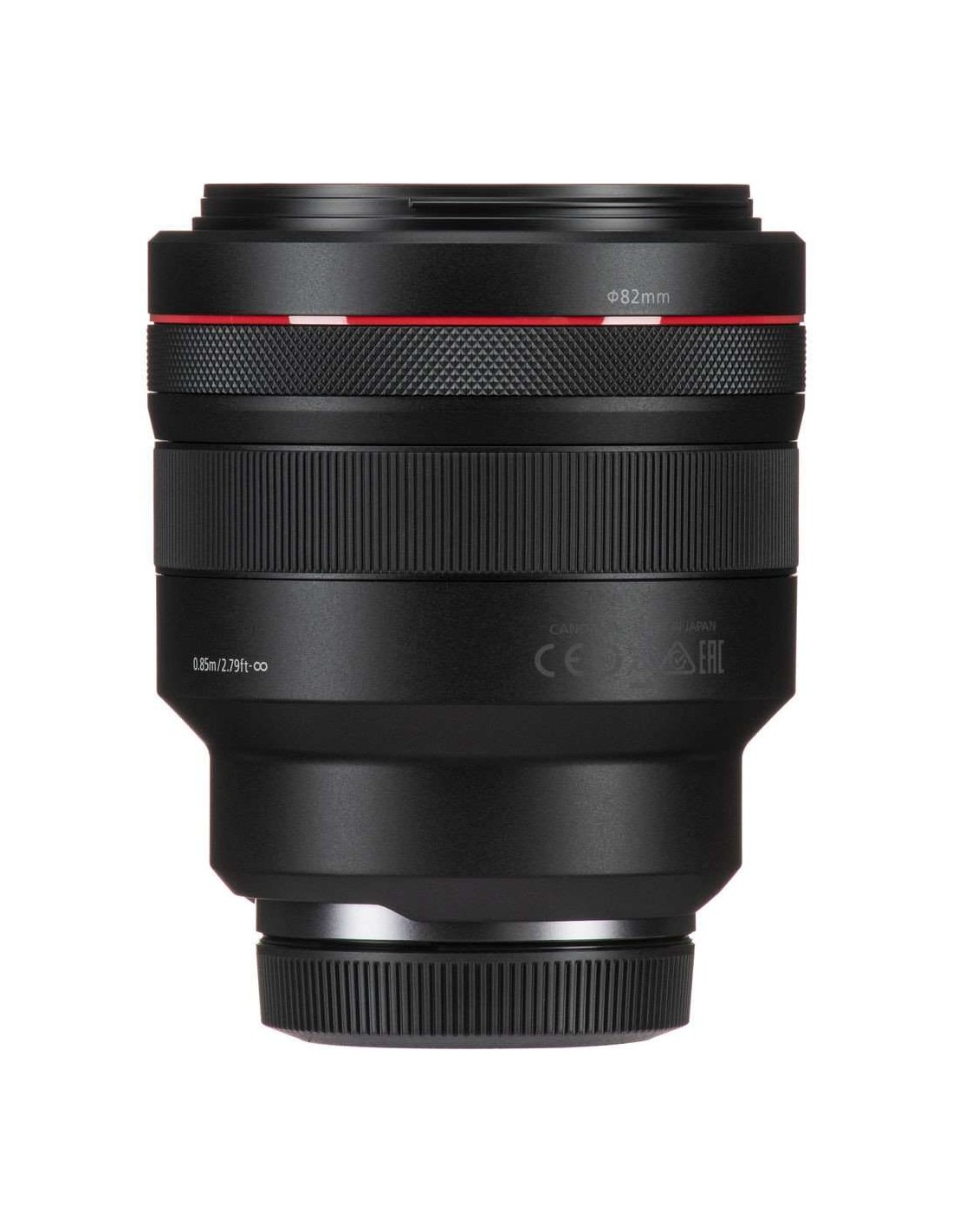


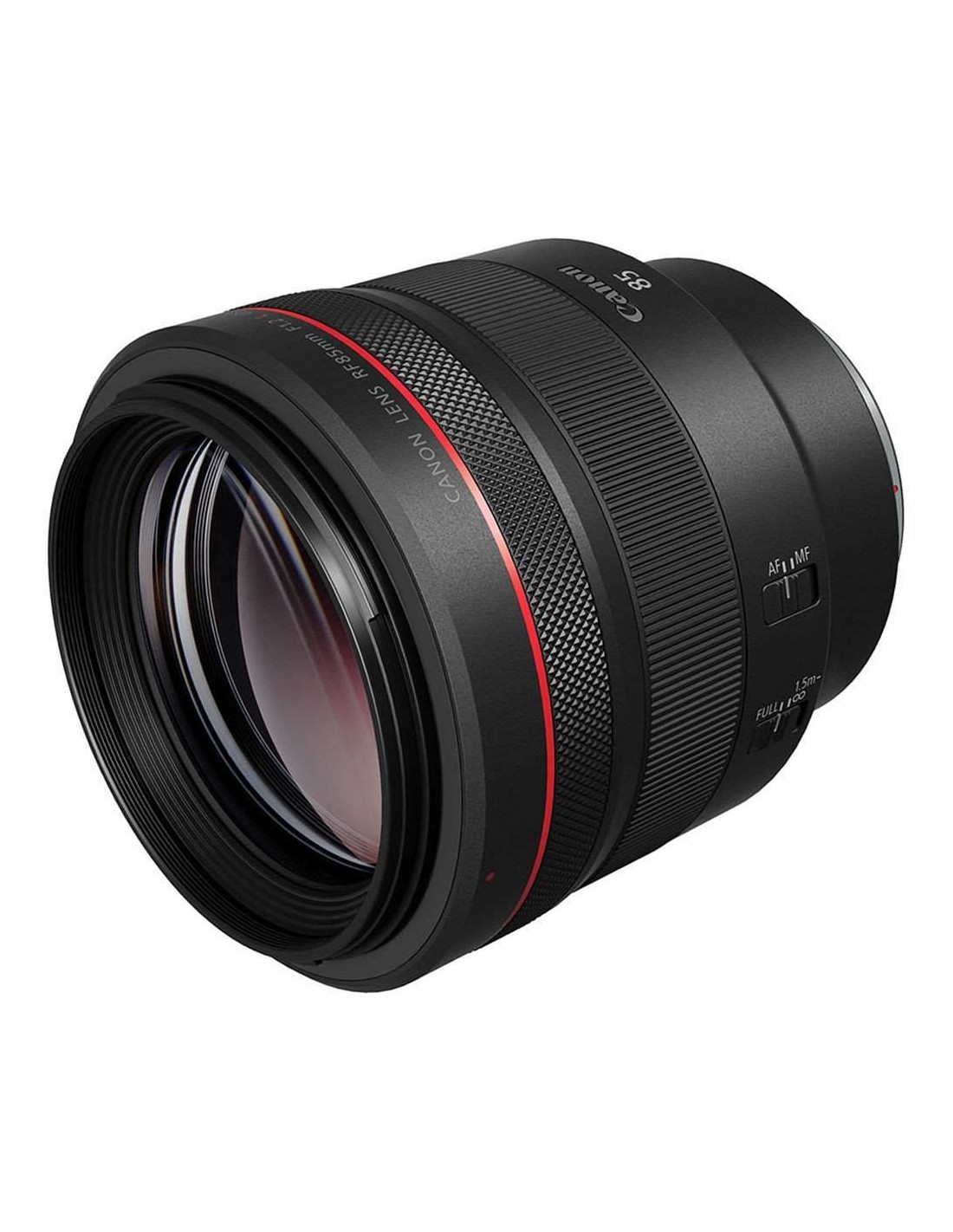
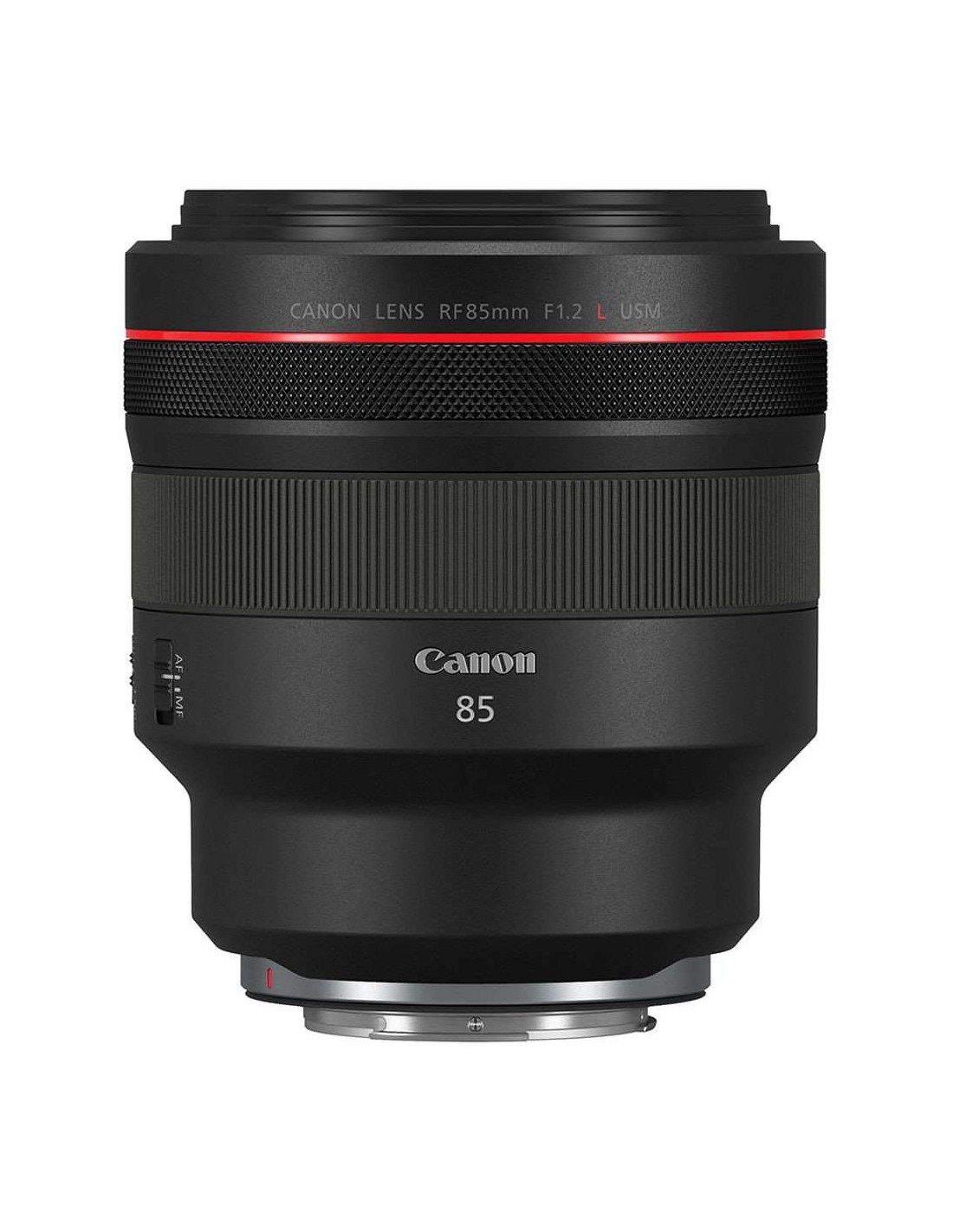

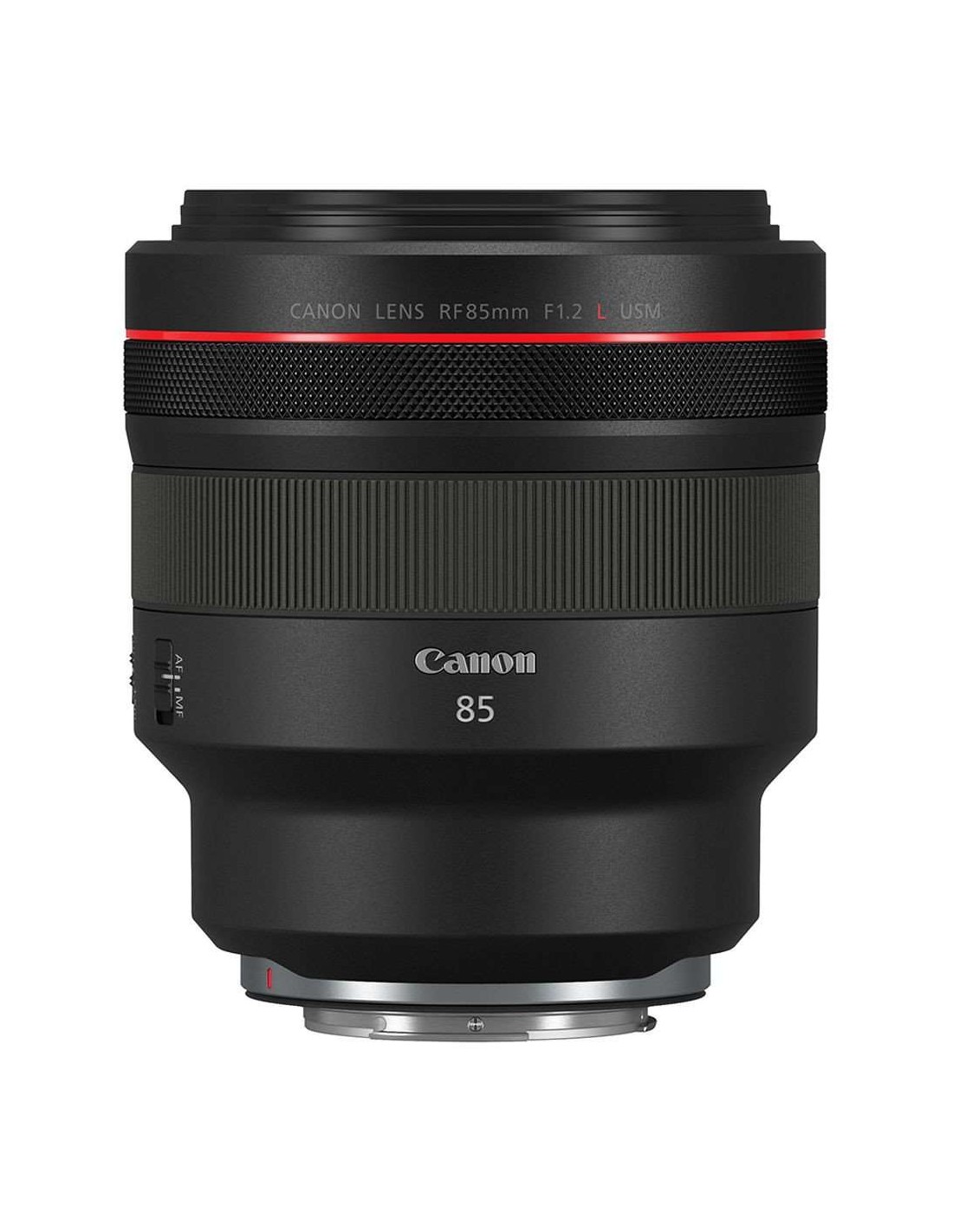

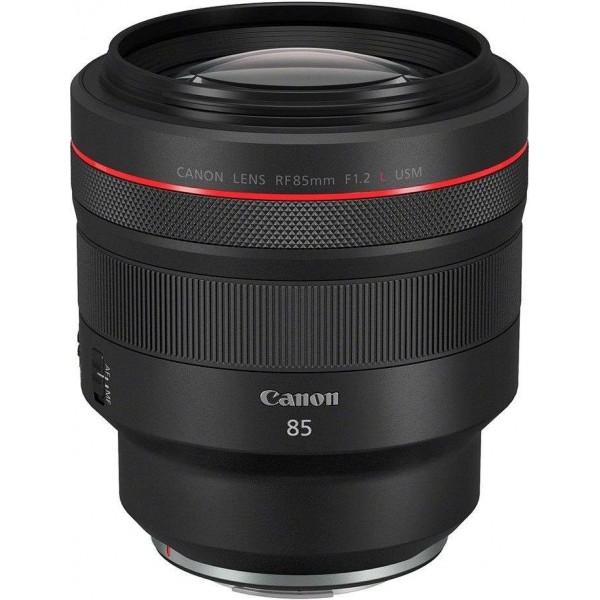
The Canon RF 85mm F1.2L USM is a professional portrait lens for Canon EOS R cameras, recommended for photographers who value strong subject separation, fine detail and a very wide aperture in available light. Its 85mm view gives faces a flattering perspective, while f/1.2 can simplify a busy background and preserve useful shutter speed as light falls. Ring USM supports accurate eye focusing and L-series construction suits demanding assignments. The trade-offs are substantial: it weighs 1,195g and has no optical stabilisation, so careful support and a well-balanced camera matter. It is a compelling choice when portrait rendering takes priority over a lightweight kit.
Combine compatible accessories and save. The more items you add, the bigger the discount.

memory card

warranty extension
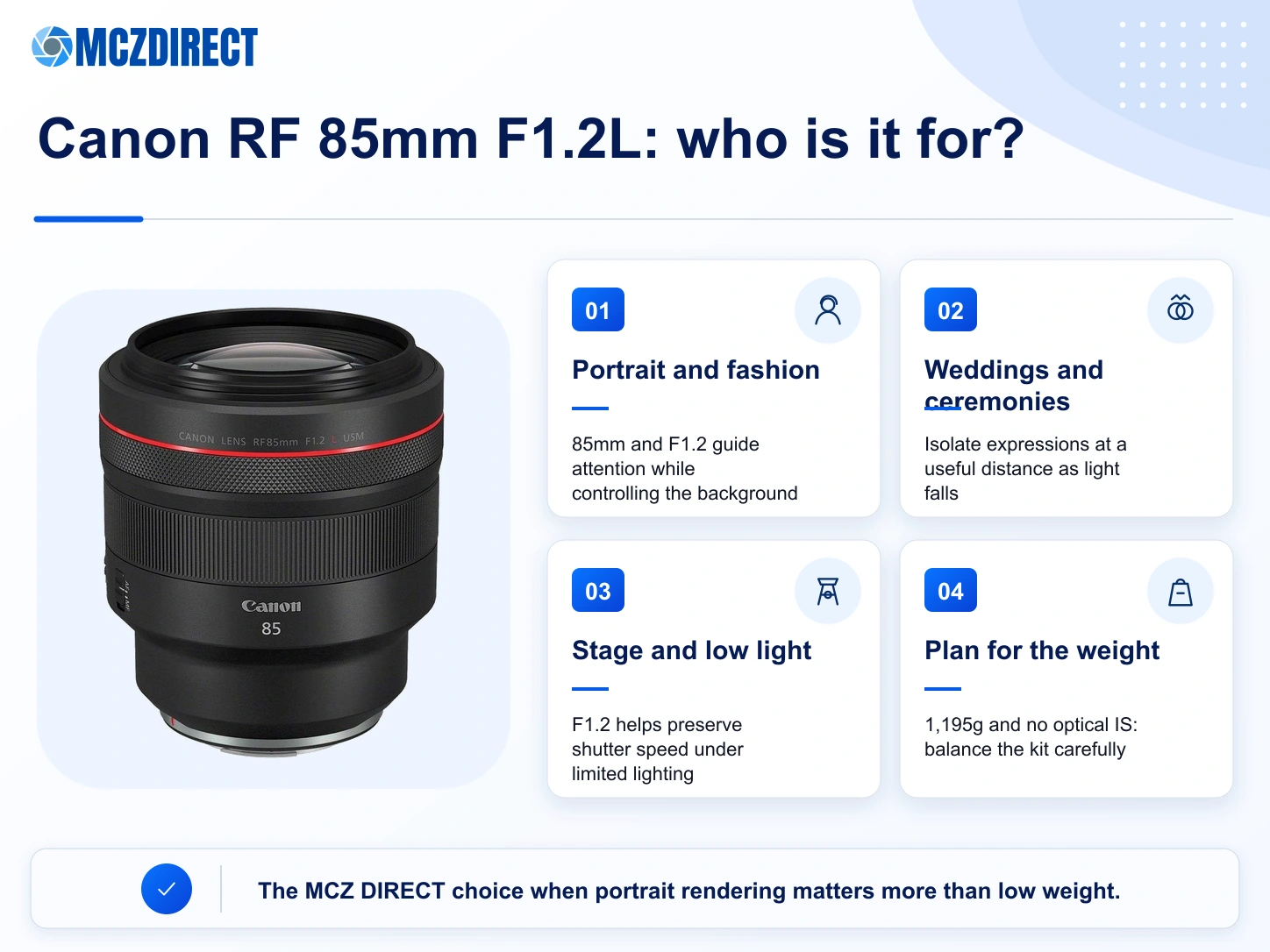
The Canon RF 85mm F1.2L USM is built for portrait, wedding and editorial photographers who want to separate a face without giving up fine detail. On full frame, 85mm provides a comfortable working distance and a flattering perspective for facial features. The f/1.2 aperture helps in low light, but its more distinctive contribution is the transition from a precisely focused eye to a quiet background. This look is not effortless. Depth of field becomes extremely shallow, the lens weighs 1,195g and there is no optical stabilisation. It is therefore a deliberate professional prime, chosen for the result it creates rather than for a small bag or casual walkaround use.
| Feature | Practical benefit | Consideration |
|---|---|---|
| 85mm on full frame | Maintain a comfortable distance and a flattering facial perspective | Framing becomes tight in a small room |
| F1.2 aperture | Simplify a busy background and preserve shutter speed as light falls | The in-focus zone becomes extremely shallow at close range |
| Ring USM | Acquire an eye or recover focus quickly between poses | Accuracy also depends on the camera, AF area and subject movement |
| 0.85m and 0.12x | Frame a face, hand, jewellery or clothing detail | This magnification does not replace a macro lens |
| 1,195g without optical IS | Supports an ambitious optical formula and L-series build | A supportive strap and substantial camera grip improve balance |
An 85mm lens lets the photographer fill the frame without moving uncomfortably close to the subject. That distance supports natural-looking facial proportions and gives the person more space, whether the portrait is directed or captured during a ceremony. It also makes a background easier to organise: stepping back and framing tighter removes distractions from the edges. Compared with 50mm, the practical difference is space. A fifty retains more context and works more easily indoors; the 85mm gives stronger control over the background but needs more working room.
| Photography | Why it suits the task | Working advice |
|---|---|---|
| Portrait and fashion | Flattering perspective, fine detail and controlled backgrounds | Focus on the nearest eye and check critical sharpness at f/1.2 |
| Wedding and ceremony | Isolate an expression from a respectful distance | Retain enough shutter speed for gestures and movement |
| Stage and low light | F1.2 helps preserve shutter speed under limited illumination | Camera IBIS cannot freeze a moving performer |
| Editorial portrait | Selective rendering and a rapid transition from eye to background | Choose the background and distance before relying on maximum aperture |
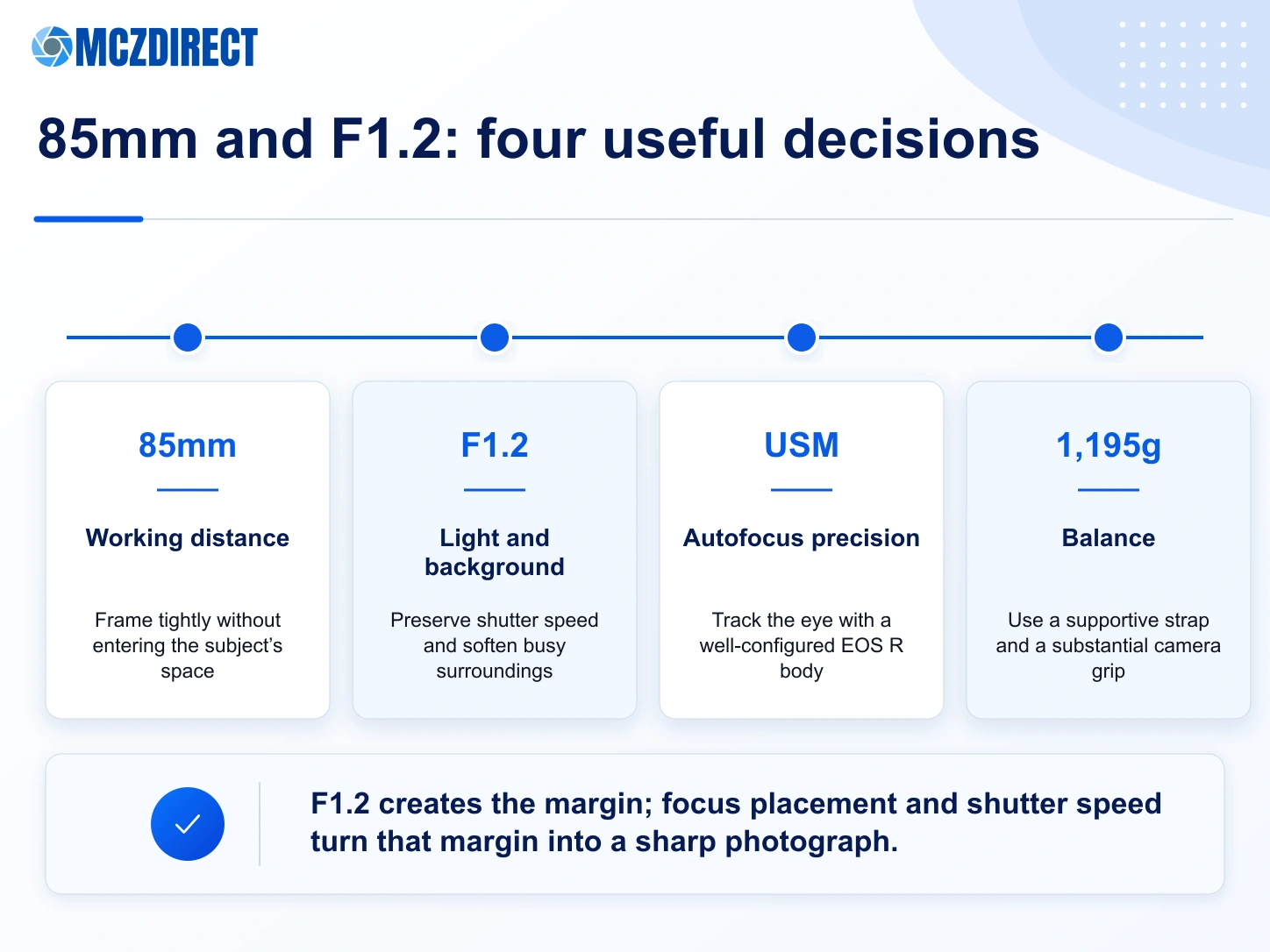
Wide open, the difference is not simply brightness. The RF 85mm F1.2 moves rapidly from sharp detail to blur, giving an eye considerable presence. At close distance, that focused plane is narrow enough for slight subject movement to shift sharpness towards eyelashes or hair. Eye detection, a short burst and regular image review are valuable. Stopping down to f/1.8 or f/2 does not defeat the purpose of the lens. It adds focus tolerance while retaining clear subject separation and a rendering that remains useful for professional portrait work.
Ring USM works with the people and eye-detection systems of an EOS R camera. A static portrait is straightforward, while a child, processional entrance or model walking towards the camera also tests the camera’s tracking settings. The lens has no optical stabilisation. IBIS in a compatible body can reduce photographer movement but cannot stop subject motion. Weight is the other practical issue. At 1,195g, the lens feels more naturally balanced on an EOS R5 Mark II or EOS R6 Mark III than on a very small body, although RF-mount compatibility is unchanged.
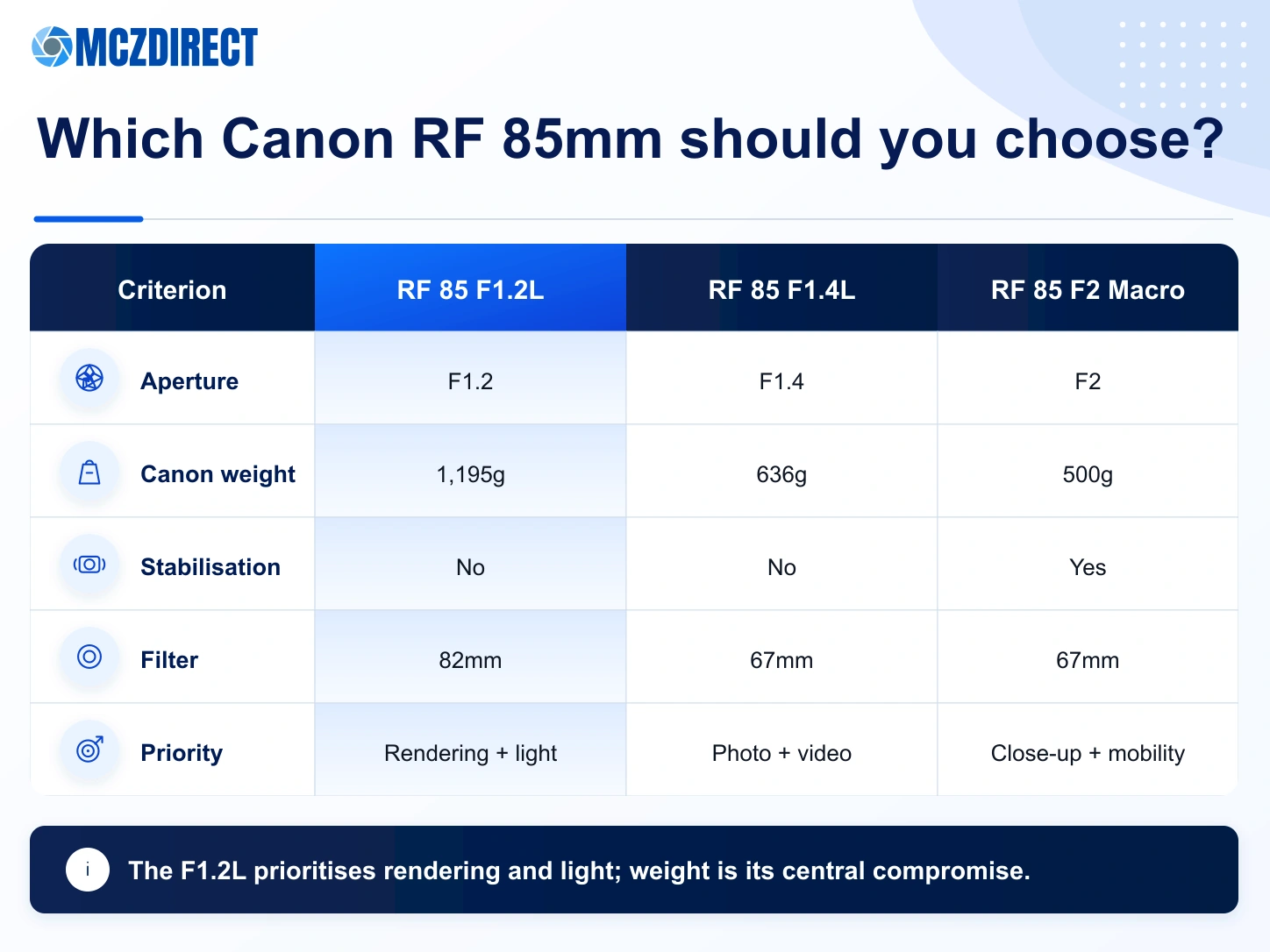
| Lens | Choose it when | Main compromise |
|---|---|---|
| RF 85mm F1.2L USM | Maximum aperture, rendering and available-light work come first | 1,195g and no optical stabilisation |
| RF 85mm F1.2L USM DS | Smoother edges around out-of-focus highlights justify a highly specialised version | Reduced transmission wide open and a benefit most visible in certain backgrounds |
| RF 85mm F1.4L VCM | A lighter L-series 85mm balanced for stills and video is more useful | F1.4 rather than f/1.2 |
| RF 85mm F2 Macro IS STM | Low weight, optical stabilisation and close focusing matter more | Less ambitious construction and maximum aperture |
This product is the standard Canon RF 85mm F1.2L USM, without Defocus Smoothing. The DS version adds a coating designed to soften the edges of out-of-focus highlights. That can suit creative portraits with bright points in the background, but it reduces transmission at wide apertures. The standard model is therefore the more versatile choice when available-light performance matters as much as bokeh. The two lenses share focal length and nominal aperture, yet they should not be treated as interchangeable products.
On a Canon EOS R7 or R10, the RF 85mm frames like approximately 136mm on full frame. This tighter view can work well for headshots, stage photography and subjects captured from farther away. It becomes difficult for a full-length portrait in a typical room. Mechanical and electronic compatibility remain complete, but the combination should be chosen for its long portrait angle rather than as a lighter substitute for full frame.
The RF mount works across the Canon EOS R range. The EOS R5 Mark II suits detailed portrait, fashion and files intended for cropping. An EOS R6 Mark III creates a balanced wedding and event kit, while the EOS R8 reduces body weight but leaves the lens dominating handling. For more environmental context, the RF 50mm F1.2L USM is the natural alternative. Other active focal lengths are collected under Canon RF lenses.
At MCZ DIRECT, we see the Canon RF 85mm F1.2L USM as the choice for a portrait or wedding photographer who builds an image around the eye, available light and the transition into blur, rather than the universal 85mm for someone prioritising a light bag. Within Canon’s RF range, it makes most sense when f/1.2 has a genuine creative and practical purpose.
Against the RF 85mm F1.4 L VCM, we recommend it when the extra aperture and rendering justify a substantially heavier combination. Against the RF 85mm F2 Macro, it trades general versatility for high-end portrait capability. Its limits are clear: 1,195g, no optical stabilisation and depth of field that demands precision wide open. For the photographer willing to work within those constraints, it remains a distinctive lens.

It is mainly for portrait, wedding, fashion and event photographers who want a very wide aperture, flattering perspective and L-series construction.
Yes. Its 85mm full-frame view provides comfortable working distance, while f/1.2 can separate a face strongly from the background.
Yes, especially for portraits, ceremonies and available-light scenes. Its 1,195g weight should be considered over a full assignment.
It gathers more light and creates very shallow depth of field. It can simplify a busy background but demands precise focusing.
It is designed for use at f/1.2. Results also depend on focus accuracy, distance, subject movement and the part of the frame being assessed.
Ring USM is responsive, but tracking also depends on the camera, eye detection, selected AF area and subject trajectory.
No. It has no optical stabilisation. IBIS in a compatible body can reduce photographer movement, but not subject motion.
It becomes noticeable over a full day. A supportive strap and camera with a substantial grip improve balance considerably.
The standard lens prioritises light transmission and versatility. The DS further softens certain out-of-focus highlights, with reduced transmission wide open.
The F1.2 prioritises maximum aperture and rendering. The F1.4 L VCM is lighter and more explicitly designed for hybrid stills and video.
The F1.2 targets high-end portrait rendering and light. The F2 Macro is lighter, stabilised and better suited to close-up work.
On the APS-C EOS R7, it frames approximately like a 136mm lens on full frame. That suits tight portraits but needs working room.