

Shopping Cart


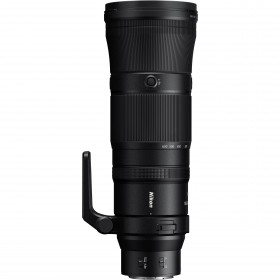
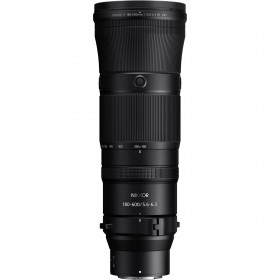



The NIKKOR Z 180-600mm f/5.6-6.3 VR is a full-frame super-telephoto zoom for bird, wildlife, aviation and outdoor sports photographers who regularly need long reach. We recommend it when 400mm is no longer enough and subject distance changes during a session. Internal zoom moves quickly from 180 to 600mm without extending the barrel, while optical VR helps settle the viewfinder during careful tracking. Nikon Z teleconverters can provide occasional extra reach when light and atmosphere permit. Its weight of nearly two kilograms and f/6.3 maximum aperture at 600mm require a suitable carrying method, solid support when waiting and adequate light outdoors. It is a coherent practical field choice today for framing distant subjects without committing to a highly specialised prime lens.
Combine compatible accessories and save. The more items you add, the bigger the discount.
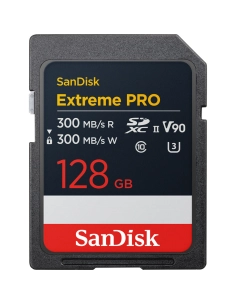
memory card

warranty extension
The NIKKOR Z 180-600mm f/5.6-6.3 VR addresses a recurring problem: a subject still looks small at 400mm. The additional 200mm changes the frame for birds, distant wildlife and aircraft without requiring a fixed focal length.
Internal zoom keeps balance consistent, VR settles the view and 180mm helps locate the subject. In return, nearly two kilograms and f/6.3 at 600mm require planning for support and light. This lens prioritises having reach available throughout the outing.
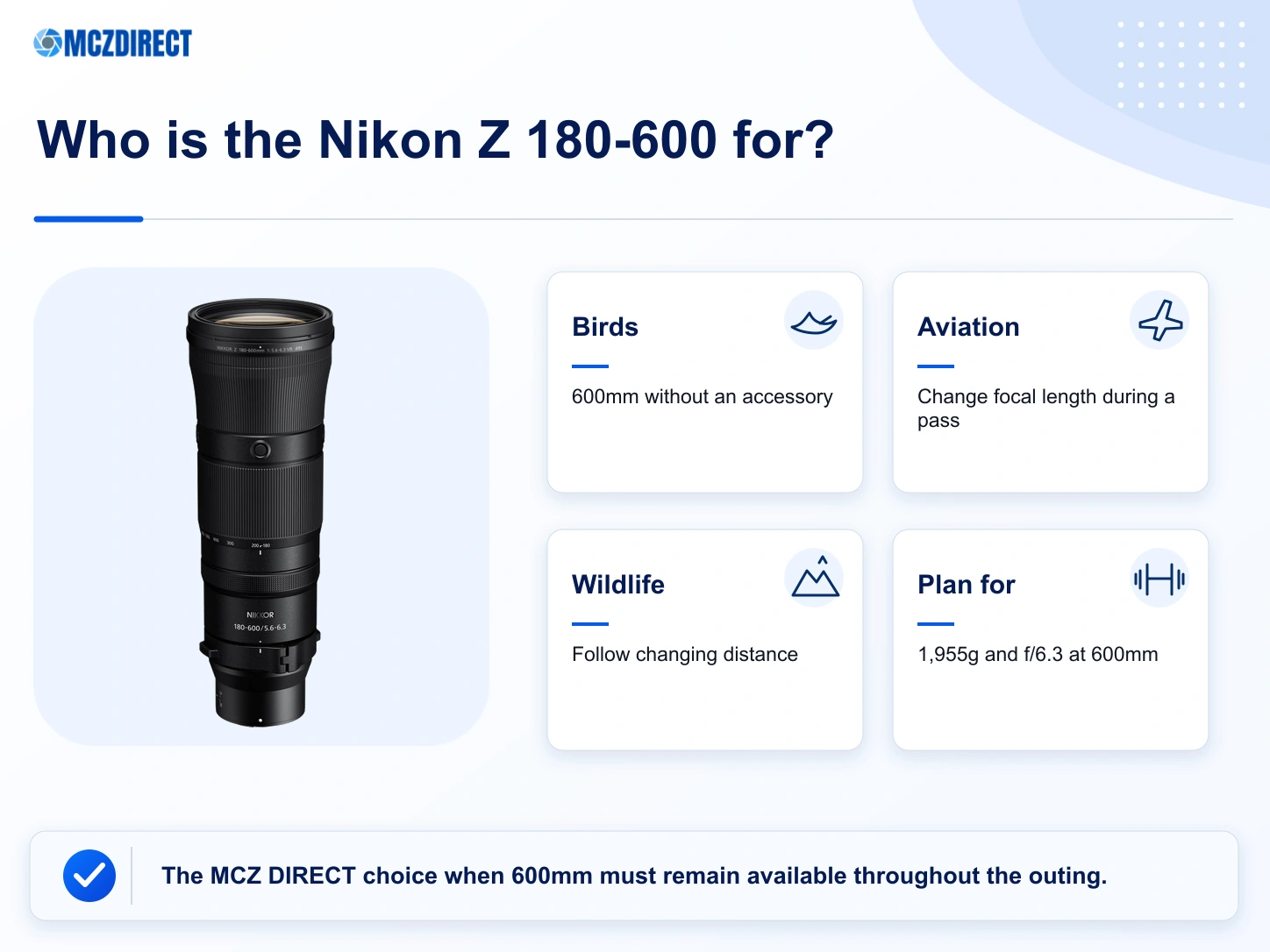
At 180mm, a bird is easier to locate and can be shown in habitat. At 600mm, the frame isolates the subject and records more detail. That change is essential when distance varies within one sequence.
VR steadies the view but cannot stop wings, running wildlife or vehicles. Shutter speed must match movement, and f/6.3 at 600mm means watching ISO as light falls.
| Specification | Practical benefit | Plan for |
|---|---|---|
| 180-600mm | From acquisition to a very tight frame | Starts longer than a 100-400 |
| Internal zoom | Stable balance and rapid reaction | Still a large system |
| 5.5-stop VR | Calmer view and help with still subjects | Cannot stop the subject |
| 1,955g without collar | Build for long reach | Support helps during waiting |
| f/6.3 at 600mm | Reach in an accessible zoom | Higher ISO in low light |
| Assignment | What the lens provides | Useful reservation |
|---|---|---|
| Birds | 600mm without a converter | Prepare speed and AF tracking |
| Distant wildlife | Zoom follows changing distance | Heavy for long hikes |
| Aviation | 180 to 600mm through a pass | Heat may limit detail |
| Outdoor sport | Reach from the stands | Not ideal for a dark hall |
| Moon and detail | Converters reach 1,200mm | Atmosphere and support matter |
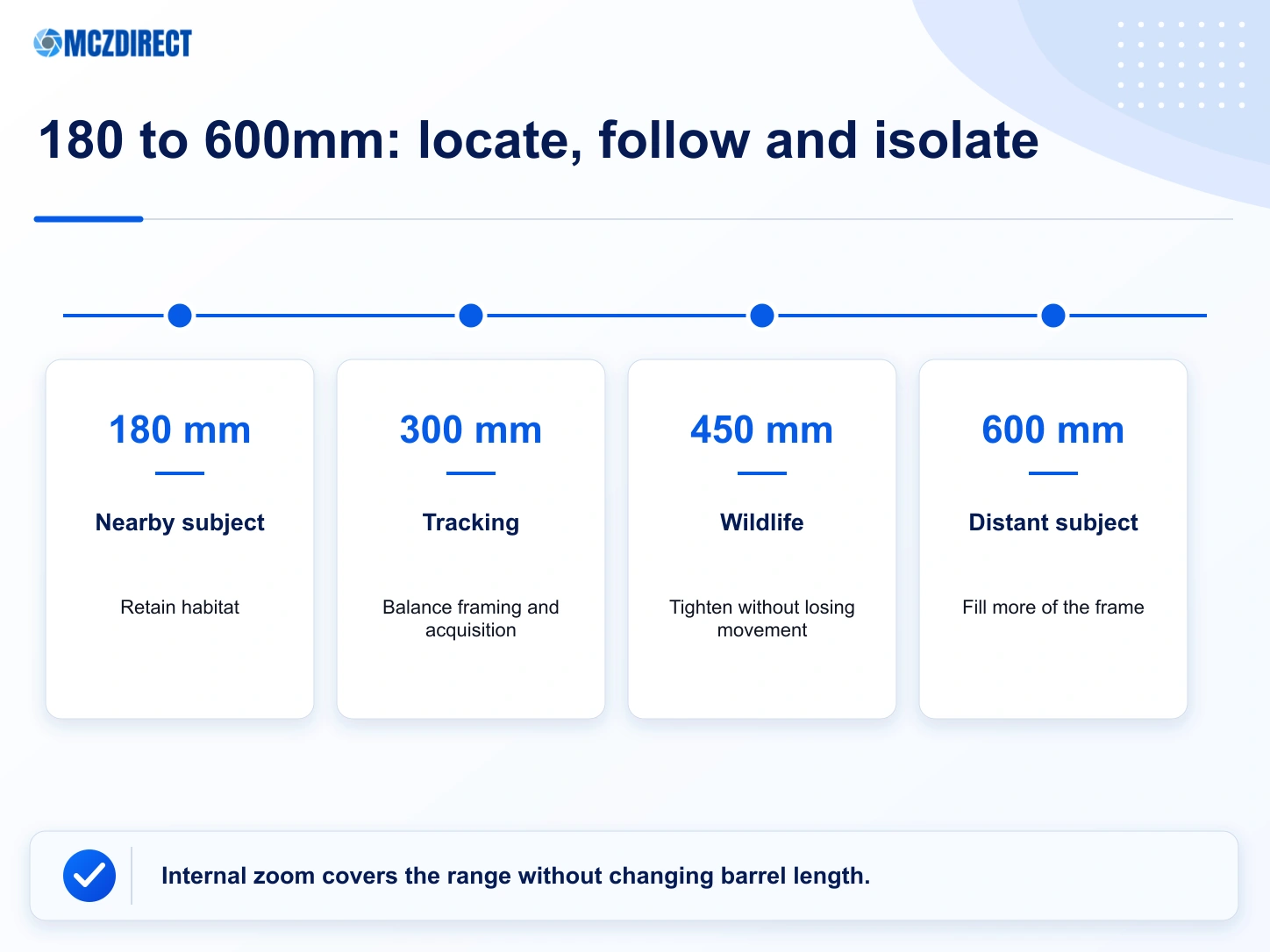
180 mm : nearby subject, retain habitat. 300 mm : tracking, balance framing and acquisition. 450 mm : wildlife, tighten without losing movement. 600 mm : distant subject, fill more of the frame.
Starting at 180mm makes a bird easier to find in the viewfinder and leaves enough habitat to understand its movement. Once tracking is established, the photographer can move through 400, 500 and 600mm without changing lenses. That flexibility matters when a bird takes off unexpectedly, approaches the hide or crosses a complicated background. It also keeps attention on behaviour instead of equipment.
At 600mm, technique remains decisive. Leave some room ahead of the flight path, choose an AF area that suits the background and use a shutter speed that matches the wings. VR steadies the view and reduces camera movement; it cannot stop the subject. A short, prepared burst often returns more usable frames than a long burst started after the critical moment.
The barrel does not extend as focal length changes. Balance therefore remains more consistent from 180 to 600mm, the front element does not move towards an obstacle and the zoom action is short. On a monopod, tripod, window support or in a hide, this makes reframing simpler and helps the camera remain ready. The benefit is practical rather than decorative.
Internal zoom does not make the lens light. It weighs about 1,955g without the collar and around 2,140g with it. Fatigue appears most during waiting, when the system must stay raised without making photographs. A monopod, gimbal head or bean bag can protect the shoulders. On a long walk, carrying method and access speed matter as much as the published weight.
Nikon rates vibration reduction at up to 5.5 stops under its test conditions. The immediate field benefit is a calmer view, making it easier to place the AF area on an eye or keep an aircraft in frame. With a still subject, VR can also support a slower shutter speed when posture and release technique are controlled.
For flight, sport or vehicles, shutter speed must still manage subject movement. VR does not replace 1/1600s or 1/2500s when the action demands it. It helps the photographer pan more smoothly and hold the composition. The selected mode should suit the movement because a panning aircraft and a perched bird require different stabilisation behaviour.
Maximum aperture changes from f/5.6 to f/6.3 through the range. In daylight this is a reasonable match for the reach and leaves room for fast shutter speeds. At dawn, beneath trees or late in the day, ISO rises sooner than it would with a 400mm f/2.8 or 600mm f/4. The bargain is clear: a very broad range and accessible system in exchange for a more modest aperture.
The lowest ISO is not always the correct priority. A slightly noisy file that is sharp on the eye and feathers is usually more valuable than a clean file with motion blur. Camera performance, RAW processing and final output size affect the margin. When light becomes too low, reducing focal length, waiting for a pause or adding support may work better than forcing an unrealistic shutter speed.
Minimum focus changes from about 1.3m at 180mm to 2.4m at 600mm. This can frame a nearby perched bird, an animal detail, a large flower or a texture without excessive movement. The telephoto perspective simplifies the background and can create a graphic image even when the subject is not extremely small.
This is not a macro lens. Tiny insects and controlled reproduction remain better served by a dedicated macro. Its strength is working distance for larger details that cannot be approached closely. At 600mm near minimum focus, depth becomes narrow, so stopping down slightly and choosing the essential plane improves clarity.
The 180-600mm range suits air displays, motorsport, surfing, athletics and action viewed from stands. At 180mm it can cover a formation or a close pass; at 600mm it isolates a distant aircraft, rider or brief phase. Internal zoom changes composition quickly without a major shift in balance.
Prepare AF area, shutter speed and drive mode before the pass. An excessively long starting focal length makes acquisition difficult, so beginning around 250 or 300mm and tightening can be safer. The f/6.3 long-end aperture is at home outdoors. For dark indoor sport at medium distance, a 70-200mm f/2.8 is normally the more appropriate tool.
The Z 1.4x converter creates a 252-840mm range and the 2x produces 360-1,200mm. This may help with a small bird, the moon or a subject that cannot be approached. It also reduces maximum aperture and asks more of light, atmosphere and focus. Across great distances, heat shimmer and haze may limit detail before focal length does.
Cropping is simpler for an occasional need: it preserves aperture and avoids another accessory but reduces final resolution. A converter is more rational when the subject is repeatedly too small and the camera retains enough light for reliable operation. Decide from the subject size in real files, not only from the attraction of a 1,200mm headline.
The NIKKOR Z 100-400mm f/4.5-5.6 VR S is smaller, lighter and starts wider. It fits hiking, compressed landscapes, larger nearby wildlife and days when 600mm would be rare. The 180-600 adds 200mm without a converter and reduces lens changes, making it more direct for birds, aviation and subjects that remain distant.
A fast 400mm f/2.8 or 600mm f/4 prime gathers far more light and offers a different optical ceiling, with a very different size and budget. The 180-600 prioritises flexible coverage. It is especially coherent when distance changes and the photographer wants to work for hours without building the whole system around one focal length.
The lens is only one part of a long-lens setup. A camera with reliable subject detection helps, but card speed, battery capacity and an appropriate support also influence the session. Long bursts fill cards quickly and reviewing every sequence in the field consumes power. Before leaving, set file format, release mode and autofocus behaviour for the intended subject rather than relying on a general-purpose camera configuration.
Fit the hood, check the collar tension and decide where the strap will carry the system. If using a tripod, confirm that the head supports the complete weight and still moves smoothly. Keep a cloth and rain cover accessible rather than buried below other equipment. These details do not improve the lens specification, but they determine whether 600mm is ready when the subject appears.
At 600mm, atmospheric conditions become part of the optical system. Heat above a road, water or field bends light and can soften detail even with perfect focus. Early morning often provides cleaner air, while moving a few metres away from a warm surface can improve results. A teleconverter magnifies the same atmospheric disturbance, so more reach is not always the solution.
Use a hood, avoid shooting through glass when possible and compare short sequences rather than judging one frame. On a support, disable any setting that produces unwanted movement and use a release method suitable for the camera. Fine detail comes from the combination of stable air, correct focus, enough shutter speed and careful processing. The lens provides reach, but the photographer still protects the path between subject and sensor.
Bird and sport sessions can create thousands of similar frames. Use bursts around a meaningful change in wing position, expression or direction rather than holding the shutter continuously. This reduces card pressure and makes selection more accurate. A fast card helps the camera clear its buffer, but disciplined timing remains the most effective storage tool.
After the session, keep a consistent backup before deleting near-duplicates. Compare focus on the eye, body position and background, then choose the frame that best explains the action. The reach of 600mm records subtle differences; an organised selection process ensures those differences are not buried inside an oversized sequence.
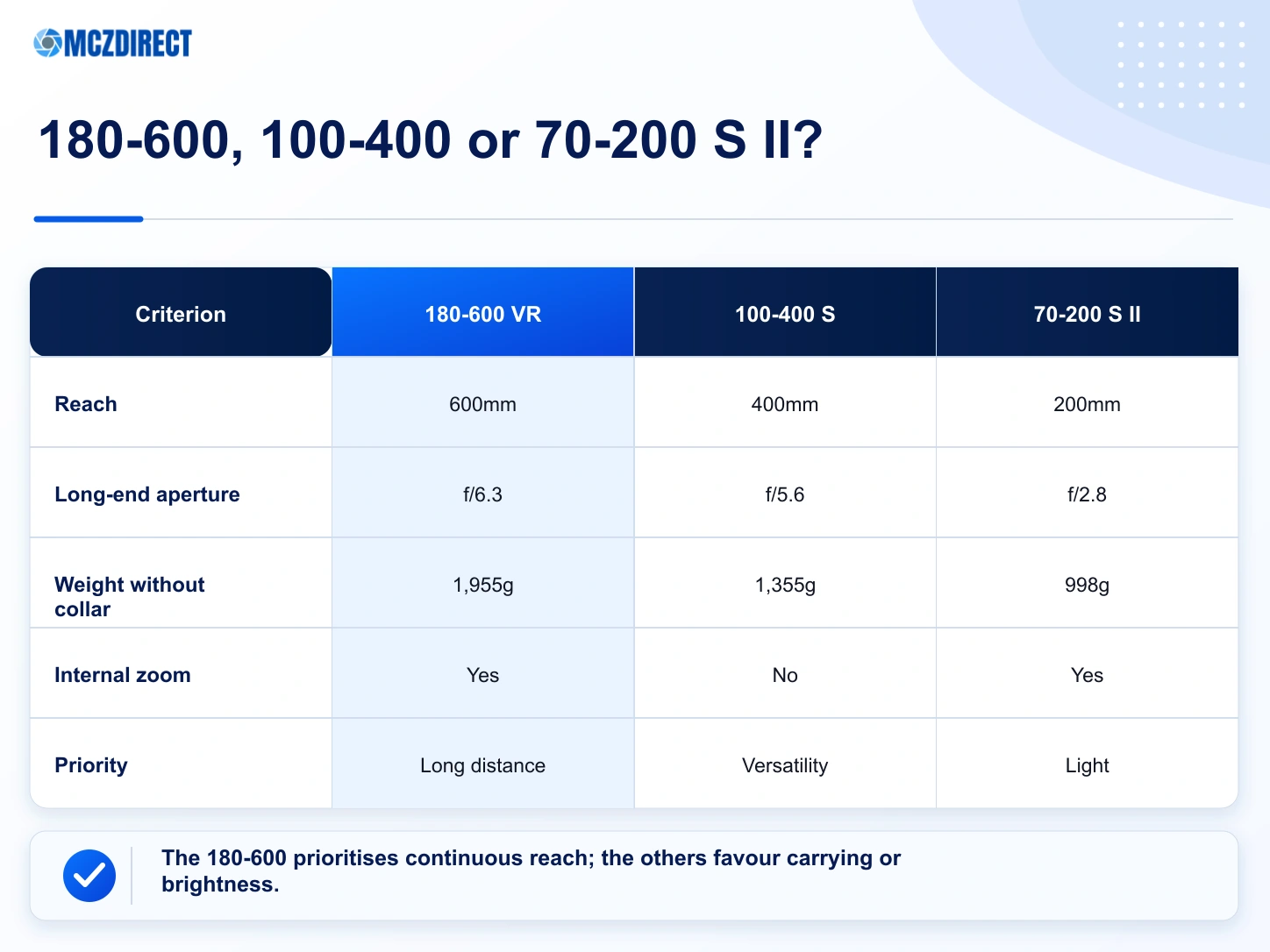
The 100-400 S is lighter, smaller and begins at 100mm. It is better for long hikes and subjects that may approach. The 180-600 is stronger when birds and aircraft remain too small at 400mm.
The 70-200 f/2.8 is much brighter for indoor sport, weddings and portraits but offers only one third of the maximum reach. Distance and light should decide the choice.
| Criterion | 180-600 VR | 100-400 S | 70-200 S II |
|---|---|---|---|
| Reach | 600mm | 400mm | 200mm |
| Long-end aperture | f/6.3 | f/5.6 | f/2.8 |
| Weight without collar | 1,955g | 1,355g | 998g |
| Internal zoom | Yes | No | Yes |
| Priority | Long distance | Versatility | Light |
At MCZ DIRECT, we recommend the NIKKOR Z 180-600mm f/5.6-6.3 VR to photographers who often return with a subject still too small at 400mm. It is particularly convincing for birds, aviation and distant wildlife, with internal zoom that supports tracking.
We would choose the 100-400 for a versatile hike and the 70-200 f/2.8 for a dark venue. The honest limitations are weight and light: nearly two kilograms and f/6.3 at 600mm must suit the assignment. When they do, the range greatly reduces missed framing opportunities.

Generated by AI from customer reviews.
