Shopping Cart
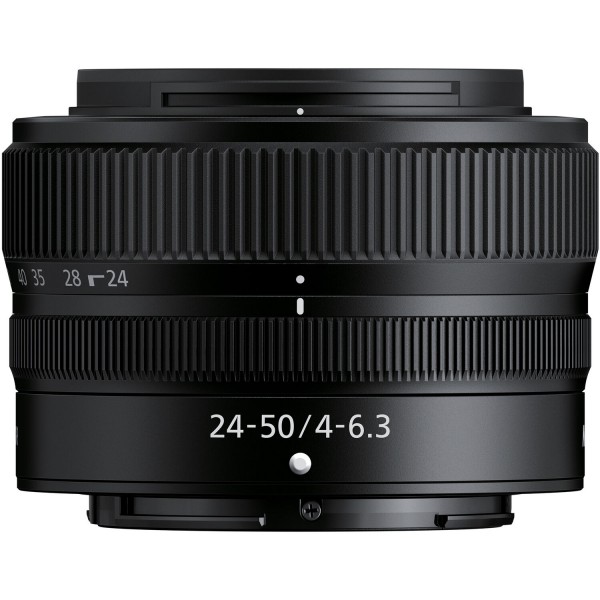
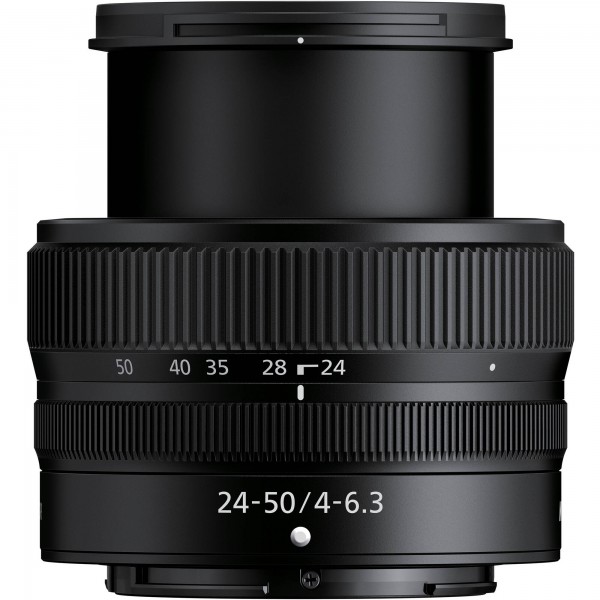
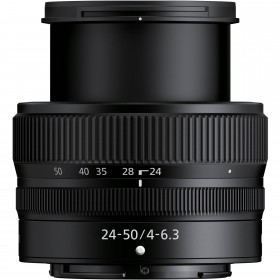
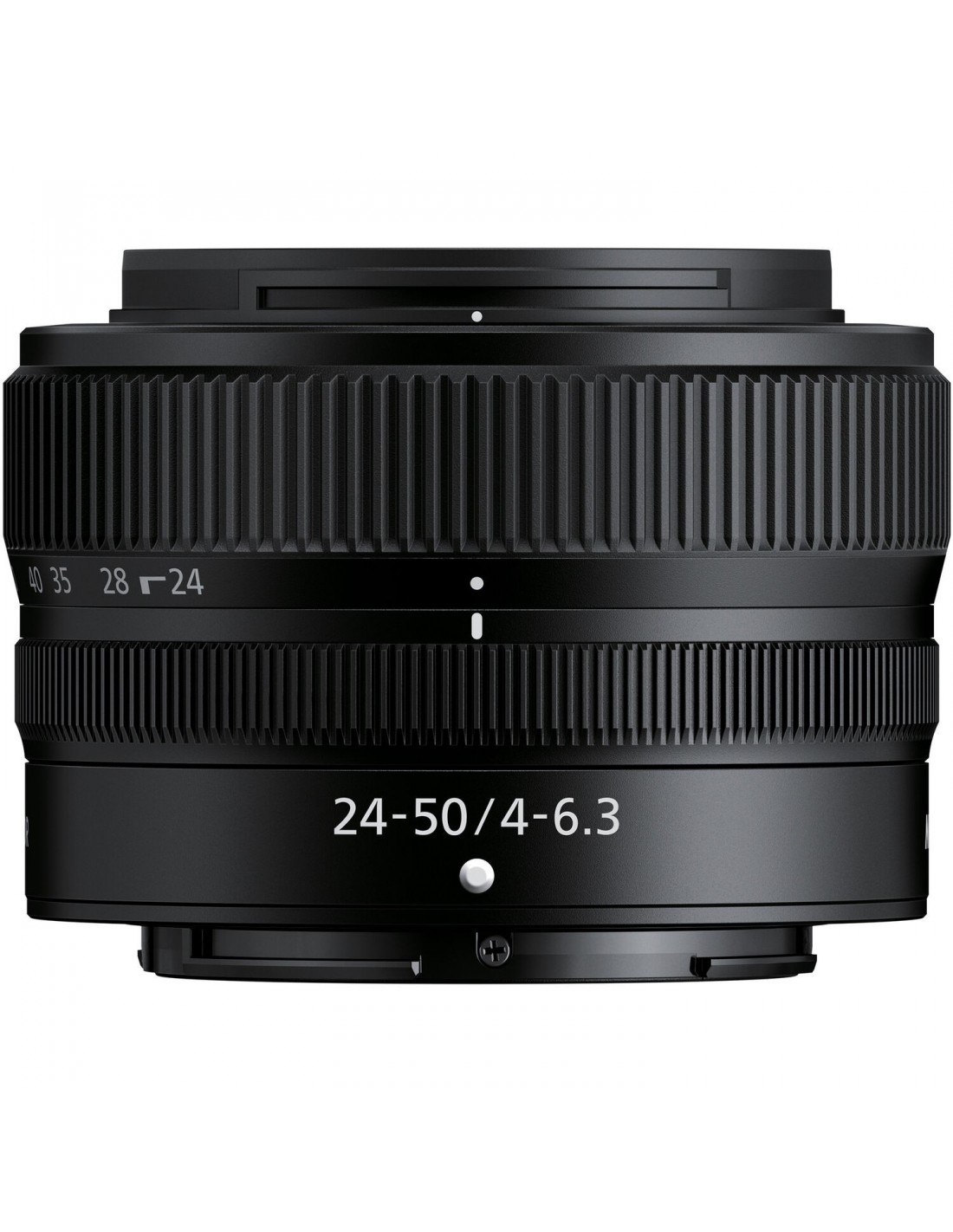

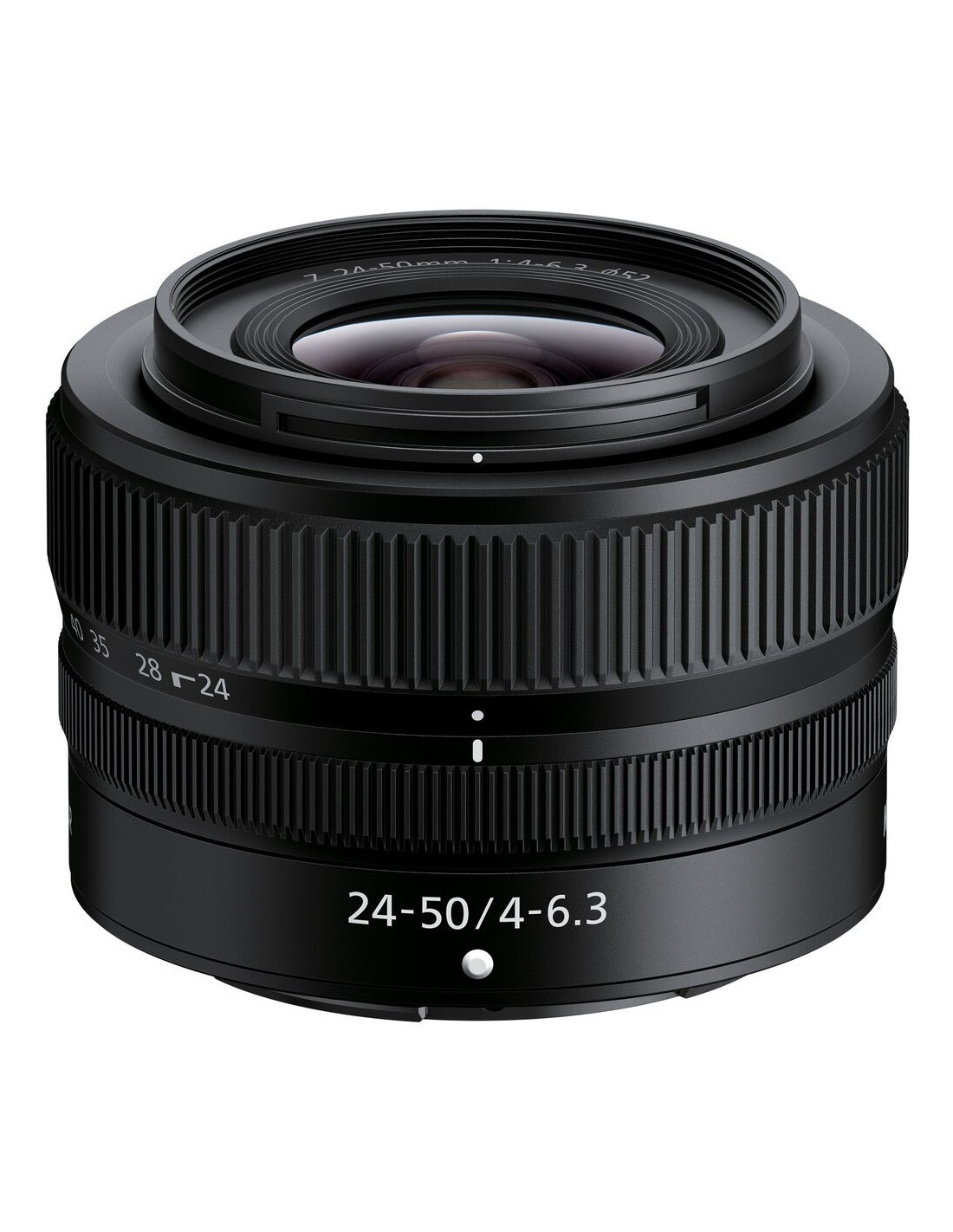

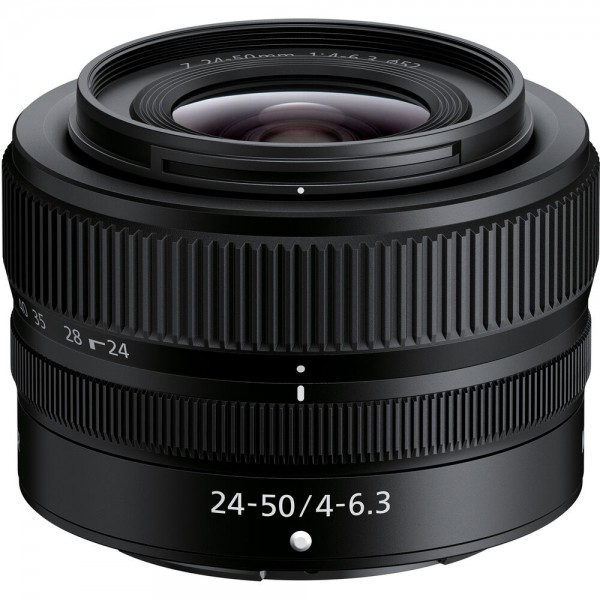
The NIKKOR Z 24-50mm f/4-6.3 is an ultra-compact full-frame zoom for Nikon Z photographers who want to travel light, and we recommend it when size matters more than long reach or a fast aperture. At 24mm it covers landscapes, streets and interiors. Between 35 and 50mm it suits everyday scenes, family pictures and environmental portraits. Its 195g weight and retractable design make a full-frame camera easier to carry throughout the day. Maximum aperture falls to f/6.3 at 50mm, so moving subjects in dim light require a higher ISO. This lens makes sense for photographers who want full-frame image quality in a kit they will actually take on a walk, a city break or a simple family outing. It also pairs naturally with a small, fast prime for evening pictures.
Combine compatible accessories and save. The more items you add, the bigger the discount.
memory card

warranty extension
The NIKKOR Z 24-50mm f/4-6.3 answers a practical question: what should stay on a full-frame Nikon Z when the camera needs to remain easy to carry? At 195g, with a barrel that retracts for storage, it keeps the complete kit close to the size people expect from a mirrorless camera.
Its range is shorter than a 24-70mm or 24-120mm zoom, yet it keeps the focal lengths used for places and everyday stories. Twenty-four millimetres describes a room or landscape, 35mm feels natural on the street and 50mm tightens a family scene. The trade-off is clear: portability takes priority over reach and low-light speed.
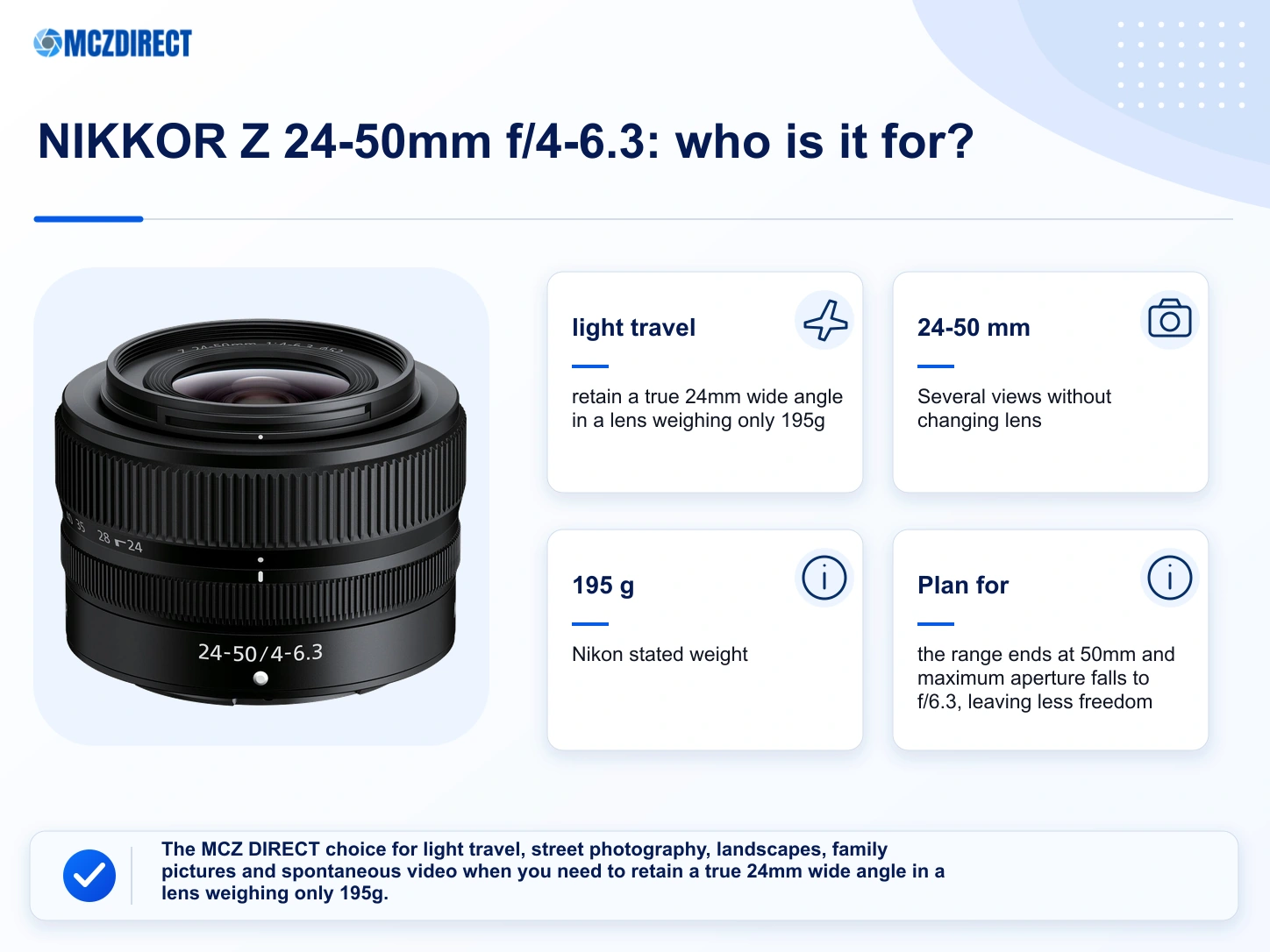
On a Nikon Z5 II, Z6 III or Zf, the combination remains discreet and balanced. That matters after several hours and makes the camera more likely to leave the hotel or the house. The retractable mechanism only requires the lens to be extended before shooting, which soon becomes part of the routine.
Outdoors in daylight, the variable aperture is rarely restrictive. Indoors, in-body stabilisation can help with a still room or a cooperative person, but it cannot freeze a child in motion. Protecting shutter speed then means accepting a higher ISO or changing to a faster lens.
| Specification | Practical benefit | Plan for |
|---|---|---|
| 24-50 mm | retain a true 24mm wide angle in a lens weighing only 195g | the range ends at 50mm and maximum aperture falls to f/6.3, leaving less freedom with moving subjects in low light |
| f/4-6.3 | A compact kit with exposure adapted to focal length | Shutter speed must follow subject movement |
| 195 g | A realistic load for the intended work | Include the camera and accessories |
| 0.35 m | Photograph detail without another lens | 0.17x is not true macro |
| No optical VR | A simpler compact design | Stabilisation never freezes subject movement |
| Assignment | What the lens provides | Useful reservation |
|---|---|---|
| light travel | 24-50 mm | the range ends at 50mm and maximum aperture falls to f/6.3, leaving less freedom with moving subjects in low light |
| street photography | 195 g and native mount | Choose shutter speed before relying on stabilisation |
| Landscape and city | Wide to tight framing in one lens | Check the short-end field of view |
| Portrait and detail | Focus from 0.35 m | Background depends on distance and aperture |
| Video | Discreet autofocus and predictable framing | Test support, shutter and AF transition |
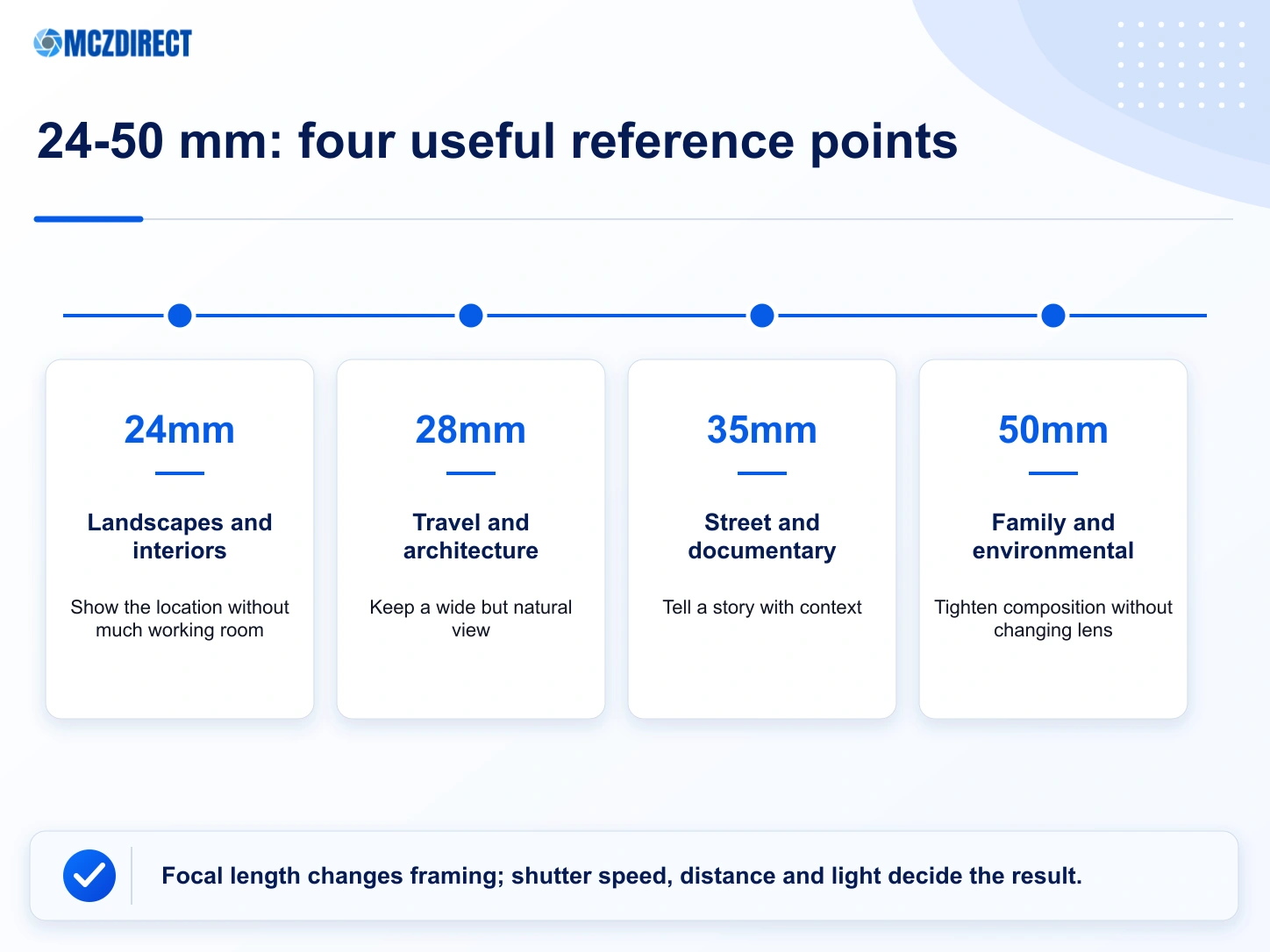
24mm : landscapes and interiors, show the location without much working room. 28mm : travel and architecture, keep a wide but natural view. 35mm : street and documentary, tell a story with context. 50mm : family and environmental portraits, tighten composition without changing lens.
At 24mm, the NIKKOR Z 24-50mm f/4-6.3 can describe a room, a street or a landscape before drawing attention to one detail. It is particularly useful when there is little room to step back. People near the edge can look stretched, so keeping faces away from the corners and holding the camera level matters. Careful position normally produces a cleaner result than relying on perspective correction later.
Around 35mm, the view feels natural for street and documentary pictures. At 50mm, it tightens a family scene, expression or object without becoming a true telephoto. The short range encourages the photographer to move and commit to a viewpoint. That simplicity can be liberating on a walk. It is less suitable for someone who frequently moves from a wide scene to a distant subject and expects the lens to bridge that entire gap.
A stated weight of 195g is not a small paper advantage. On a Z5 II, Z6 III or Zf, it keeps the complete outfit comfortable for a city break, a family afternoon or a full day on foot. The barrel retracts for storage and must be extended before the camera can shoot. That extra turn soon becomes routine, and the reward is a lens that occupies remarkably little space when packed.
This size also changes what else needs to go in the bag. For daylight travel, the camera, 24-50 and a spare battery may be enough. A small fast prime is a sensible addition for evening work. Carrying another heavy overlapping zoom would undermine the reason for choosing this lens. Its value appears when the photographer wants the camera ready more often, rather than a bag capable of answering every possible assignment.
Maximum aperture narrows from f/4 to f/6.3 through the zoom range. This is rarely troublesome outdoors in good light. Indoors or at dusk, it forces a choice between shutter speed and ISO. In-body stabilisation on a compatible camera can help with architecture or a cooperative subject, but it cannot freeze a child, a gesture or a person walking through the frame.
In those situations, protecting shutter speed and accepting some noise is normally the safer decision. A modern Nikon Z file gives useful room for careful noise reduction, while motion blur cannot be recovered. A fast prime remains the better tool for receptions, stage work or strongly separated portraits. The 24-50 is honest about its purpose: portability comes first, and low-light speed is the compromise that makes the small design possible.
Starting at 24mm separates this lens from compact options that begin with a narrower view. It can fit a building into the frame from across a street, show a hotel room without standing against the wall and place a strong foreground into a landscape. Keeping the body level helps control converging verticals. Leaving a little room around important edges also makes later perspective adjustment less destructive.
The 52mm filter thread keeps polarisers and neutral-density filters small. A polariser can manage reflections, although its effect across a wide blue sky may look uneven at 24mm. For long exposures, a tripod gives more consistent framing than stabilisation alone. Because the lens is so light, a photographer can allocate more of the carrying budget to that support without making the overall travel kit excessive.
A minimum focus distance of 0.35m throughout the range is useful for food, craft objects, flowers and architectural details. Maximum reproduction is 0.17x, so this remains close-up capability rather than macro. At 50mm, bringing the subject close and leaving space behind it can still soften the background despite the f/6.3 aperture.
Stopping down slightly describes a three-dimensional object more clearly, while maximum aperture can isolate one label or texture. A true NIKKOR Z MC is required for jewellery, tiny components or accurate small-subject reproduction. The 24-50 is better understood as a travel storytelling lens: it can move from the whole place to a meaningful detail without adding specialist equipment to the bag.
At 195g, the lens is easy to balance on a compact gimbal and less tiring for handheld travel clips. Its range covers establishing shots, street scenes, a presenter and moderate detail. Because maximum aperture changes with focal length, exposure can shift during a zoom in an automatic mode. Setting f/6.3 manually across the range keeps brightness consistent when a continuous zoom is important.
It is a strong match for short travel sequences and spontaneous content, not a substitute for a fast lens in a dark venue. The camera mode also matters. Electronic stabilisation or particular video formats may crop the field of view, making 24mm less wide than expected. Checking the actual frame before recording is more reliable than assuming the still-photo angle will be preserved in every video setting.
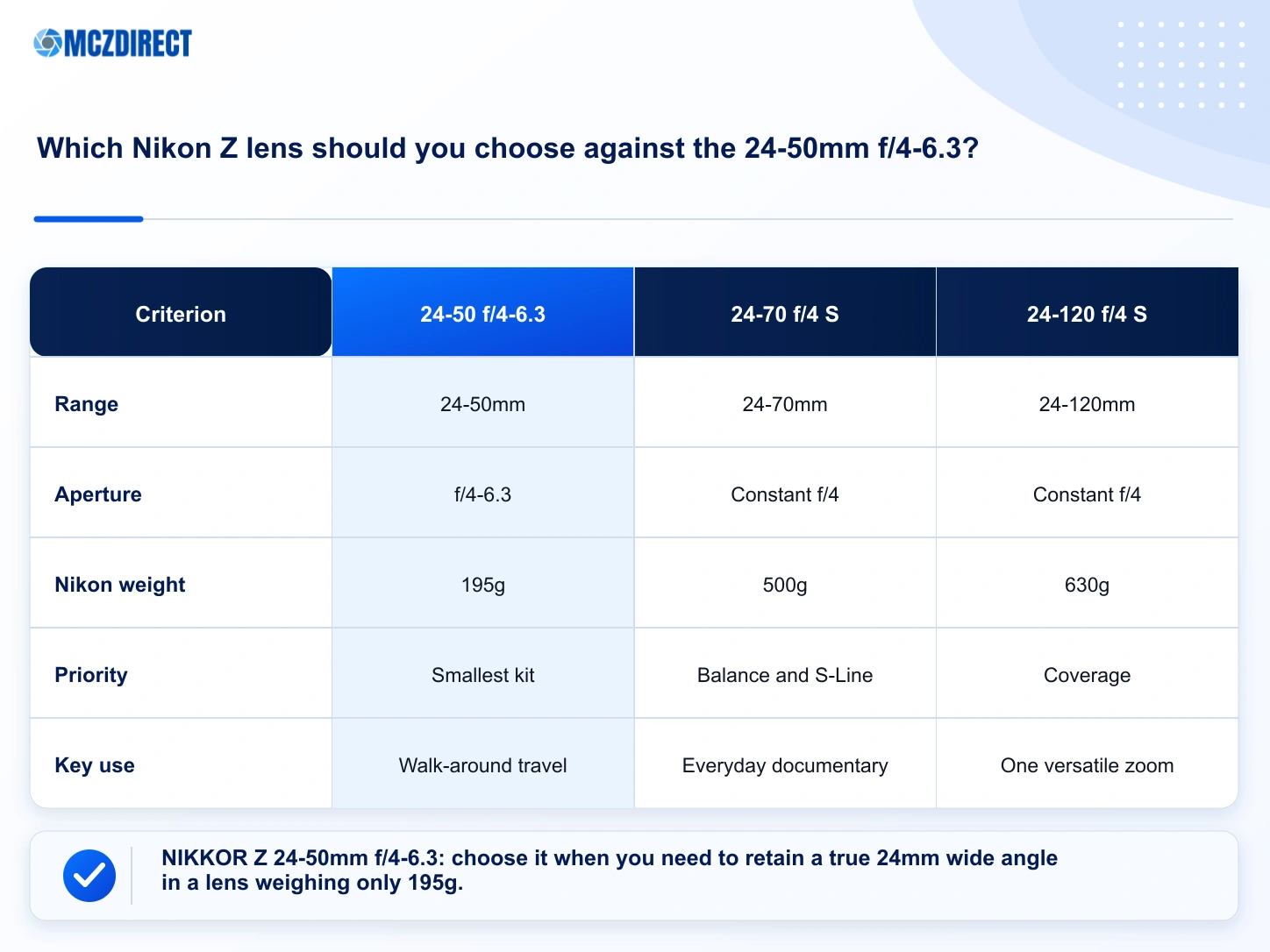
The 24-70mm f/4 S adds reach, a constant aperture and S-Line construction, but weighs about 500g. The 24-120mm f/4 S reaches substantially farther and works as a more complete single-lens solution at roughly 630g. The 24-50 does not beat either for coverage. It wins when the smallest bag and lowest carried weight are more important than reaching beyond a normal perspective.
For hiking, urban visits and a camera that stays available all day, the 24-50 has a clear role. For an event, professional assignment or trip where changing lenses is undesirable, the 24-120 offers more security. The decision is really about which restriction is easiest to accept: moving to frame, carrying more weight or adding a second lens. No specification table can make that practical choice for the photographer.
The 24-50mm works best when the rest of the kit respects its purpose. A photographer who mainly walks through cities, visits museums or records family life can use it alone through most of the day. For the evening, a small fast prime adds low-light freedom without making the bag cumbersome. This pairing covers broad scenes, natural everyday framing and available-light pictures while keeping the camera easy to reach. It is often more coherent than adding a second standard zoom that repeats the same focal lengths and removes the weight advantage.
Before a trip, it helps to review the subjects rather than pack for every possibility. If distant wildlife, compressed landscapes or formal portraits are central, the 24-120mm or a telephoto deserves the space instead. If the plan involves streets, interiors, meals and people within a few metres, this compact zoom is enough more often than its short specification suggests. The practical benefit is not owning the widest range. It is spending less time deciding which lens to mount and more time keeping the Nikon ready when an ordinary moment becomes worth photographing.
The range ends at 50mm and maximum aperture falls to f/6.3, leaving less freedom with moving subjects in low light. That reservation explains why the NIKKOR Z 24-70mm f/4 S or NIKKOR Z 24-120mm f/4 S may fit a particular assignment better.
The decision is not simply about the longest range or fastest aperture. Compare the load actually carried, the subjects photographed most often and how many lens changes are acceptable during a day.
| Criterion | 24-50 f/4-6.3 | 24-70 f/4 S | 24-120 f/4 S |
|---|---|---|---|
| Range | 24-50mm | 24-70mm | 24-120mm |
| Aperture | f/4-6.3 | Constant f/4 | Constant f/4 |
| Nikon weight | 195g | 500g | 630g |
| Priority | Smallest kit | Balance and S-Line | Coverage |
| Key use | Walk-around travel | Everyday documentary | One versatile zoom |
At MCZ DIRECT, we see it as the choice for photographers who genuinely want a compact full-frame camera. It is not trying to replace a professional zoom. Its strength is making the camera easier to take everywhere, which can matter more than impressive specifications for personal and travel photography.
We would move to the 24-70mm f/4 S when 70mm reach, constant aperture and S-Line rendering matter more. The 24-120mm f/4 S is stronger as a one-lens solution. The 24-50 keeps a unique advantage when 195g and minimum packing space are the deciding factors.