Shopping Cart
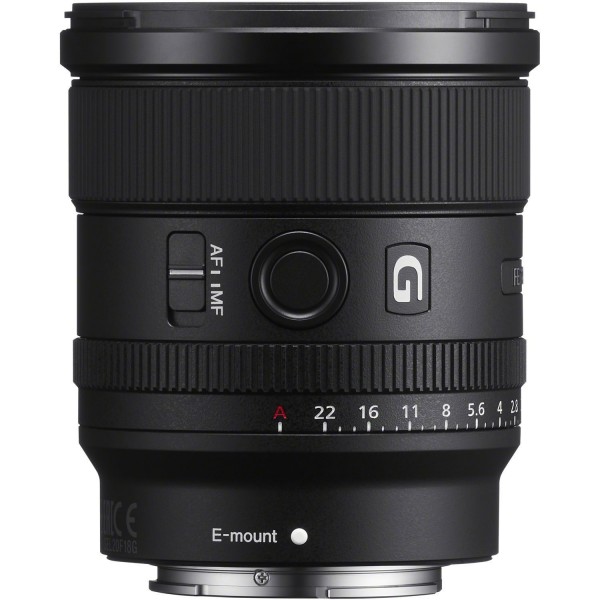
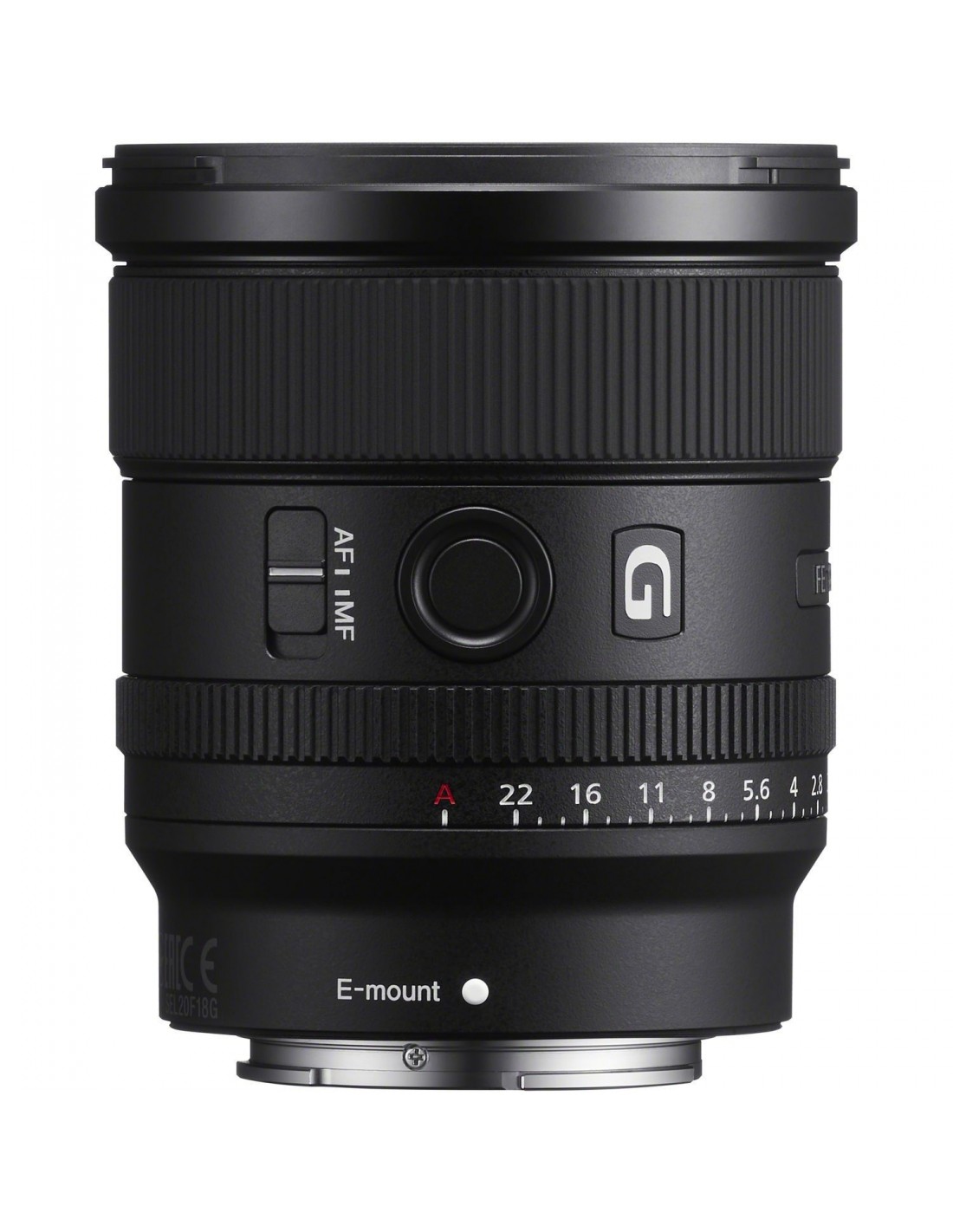
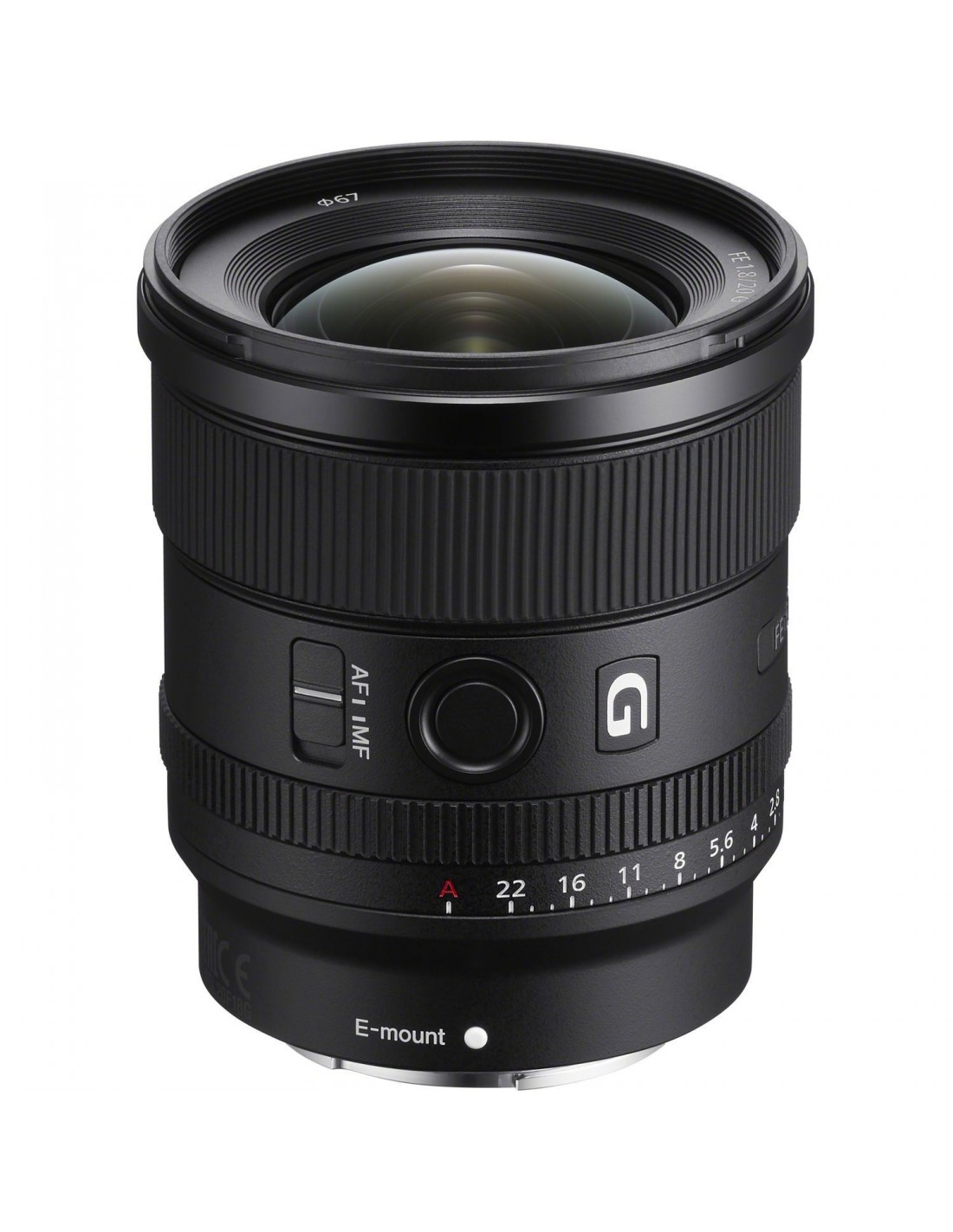


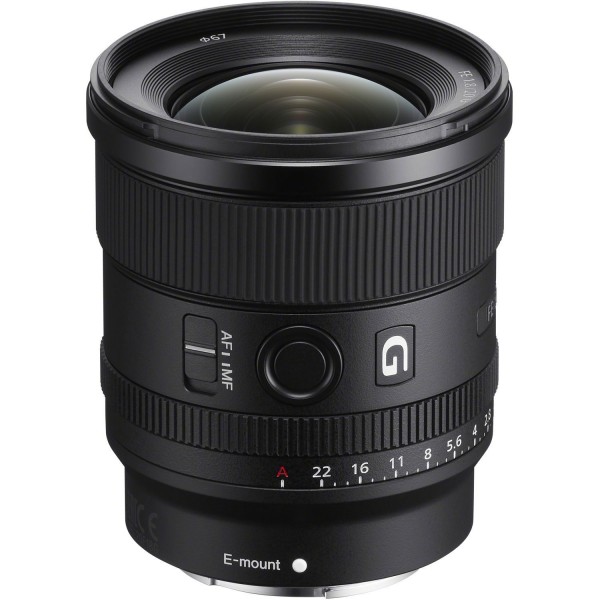
The Sony FE 20mm F1.8 G is a full-frame ultra-wide prime for landscape, architecture, astrophotography and video shooters, recommended when a broad view, a bright aperture and low carrying weight matter together. Its 20mm field of view includes noticeably more sky or interior space than a 24mm lens, while F1.8 helps preserve a workable shutter speed as available light falls. Two XD linear motors provide quick, quiet autofocus, and the de-clickable aperture ring is useful for video. At 373g, the lens remains easy to carry and balance on a compact Alpha body or gimbal. It best suits photographers who already want the distinctive perspective of a fixed 20mm and value low-light capability more than the framing flexibility of a zoom.
Combine compatible accessories and save. The more items you add, the bigger the discount.
memory card

warranty extension
The Sony FE 20mm F1.8 G is a compact ultra-wide prime for night landscapes, interiors, architecture, astrophotography and lightweight video work. The practical difference starts with the view: 20mm includes substantially more of a room, foreground or night sky than 24mm, without moving into the highly specialised perspective of 14mm. Its F1.8 aperture helps when light is scarce, while the 373g body and 67mm front filter thread keep the setup manageable outdoors. This lens is therefore aimed at photographers and filmmakers who are comfortable composing with a fixed focal length and want a broad, bright lens rather than the changing viewpoint of a zoom.
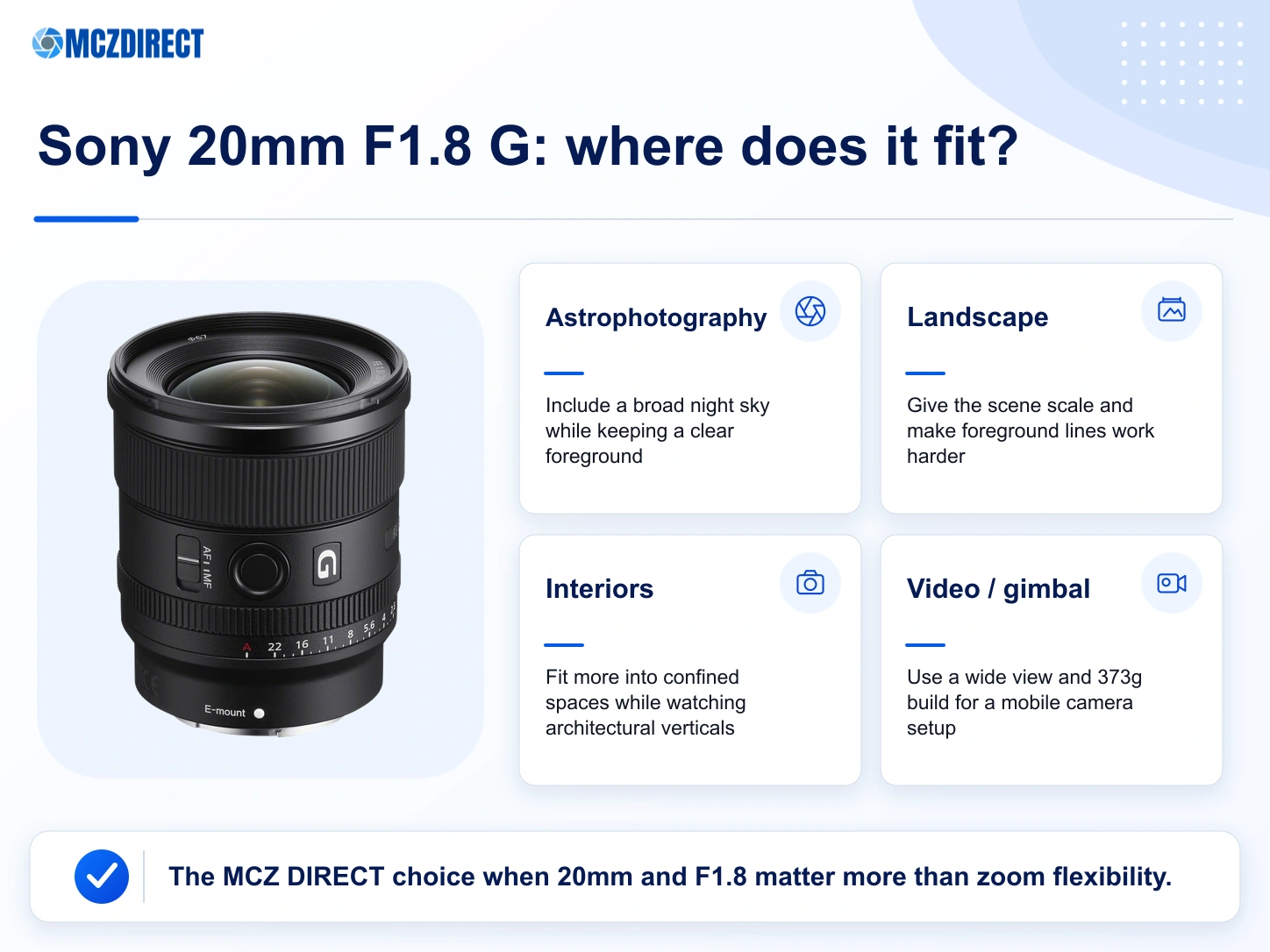
For astrophotography, 20mm leaves enough room for a large section of sky and a meaningful foreground. F1.8 can shorten the exposure or reduce the ISO required compared with an F2.8 zoom. It does not remove the need for accurate manual focus and an appropriate shutter time, because the stars will still trail during an exposure that is too long.
In landscape work, the wide view becomes most useful when there is something close to the camera. A rock, plant or path can anchor the frame while distant scenery remains visible. The trade-off is that every edge matters: a clipped object or stretched figure close to a corner is more obvious at 20mm than it would be with a normal lens.
The 67mm thread is a practical advantage for photographers who use screw-in filters. A polariser, neutral-density or graduated filter can be fitted without a specialist rear-filter system, although a slim mount is preferable on such a wide lens.
| Shooting use | What 20mm adds | What to consider |
|---|---|---|
| Astrophotography | A broad night sky and F1.8 to control exposure time or ISO | Star sharpness still depends on focus and shutter time |
| Landscape | A strong foreground with an expansive sense of space | Check every edge and keep the horizon deliberate |
| Architecture and interiors | More of the scene when there is little room to step back | Keep the camera level to limit converging verticals |
| Video and gimbal | 373g, quiet AF and a de-clickable aperture ring | No optical stabilisation inside the lens |
| Environmental close-ups | A nearby subject with plenty of surrounding context | 0.22x manual magnification is not true macro |
In a small room, the lens can show how furniture and spaces relate without forcing the camera into a doorway. Architecture benefits from the same coverage, but the camera should be kept level whenever possible. Tilting it sharply upwards or downwards makes converging verticals more pronounced, regardless of the lens correction profile.
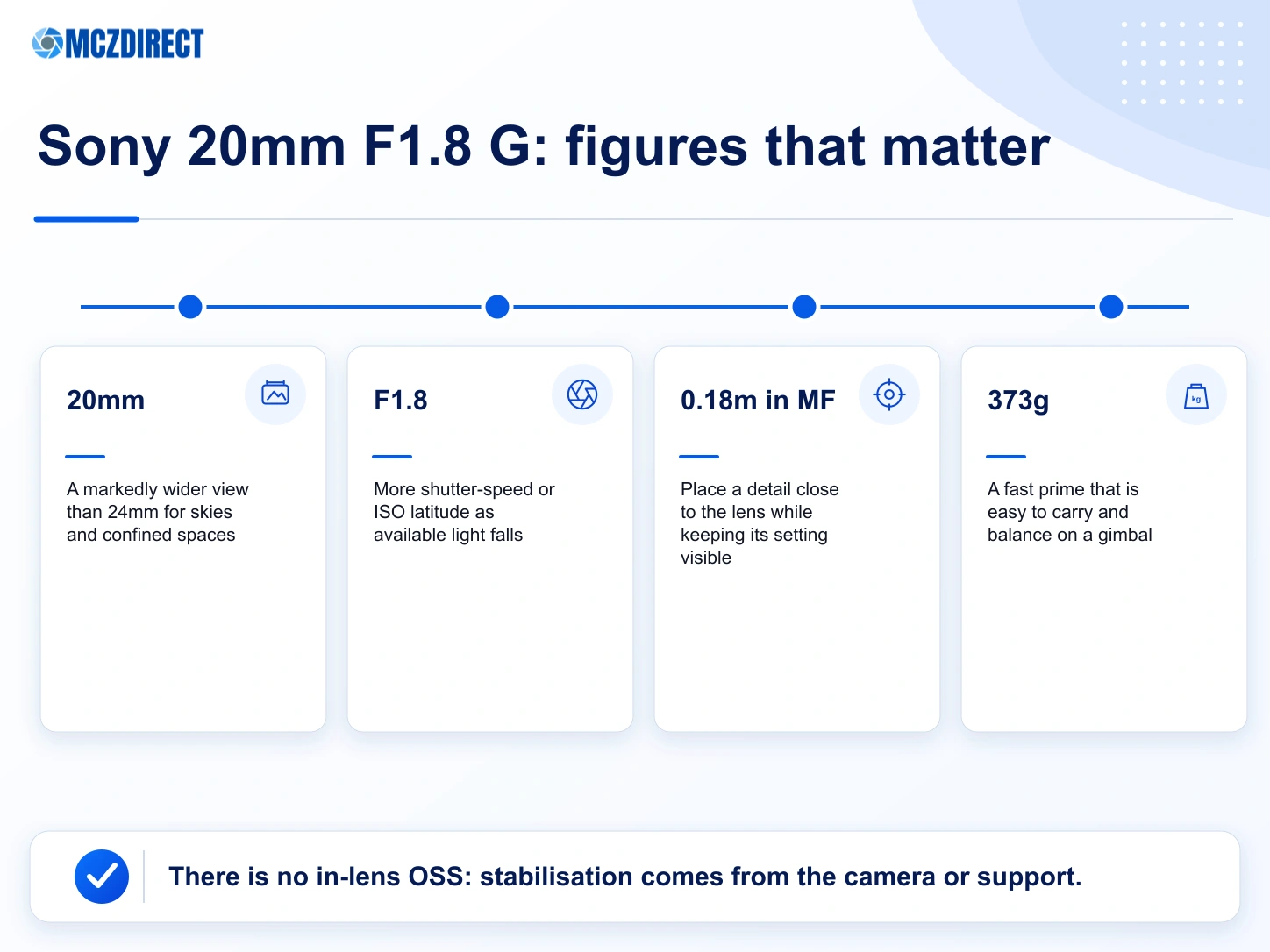
Close focusing changes the character of a 20mm image. At 0.19m in autofocus or 0.18m manually, a foreground object can become prominent while the setting remains part of the story. The maximum 0.22x manual magnification is useful, but this is still an environmental close-up rather than true macro work.
Video shooters gain a light 373g lens, quiet XD motors and a de-clickable aperture ring. Those features suit gimbals, interiors and presenter-to-camera work. There is no optical SteadyShot in the lens, so stabilisation depends on the camera body, an external support or careful handheld technique.
| Specification | Practical benefit | Keep in mind |
|---|---|---|
| 20mm and 94° view | Includes more sky, room or foreground than a 24mm lens | People near the corners can look stretched |
| F1.8 aperture | More low-light latitude and stronger separation at close range | Depth of field becomes shallow near minimum focus |
| 0.19m AF / 0.18m MF | Build an image around a prominent foreground object | Maximum magnification is 0.20x AF or 0.22x MF |
| Two XD motors | Quick, quiet focus response for stills and video | Performance also depends on the camera and AF settings |
| 373g and 67mm filters | A portable setup with conventional screw-in filters | A thick filter mount may increase corner shading |
Among full-frame Sony lenses, the Sony FE 14mm F1.8 GM delivers a much more expansive and dramatic view. It is a strong choice for very tight spaces or a huge night sky, but it requires disciplined composition. The Sony FE 24mm F1.4 GM is less extreme, adds an F1.4 aperture and often feels more natural for reportage or environmental portraits.
A Sony FE 16-25mm F2.8 G or Sony FE 16-35mm F2.8 GM II is easier when the camera position cannot change. The zoom lets the photographer refine framing immediately, whereas the 20mm prime asks them to move or crop. In return, the prime offers F1.8 and a compact 373g build.
On an APS-C Sony body, the field of view is equivalent to roughly 30mm on full frame. The lens remains bright and compact, but it no longer behaves as an ultra-wide. APS-C users should choose it for that moderately wide view or as part of a planned move to full frame.
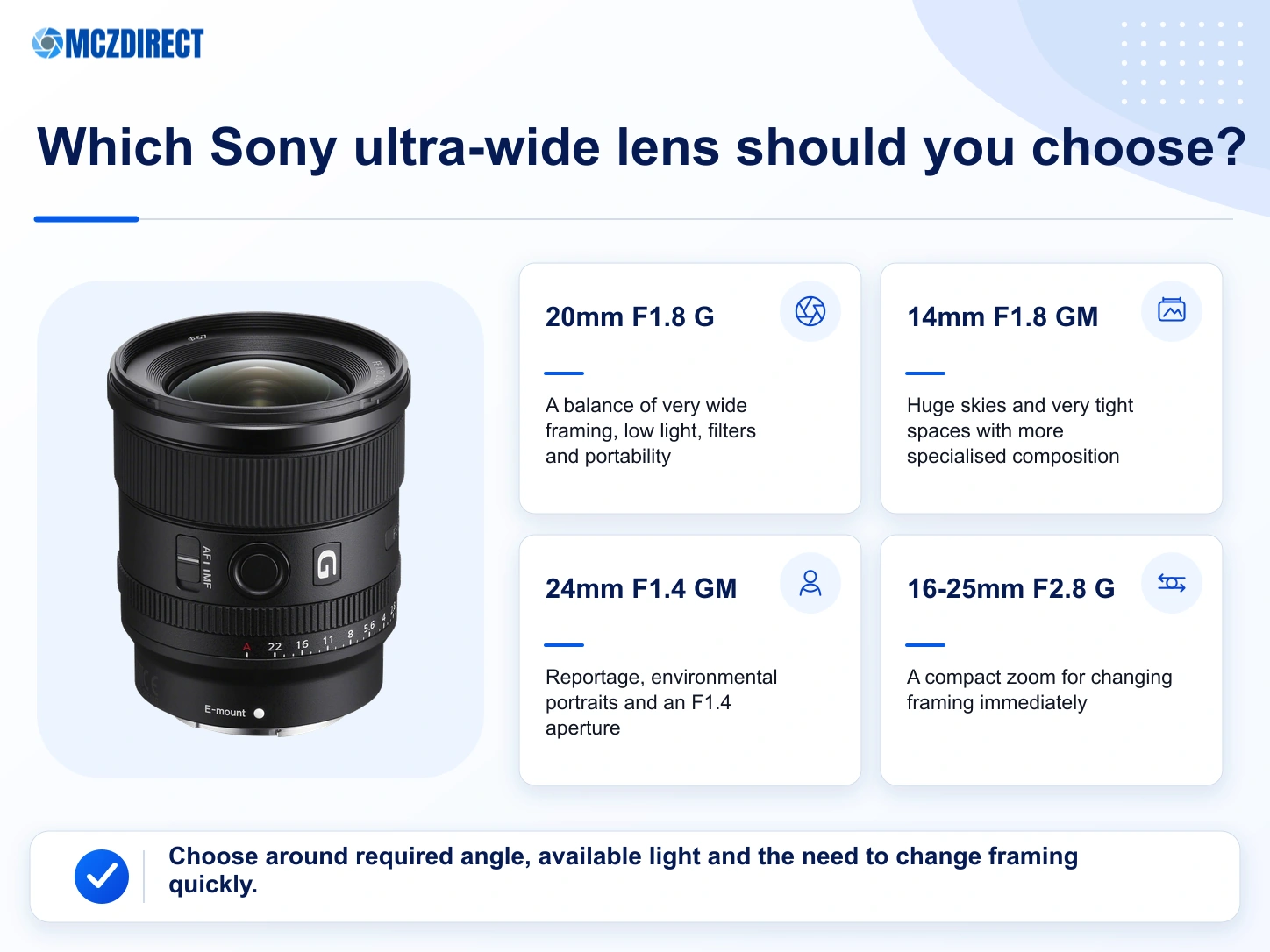
| Lens | Best reason to choose it | Main trade-off |
|---|---|---|
| Sony FE 20mm F1.8 G | Balanced width, F1.8, 373g and a 67mm filter thread | Fixed focal length and no OSS |
| Sony FE 14mm F1.8 GM | A far wider view for large skies and confined spaces | More specialised framing and no standard front filter thread |
| Sony FE 24mm F1.4 GM | Reportage, environmental portraits and F1.4 low-light work | Less coverage when space is tight |
| Sony FE 16-25mm F2.8 G | Compact zoom flexibility around the 20mm viewpoint | One and a third stops slower than F1.8 |
| Sony FE 16-35mm F2.8 GM II | A broader working range with G Master construction | Heavier and less bright than the prime |
At MCZ DIRECT, we see it as the most balanced Sony option for a photographer who wants a clearly wider view than 24mm without committing to the specialised perspective of 14mm. It is especially convincing for astrophotography, landscapes, interiors and a light video kit.
Against the Sony FE 24mm F1.4 GM, we recommend the 20mm when field of view and lower weight matter more than F1.4 and a more natural reportage perspective. Against a 16-25mm or 16-35mm zoom, the prime makes sense when F1.8 and compactness are more important than instant framing flexibility.
Its honest limitation is the fixed ultra-wide viewpoint: it rewards careful composition and will not suit every subject. Choose the SEL20F18G if 20mm already matches the way you want to frame and you need a bright, portable lens that accepts conventional front filters.

It is used for ultra-wide landscapes, astrophotography, architecture, interiors and video, particularly where there is little room to step back or a large part of the setting must remain visible.
Yes. Its 20mm view includes a broad section of sky and F1.8 helps control exposure time or ISO. Accurate focus and a suitable shutter time are still required for sharp stars.
Yes. It is designed for full-frame Sony E-mount cameras and can also be used on APS-C E-mount bodies, where it gives a view equivalent to roughly 30mm on full frame.
No. The lens has no optical SteadyShot. When used with a stabilised Sony body, stabilisation comes from the camera sensor and cannot freeze subject movement.
Yes. Its 373g weight, quiet XD linear motors and de-clickable aperture ring are useful for video, gimbal work, interiors and presenter-to-camera shots.
It accepts 67mm screw-in filters. A slim filter mount is preferable to reduce the risk of mechanical vignetting on the ultra-wide frame.
Sony specifies 0.19m in autofocus and 0.18m in manual focus, allowing a nearby foreground subject to remain prominent within a wide setting.
No. Maximum magnification is 0.20x in autofocus and 0.22x manually. It supports close environmental images but does not replace a macro lens.
Yes, especially where space is limited. Keeping the camera level helps control converging verticals, and care is needed with people or objects near the frame edges.
Choose the 20mm for a wider view and lower weight. Choose the 24mm F1.4 GM for reportage, environmental portraits and situations where F1.4 takes priority.
The 14mm gives a much wider, more specialised view. The 20mm is easier to compose, accepts 67mm front filters and suits a wider range of everyday scenes.
The 20mm is brighter for low-light work. The 16-25mm zoom is more flexible when the camera position or required framing changes frequently.
No. The SEL20F18G belongs to Sony’s G range. G Master or GM is not the correct designation for this model.