

Shopping Cart

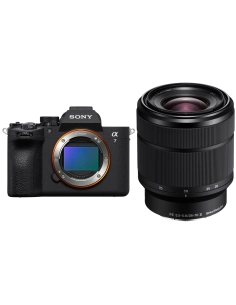
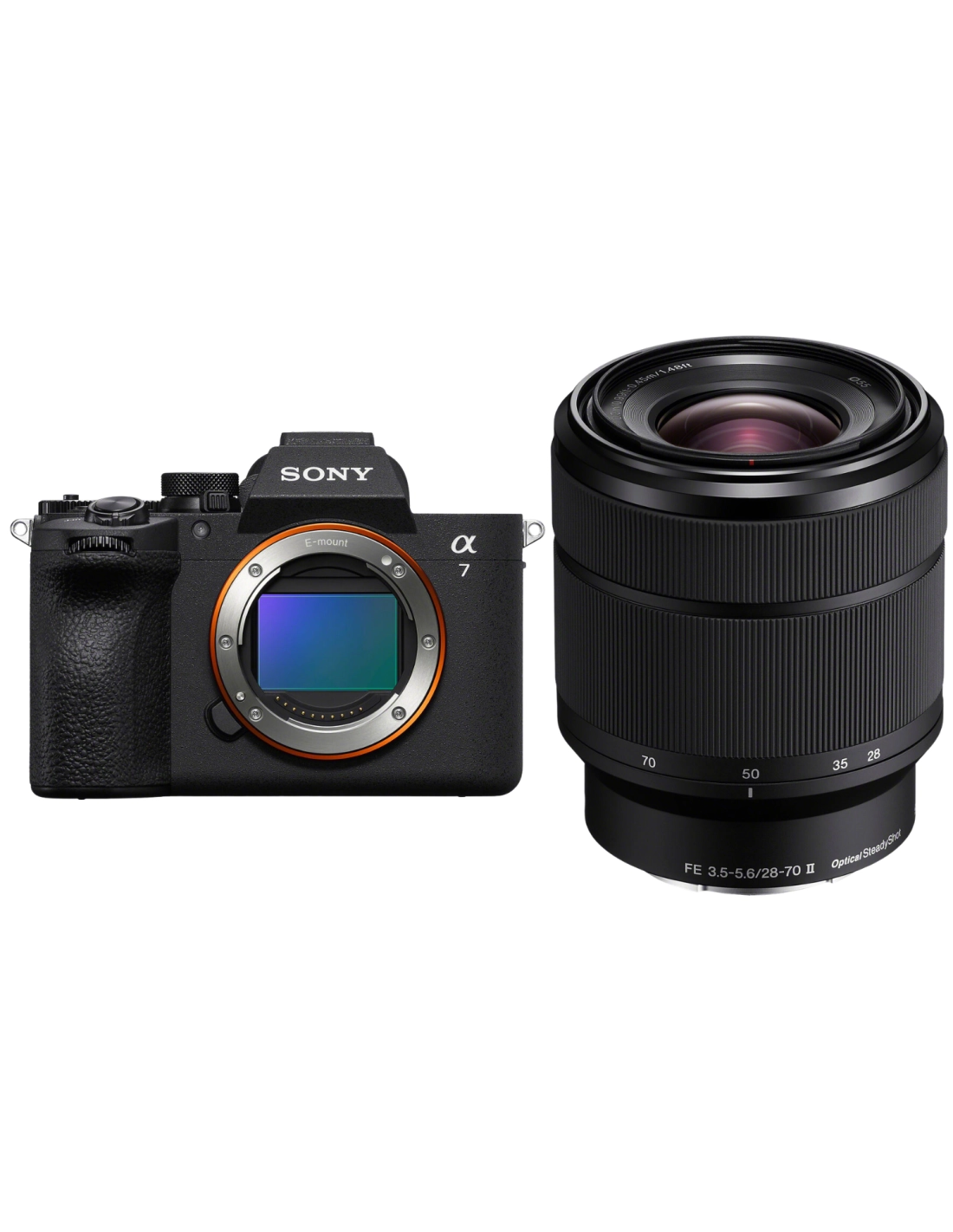
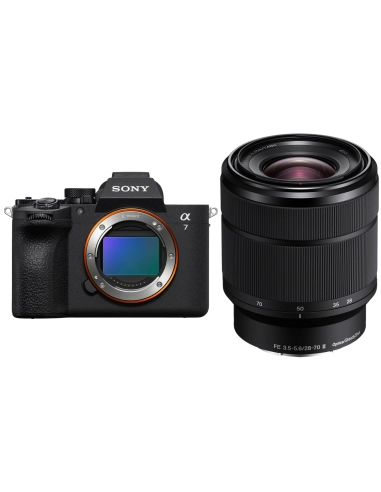
Sony Alpha 7 V + FE 28-70mm F3.5-5.6 OSS II
IN STOCK
€2,337.00
€2,460.00-5%
- 100% newBrand-new and authentic product
- Final priceNo unpleasant surprises! The displayed price is the final amount paid for your purchase.
- Estimated delivery Thu 30 - Fri 31 JulEstimate based on available stock, order time, business days and carrier delivery times.
- 3-year MCZ DIRECT warranty
- Free delivery with insurance includedYour order is protected from dispatch to delivery: in case of loss, theft or damage during transport, your parcel is insured up to its value.
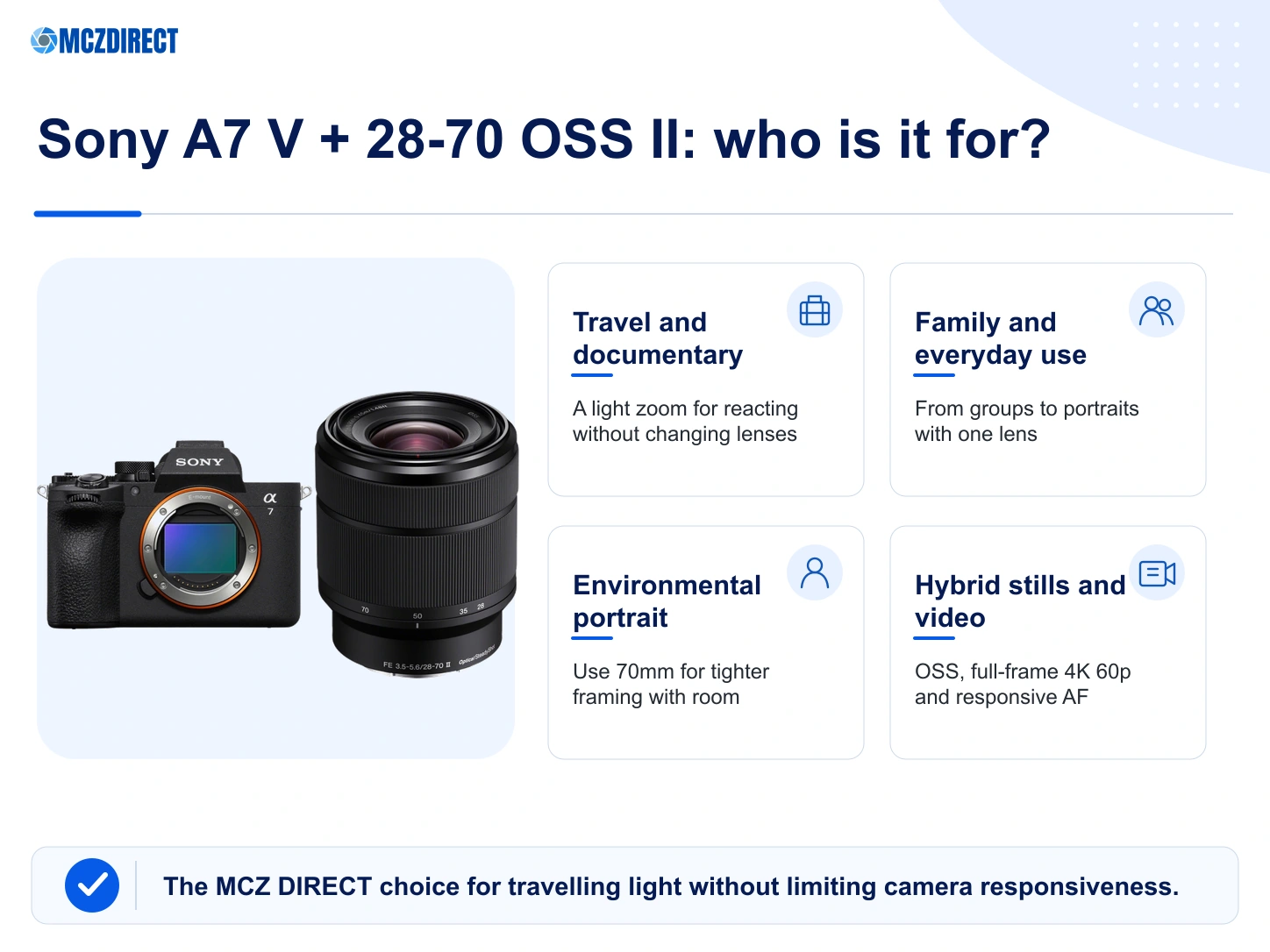
The Sony Alpha 7 V with FE 28-70mm F3.5-5.6 OSS II is a full-frame mirrorless kit for photographers who want responsive autofocus, useful speed and an everyday zoom without committing immediately to a specialised lens, and we recommend it when portability matters as much as versatility. Its 33MP sensor, subject-recognition autofocus and electronic shooting up to 30fps suit travel, family work, documentary photography, environmental portraits and moving subjects. The 293g lens moves from moderate wide angle to short telephoto, while Optical SteadyShot works with the camera stabilisation for stills and video. This is a particularly sensible first Sony E-mount combination when you need a balanced kit now and the freedom to add brighter or longer lenses later without unnecessary carrying weight.
Sony A7 V + 28-70mm OSS II: a light full-frame working kit
This configuration pairs the Sony Alpha 7 V with the updated FE 28-70mm F3.5-5.6 OSS II. Sony identifies the official kit as ILCE-7M5M. It combines a fast 33MP body with a 293g standard zoom, creating a camera that is easier to carry for a full day than the brighter professional zoom alternatives. The point is not to win a specification contest. It is to cover a useful range with one stabilised lens while leaving room to add a prime, wider zoom or telephoto once a clear need emerges.
At 28mm the lens handles street scenes, groups, travel views and reasonably open interiors. The 35-50mm region feels natural for documentary and family photography. At 70mm it gives a more selective view for a portrait, gesture or detail. There are honest boundaries: 28mm is not as wide as 24mm, and the variable F3.5-5.6 maximum aperture is less comfortable than F2.8 when light falls.
Key strengths of the Sony Alpha 7 V 28-70mm kit
- 33MP full-frame Exmor RS sensor for detailed files without the storage burden of an ultra-high-resolution body.
- Electronic shooting up to 30fps with AF/AE tracking and uninterrupted viewing under Sony’s stated conditions.
- AI-assisted subject recognition for people, animals, birds, vehicles and other supported subjects.
- 293g 28-70mm zoom that is markedly lighter than brighter professional standard zooms.
- Optical SteadyShot in the lens working with the compatible camera’s five-axis stabilisation.
- Full-frame 4K 60p oversampled from approximately 7K for detailed hybrid production.
- 4K 120p in Super 35 when slow motion matters more than retaining the full-frame angle of view.
- Two media slots, with one accepting CFexpress Type A and UHS-I/II SD cards.
- Four-axis articulated monitor for high, low, horizontal and vertical framing.
- Approximately 988g ready to shoot, calculated from the camera with battery/card plus the lens, before other accessories.
28 to 70mm: four useful ways to frame
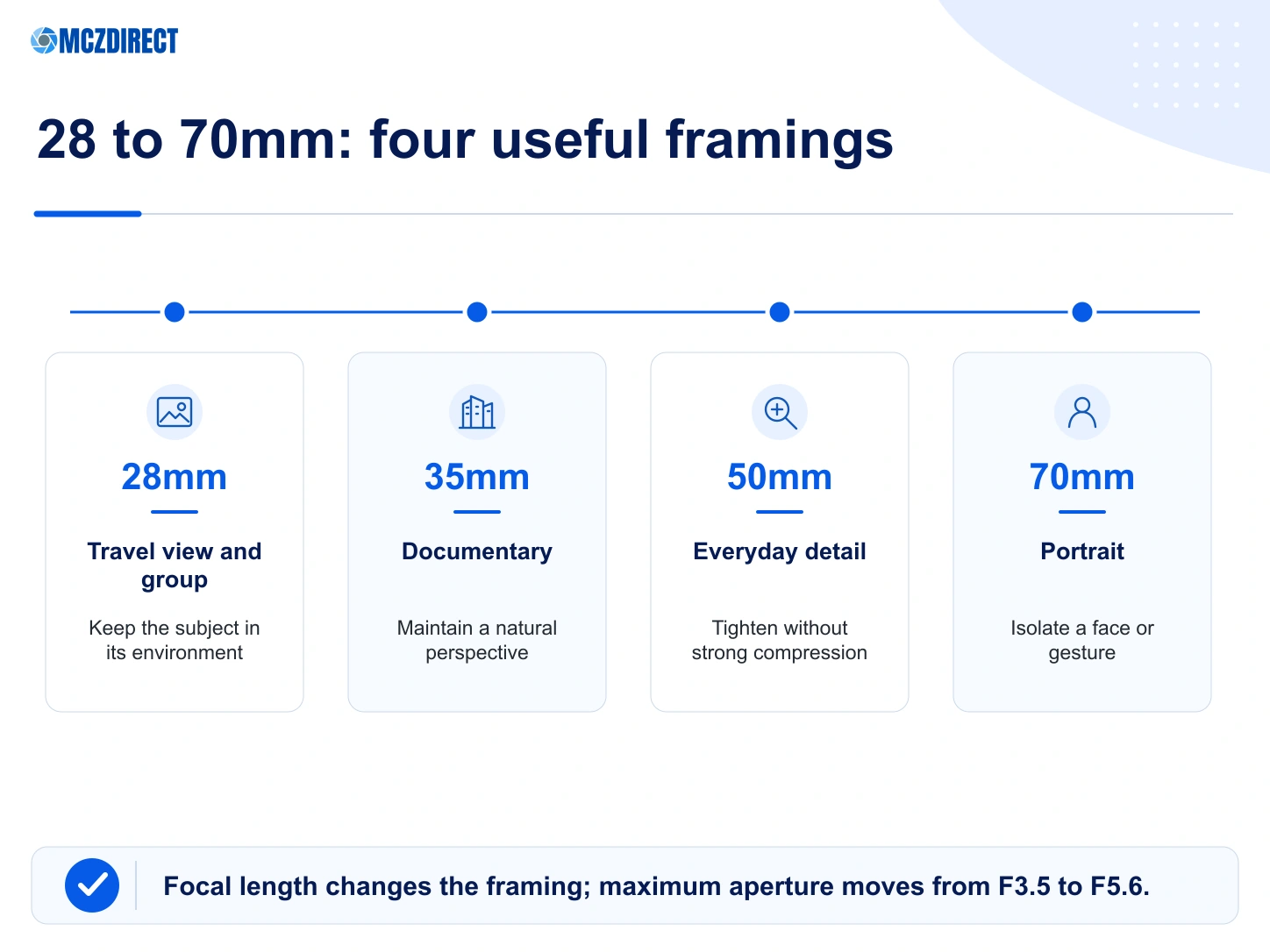
A standard zoom cannot replace every focal length, but it reduces lens changes as the distance to a subject shifts. That matters on a city walk, during travel or at a family event where the moment will not wait. These four points on the zoom ring provide a more useful guide than the ratio alone.
| Focal length | Natural use | Practical effect |
|---|---|---|
| 28mm | Travel view, street, group | Keep a subject in context, provided there is enough room in tighter interiors. |
| 35mm | Documentary and everyday work | Maintain a natural perspective while staying close to the scene. |
| 50mm | Detail and environmental portrait | Tighten composition without strong perspective compression. |
| 70mm | Portrait and closer framing | Isolate a face, gesture or object from a comfortable distance. |
What the camera specifications mean in practice
The A7 V is more than an A7 IV with a few larger numbers. Its partially stacked sensor reads data faster, making electronic bursts and subject tracking more useful when timing is uncertain. The difference is most visible during a brief expression, a child changing direction, an animal moving through the frame or a short sequence of sport.
| Feature | Practical benefit | What to plan for |
|---|---|---|
| 33MP | Detailed output, sensible cropping and large prints without an extreme workflow. | Final quality still depends on technique, light and lens choice. |
| Up to 30fps | More frames to choose from during a very short action with AF/AE tracking. | Rate and duration depend on file format, card and settings. |
| 759-point AF | Broad coverage and subject recognition keep attention on composition. | Detection mode and AF area still need to match the subject. |
| OSS + five-axis IBIS | More handheld latitude with relatively static subjects. | Stabilisation cannot freeze subject movement. |
| 293g zoom | A camera-and-lens combination near 988g before other accessories. | Low weight comes with a variable F3.5-5.6 aperture. |
A coherent stills and video combination
The SEL28702 is designed to keep pace with the faster burst rates of recent Sony bodies. On the Alpha 7 V it supports shooting up to 30fps and maintains discreet autofocus. For video, compatible focus-breathing compensation reduces angle-of-view changes during focus pulls. Lens OSS, in-body stabilisation and Active mode provide a useful handheld foundation, though they cannot turn a walking shot into a fully stabilised rig.
Full-frame 4K 60p is oversampled from an approximately 7K readout and is the natural choice for interviews, documentary clips and hybrid event coverage. 4K 120p provides stronger slow motion but uses a Super 35 crop. The 28mm end therefore behaves as a noticeably tighter view, which matters for handheld self-filming or cramped interiors.
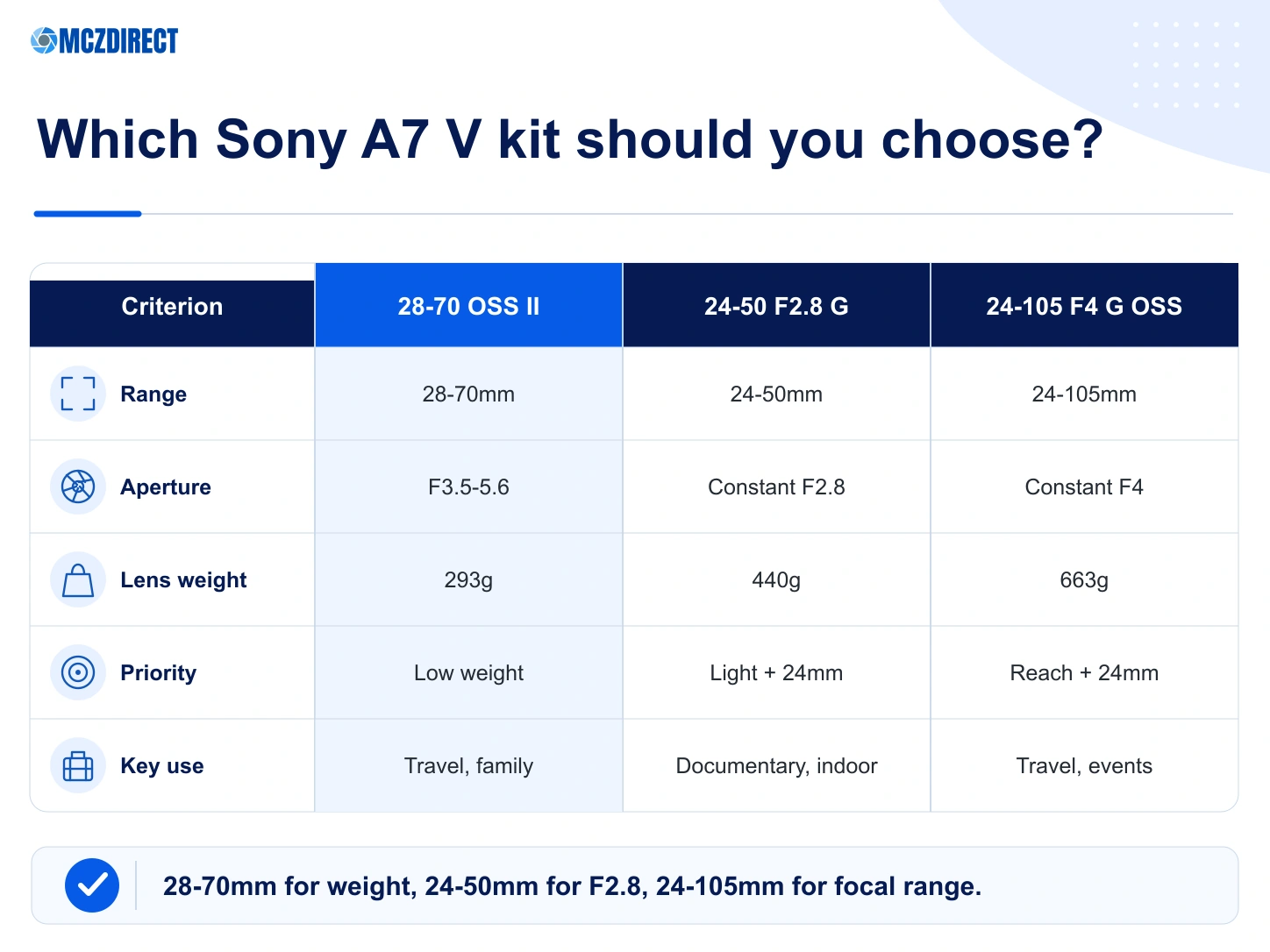
Which Sony A7 V kit should you choose?
The 28-70 OSS II pairing is the mobility-led option, not a lesser version of the camera. Other active kits trade weight for a wider starting point, a brighter constant aperture or more reach. The sensible decision follows the subjects you actually photograph.
| Configuration | Choose it when… | Main compromise |
|---|---|---|
| A7 V + 28-70 OSS II | You want the lightest everyday zoom kit for travel, family and general use. | Starts at 28mm and uses a variable F3.5-5.6 aperture. |
| A7 V + 24-50 F2.8 G | You value 24mm, low-light work and constant F2.8 in a still-compact lens. | The range ends at 50mm and the lens weighs about 440g. |
| A7 V + 24-105 F4 G OSS | You need 24-105mm coverage for travel, documentary work and portraits with one lens. | The approximately 663g lens makes a noticeably heavier combination. |
Limitations worth understanding
The FE 28-70mm OSS II stays compact by accepting clear compromises. Its 28mm wide end can feel restrictive for architecture, a small room or front-facing video. At 70mm the maximum aperture is F5.6, so dim interiors may require a higher ISO, a slower shutter when the subject allows it, or additional light. For weddings, stage work and portraits with stronger background separation, the A7 V with FE 24-70mm F2.8 GM II is the more appropriate pairing, at a higher weight and with a more specialised brief.
Reach stops at 70mm as well. This is not a distant sport or wildlife lens. The body has the speed and tracking ability, but those subjects require a telephoto. The kit is an excellent general foundation rather than a final answer to every assignment.
Body only or the 28-70mm OSS II kit?
Choose the Sony Alpha 7 V body only if suitable E-mount lenses are already in your bag or if the work immediately demands one precise focal length. The 28-70mm kit makes more sense when you want a light, stabilised lens from day one and enough range to discover which focal lengths you use most. The Sony A7 V category brings the active configurations together for a cleaner comparison.
Our verdict on the Sony A7 V with 28-70mm OSS II
At MCZ DIRECT, we see this as the range choice for photographers who want the A7 V’s responsiveness without immediately building a specialised, heavy kit. It is particularly well judged for travel, everyday documentary work, family photography and hybrid stills/video use. Against the 24-105mm F4 G OSS pairing, we recommend it when low carrying weight and discretion matter more than starting at 24mm or reaching 105mm.
Its weakness is inseparable from its appeal: the FE 28-70mm OSS II is a compact variable-aperture zoom. It does not replace F2.8 in low light, an ultra-wide lens or a telephoto. As a balanced route into Sony full frame, however, with an approximately 988g ready-to-shoot combination and a clear upgrade path, it is a thoughtfully constructed kit.

SONYA7V2870OSSII
9503598422892
Technical specifications
General
Brand
Sony
Product type
Full-frame mirrorless camera with 28-70mm standard zoom kit
Camera type
Interchangeable-lens digital camera
Product line
Sony Alpha
Product series
Alpha 7
Specific model
ILCE-7M5M
Release date
2025-12-02
Available languages
Multilingual, including English
Camera
Level
Advanced / enthusiast
Processor
BIONZ XR2
Image ratio
3:2
Image stabilization
Yes
Autofocus
Yes
Lens mount
Sony E
RAW
Yes
File formats
JPEG (DCF Ver. 2.0, Exif Ver. 2.32, MPF Baseline compliant), HEIF (MPEG-A MIAF compliant), RAW (Sony ARW 6.0 format compliant)
Max burst speed
30 fps
Lens included
Yes
Kit configuration
Sony Alpha 7 V with FE 28-70mm F3.5-5.6 OSS II
Included lens count
1
Included lens 1
Sony FE 28-70mm F3.5-5.6 OSS II
Lens 1 model
SEL28702
Lens 1 mount
Sony E
Lens 1 format
Full Frame
Lens 1 focal length
28-70mm
Lens 1 max aperture
F3.5-5.6
Lens 1 stabilization
Yes, Optical SteadyShot
Uses
All-round use
Yes
Architecture
Yes
Landscape
Yes
Portrait
Yes
Travel
Yes
Reportage
Yes
Sports
Yes
Wildlife
Yes
Photo / video
Yes
Vlogging
Yes
Sensor
Sensor type
35 mm full frame (35.9 x 23.9 mm), Exmor RS CMOS sensor
Sensor size
35.9 x 23.9 mm
Crop factor
1.0x
Autofocus points
759
Resolution
33 MP
Maximum resolution
7008 x 4672
Sensor cleaning
Yes
Standard ISO range
ISO 100-51200
Maximum native ISO
ISO 51200
Expandable ISO
ISO 50-204800 photo / ISO 100-102400 video
Exposure
Metering modes
1200-zone evaluative metering
Metering zones
1200
Exposure compensation
± 5.0 EV (1/3 EV, 1/2 EV steps selectable)
Fastest shutter speed
1/16000 s E / 1/8000 s M
Slowest shutter speed
30 s, Bulb
Bulb mode
Yes
Manual exposure
Yes
White balance settings
Colour temperature range 2500 K-9900 K
Aperture priority
Yes
Shutter priority
Yes
Display
Display type
3.15" (3.2-type) type TFT
Display size
3.2
Display resolution
2095104
Touchscreen
Yes
Live View
Yes
Viewfinder
Viewfinder
Yes
Viewfinder type
0.51" electronic viewfinder (Quad-VGA OLED)
Viewfinder coverage
100%
Viewfinder magnification
Approx. 0.78x (with 50 mm lens at infinity), -1 m-1)
Diopter range
-4.0 to +3.0 m
Flash
Built-in flash
No
Flash sync speed
1/250 s (35 mm full frame)
Flash modes
External Sony Alpha System Flash via Multi Interface Shoe
Flash technology
Sony Multi Interface Shoe
Accessory shoe
Yes
Video
Video function
Yes
Full HD
Yes
4K UHD
Yes
6K video
No
7K video
No
8K video
No
Internal RAW recording
No
Clean HDMI output
Yes
Maximum video resolution
3840 x 2160
Video frame rates
Video up to 3840 x 2160 depending on Sony recording modes
Video compression
XAVC S: MPEG-4 AVC/H.264, XAVC HS: MPEG-H HEVC/H.265
Video file formats
XAVC S HD, XAVC S 4K, XAVC S-I HD, XAVC S-I 4K, XAVC HS 4K
Audio
Built-in microphone
Built-in stereo
Storage
Internal memory
No
Dual card slot
Yes
Memory types
SLOT1: Multi slot for SD (UHS-I/II compliant) memory card / CFexpress 2 Type A card, SLOT2: Slot for SD (UHS-I/II compliant) memory card
Card types
SD, SDHC, SDXC, CFexpress Type A
SD speed classes
Depending on compatible SD/CFexpress card
Connectivity
HDMI
Yes
HDMI type
HDMI Type-A
Microphone input
Yes
Microphone input type
3.5mm stereo minijack or Multi Interface Shoe digital audio depending on model
Headphone output
Yes
USB
Yes
USB type
SuperSpeed USB 10 Gbps (USB 3.2) compatible, PORT2: Hi-Speed USB 480 Mbps (USB 2.0) compatible)
Ethernet
No
Wireless
Wi-Fi
Yes
Bluetooth
Yes
NFC
No
GPS
No
Physical properties
Weight
610 g
Depth
8.24 cm
Width
13.03 cm
Height
9.64 cm
Colour
Black
Waterproof
No
Splash resistant
Yes
Shockproof
No
Dust resistant
Yes
AF assist light
Yes
Minimum operating temperature
0 °C
Maximum operating temperature
40 °C
Battery
Battery
NP-FZ100
Photo battery life
Approx. 630 shots (Viewfinder) / Approx. 750 shots (LCD monitor) (CIPA standard)
USB charging
Yes
USB power delivery
Yes
Charger included
No
Buying guidance
Best for
Travel, everyday documentary, family photography, environmental portraits, hybrid content and a first versatile Sony E-mount kit.
Less suited to
Ultra-wide interiors, distant sport or wildlife, and low-light work that requires a constant F2.8 aperture.
Compatibility
The included SEL28702 is a full-frame Sony E-mount lens directly compatible with the A7 V and can be used on E-mount APS-C bodies with an approximately 42-105mm equivalent angle of view.
Note
The lens does not support Sony 1.4x or 2.0x teleconverters. Burst, video and stabilisation performance depends on settings, media and operating conditions.
Included lens
Lens type
Full-frame standard zoom lens
Lens series
Sony FE
Focal range
28-70mm
Optical construction
9 elements in 8 groups
Optical stabilisation
Yes, Optical SteadyShot
AF drive
Linear motor
Minimum focusing distance
30-45cm depending on focal length
Maximum magnification
0.19x
Maximum aperture
F3.5-5.6
Minimum aperture
F22-36
Diaphragm blades
7, circular diaphragm
Optical zoom
2.5x
Lens weight
293g
Filter diameter
55mm
Lens length
8.3cm
Lens diameter
72.5mm
Dust/splash resistance
Yes, dust- and moisture-resistant design
Sony A7 V 28-70mm OSS II kit frequently asked questions
What is the Sony A7 V with 28-70mm OSS II kit?
It pairs the full-frame Sony Alpha 7 V with the FE 28-70mm F3.5-5.6 OSS II zoom. This light configuration covers travel, documentary, family, environmental portrait and hybrid stills/video work.
Is the Sony A7 V 28-70mm an official Sony kit?
Yes. Sony identifies this combination as ILCE-7M5M. The camera body is ILCE-7M5 and the lens is SEL28702.
Who is the Sony A7 V 28-70mm kit for?
It suits photographers wanting a light standard zoom for travel, everyday documentary work, family photography, environmental portraits and hybrid video. Distant sport, wildlife or ultra-wide work requires another lens.
What can be photographed with a 28-70mm lens?
At 28mm it covers travel views, streets and groups; 35-50mm suits documentary and everyday work; 70mm suits portraits and details. It does not replace an ultra-wide or telephoto.
Does lens OSS work with Sony A7 V in-body stabilisation?
Yes. The SEL28702 Optical SteadyShot is designed to work with the compatible camera’s in-body stabilisation. It reduces camera shake but cannot freeze a moving subject.
Can the FE 28-70mm OSS II keep up with the Sony A7 V 30fps burst?
Yes. Sony states that the SEL28702 supports fast AF/AE tracking on recent bodies, while the A7 V reaches up to 30fps. Actual rate depends on file format, card and settings.
Is this Sony A7 V kit suitable for video?
Yes. The camera records full-frame 4K 60p and 4K 120p with a Super 35 crop among its modes. The lens adds OSS and supports focus-breathing compensation on a compatible body.
Sony A7 V body only or 28-70mm kit: which should I choose?
Body only is logical if you already own suitable Sony E-mount lenses. Choose the 28-70mm kit when you need a light, stabilised and versatile lens from the first day.
Sony A7 V 28-70mm or 24-50mm F2.8 G: which should I choose?
The 28-70mm favours low weight, 70mm reach and optical stabilisation. The 24-50mm F2.8 G starts at 24mm and keeps F2.8 for low light, but stops at 50mm.
Sony A7 V 28-70mm or 24-105mm F4 G OSS: which should I choose?
The 28-70mm is much lighter and covers everyday use well. The 24-105mm starts wider, reaches farther and keeps constant F4, but the lens weighs about 663g rather than 293g.
Is the 28-70mm F3.5-5.6 suitable for low light?
It can work in moderate light with help from stabilisation, but the maximum aperture falls to F5.6 at 70mm. A fast prime or F2.8 zoom is better for moving subjects in dim interiors or stronger background blur.
How much does the Sony A7 V with 28-70mm OSS II weigh?
The combination weighs approximately 988g before other accessories. This adds the 695g camera with battery/card to the 293g lens; final weight varies with card, filter, strap and accessories.
Is the FE 28-70mm OSS II compatible with other Sony cameras?
Yes. It is a full-frame Sony E-mount lens. It can also be used on an E-mount APS-C body, where its angle of view is equivalent to approximately 42-105mm.
Are a memory card and charger included?
Sony does not list a memory card, mains charger or USB cable in the official kit contents. The NP-FZ100 battery is included. Check the box-content block for separate camera and lens lists.
Reviews Sony Alpha 7 V + FE 28-70mm F3.5-5.6 OSS II
0 Rating
Customer photos
No customer photos yet
Tap to zoom
ALEX (In testing phase)