

Shopping Cart

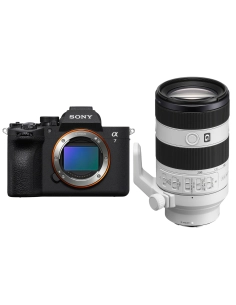
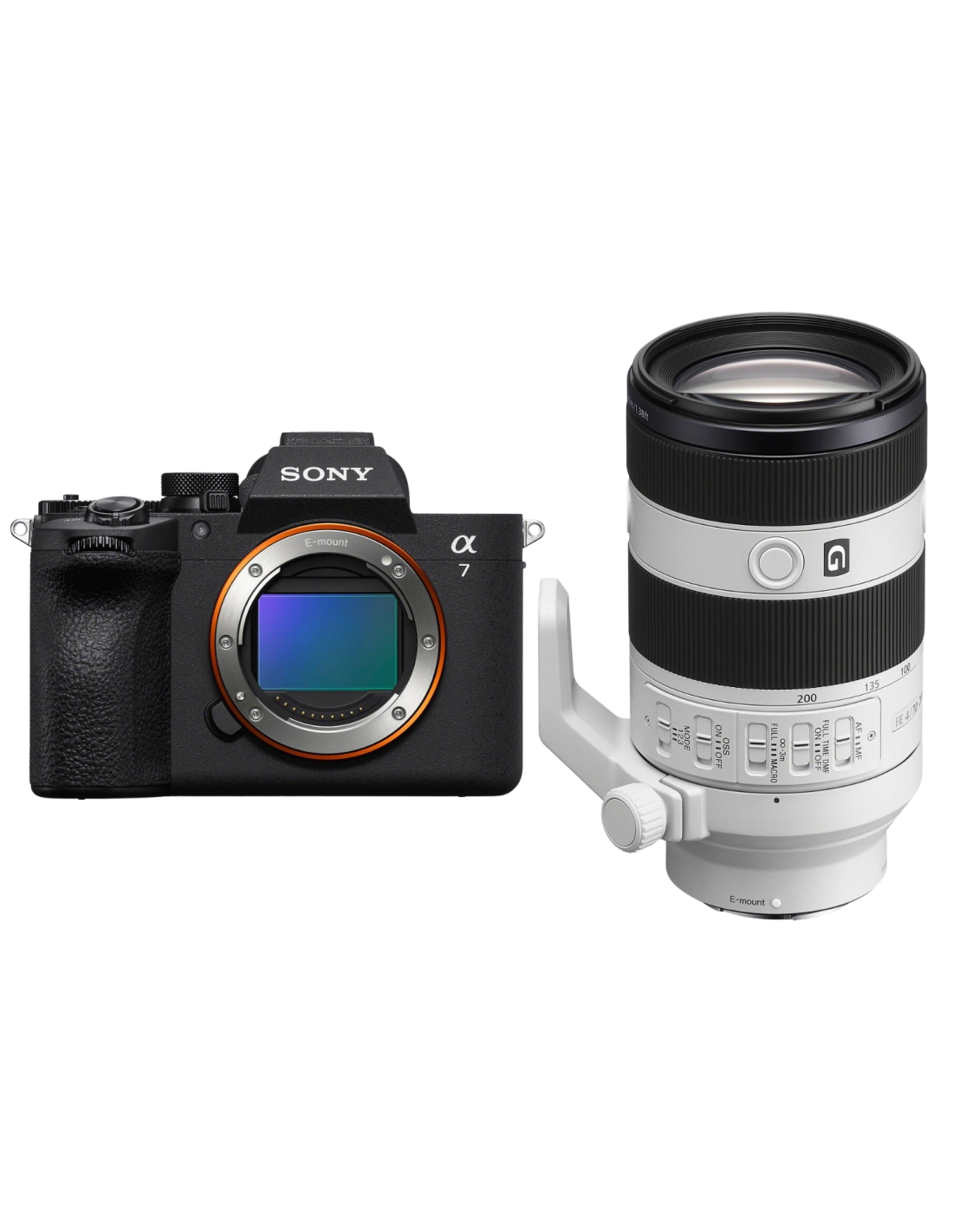
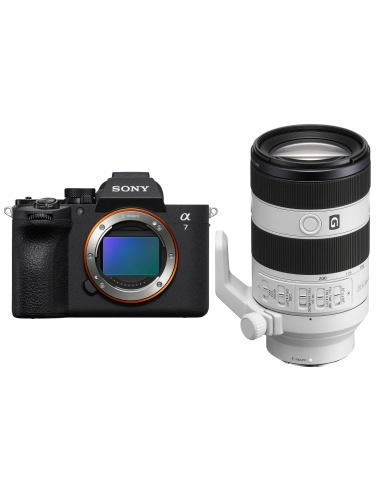
Sony Alpha 7 V + FE 70-200mm f/4 Macro G OSS II
IN STOCK
€3,269.90
€3,442.00-5%
- 100% newBrand-new and authentic product
- Final priceNo unpleasant surprises! The displayed price is the final amount paid for your purchase.
- Estimated delivery Thu 30 - Fri 31 JulEstimate based on available stock, order time, business days and carrier delivery times.
- 3-year MCZ DIRECT warranty
- Free delivery with insurance includedYour order is protected from dispatch to delivery: in case of loss, theft or damage during transport, your parcel is insured up to its value.
The Sony Alpha 7 V with FE 70-200mm F4 Macro G OSS II is a full-frame kit recommended for nature, travel, documentary and portrait photographers who want to move from distant subjects to close details without changing lenses. Its 70-200mm range keeps a constant F4 aperture and delivers 0.5x maximum magnification throughout the zoom. In practical use, the 33MP camera combines subject recognition and electronic shooting up to 30fps with the telezoom’s optical stabilisation and close-focus ability. It suits wildlife, compressed landscapes, outdoor portraits, flowers and smaller objects. F4 needs more light than a 70-200mm F2.8, particularly for fast indoor action. We recommend this pairing when flexible framing, useful close focus and a more portable telephoto setup matter more than maximum low-light speed.
Sony A7 V with 70-200mm F4 Macro: reach and close focus in one kit
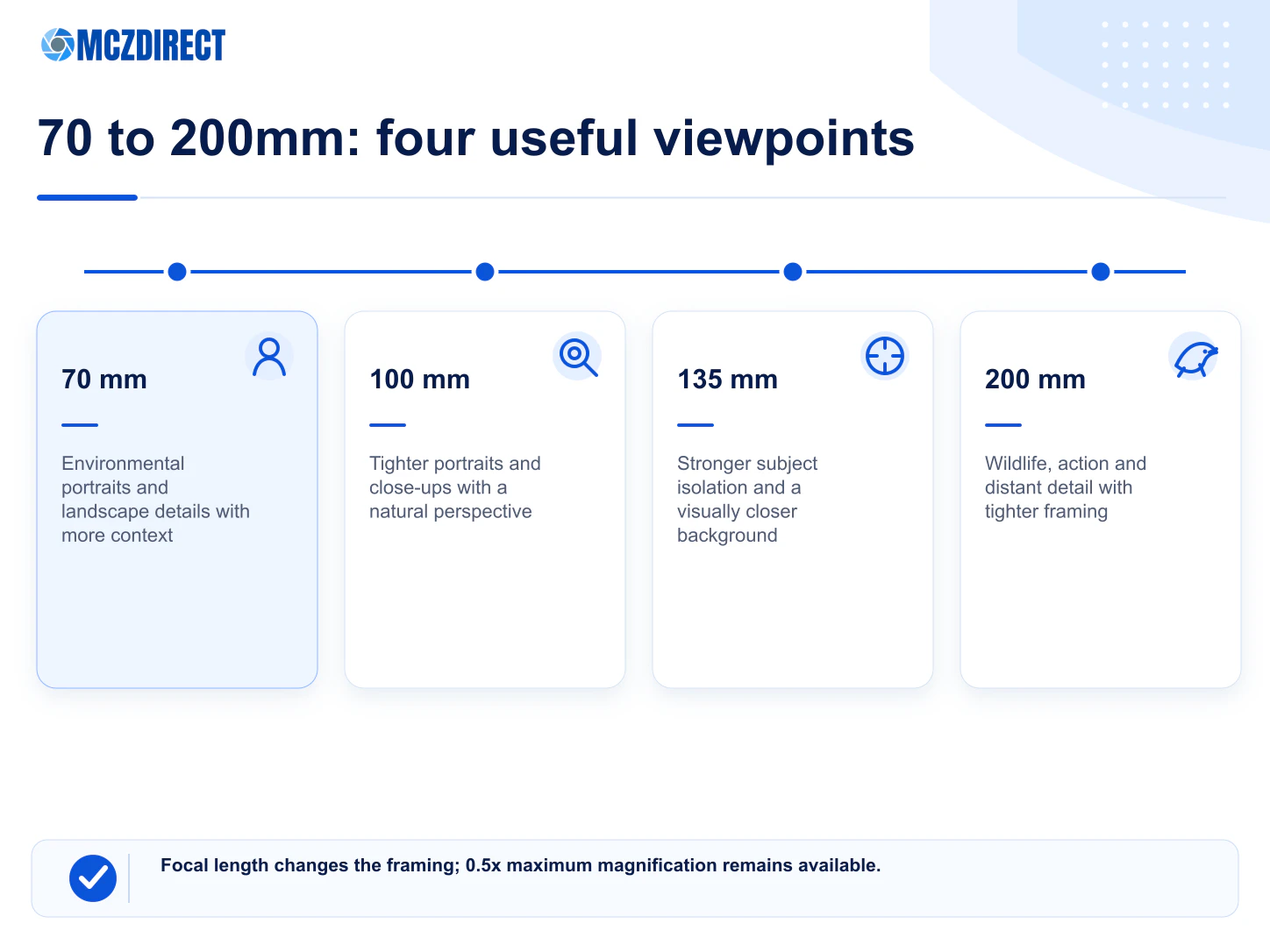
This pairing gives the Alpha 7 V a telephoto zoom that is useful at both ends of the subject-distance scale. At 70mm it can include more context around a portrait or landscape detail; at 200mm it tightens perspective for wildlife, events and distant features. Unlike a conventional telezoom, the SEL70200G2 also reaches 0.5x magnification throughout its range.
The 33MP body adds advanced subject recognition and electronic shooting up to 30fps. The included lens is Sony model SEL70200G2; it contributes constant F4, optical stabilisation and a 0.26-0.42m minimum focus distance, depending on focal length. It is not as bright as a 70-200mm F2.8 and it does not provide native 1:1 macro. Its strength is the number of situations it covers without a lens change.
Key strengths of the Sony A7 V telephoto kit
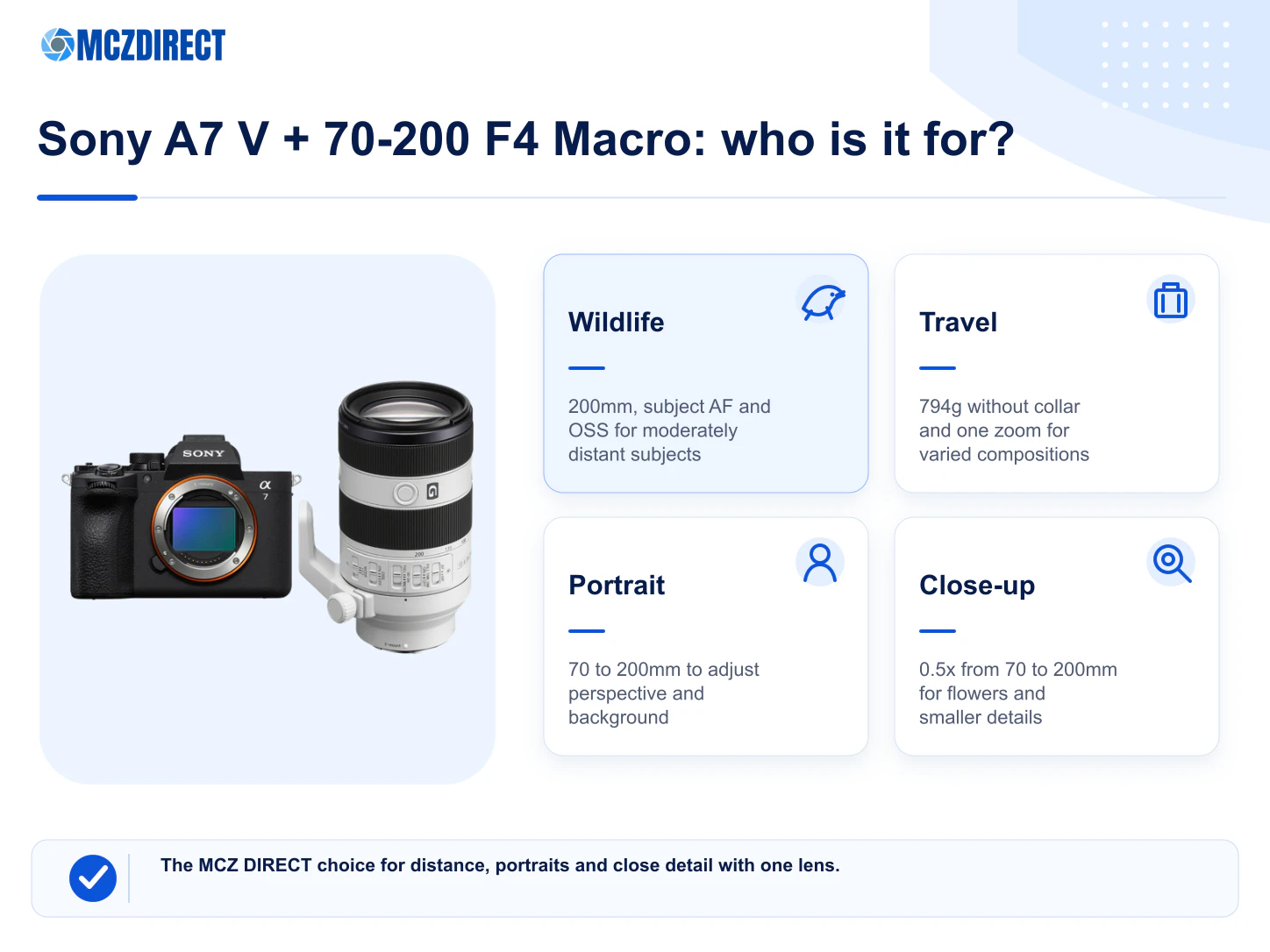
- 70-200mm framing range for environmental portraits, tighter compositions and moderately distant subjects.
- Constant F4 maximum aperture across the full zoom range.
- 0.5x maximum magnification at every focal length for flowers, textures and smaller products.
- 0.26-0.42m minimum focus depending on zoom position.
- Optical SteadyShot with MODE3 to help stabilise framing around moving subjects.
- 33MP full-frame capture with useful room for a considered crop.
- Camera subject recognition for wildlife, action, portrait and less predictable scenes.
- Electronic shooting up to 30fps when the selected format and settings permit.
- Approximately 794g without the tripod mount, keeping the lens realistic for travel and field use.
- Sony 1.4x and 2x teleconverter support; the 2x extends reach to 400mm and magnification to 1:1.
Where the 70-200mm F4 Macro makes practical sense
The difference is most useful when a subject changes faster than your kit can. A trail can present a distant animal, compressed landscape layers and a close flower within a few minutes. The zoom lets you respond without exposing the sensor or carrying a dedicated close-up lens for every walk.
| Task | What the kit adds | Consider first |
|---|---|---|
| Nature and lighter wildlife | 200mm reach, subject tracking, burst shooting and OSS. | Small distant birds may still need more than 200mm. |
| Outdoor portraits | Flexible perspective from 70 to 200mm with clean subject separation. | F4 softens the background less than F2.8. |
| Travel and landscape | Portable telephoto framing for distant buildings, peaks and details. | A wide lens is still needed for expansive scenes. |
| Flowers and close detail | 0.5x magnification at every focal length with adjustable working perspective. | Native reproduction stops short of 1:1. |
| Outdoor sport | Responsive AF, 70-200mm framing and high burst speed in sufficient light. | Indoor or night action favours F2.8. |
Understanding the 0.5x macro label
At 0.5x, a 20mm subject produces a 10mm image on the sensor. That is enough for flowers, butterflies, watches and material details, but it is not the life-size 1:1 reproduction associated with a dedicated macro prime. The unusual advantage is that 0.5x remains available across the zoom, so framing and working distance can change without abandoning close focus.
Adding Sony’s compatible 2x teleconverter extends the lens to 400mm, changes the maximum aperture to F8 and raises magnification to 1:1. It is a useful specialist option, not a free upgrade: less light means more demanding technique. For consistently tiny subjects, the A7 V with 100mm Macro GM is the stronger macro tool. For mixed nature, portrait and travel work, this zoom is easier to live with.
Autofocus, stabilisation and shooting pace
The lens uses Sony’s XD Linear Motor technology and is designed to keep pace with fast Alpha bodies. The A7 V can recognise different subject categories, but AF area and shutter speed still need to match the movement. A 30fps burst offers more frames around a brief gesture; it does not turn an unsuitable setup into a sharp sequence.
Optical SteadyShot reduces photographer movement and MODE3 prioritises stable framing around moving subjects. It helps at 200mm and in video, but cannot freeze an animal, athlete or wind-blown flower. Subject movement still determines the shutter speed.
| Feature | Practical benefit | Honest limitation |
|---|---|---|
| 33MP | Fine detail and a useful crop margin for wildlife or landscape. | An A7R body remains stronger for maximum resolution. |
| 70-200mm F4 | Flexible framing with a constant maximum aperture. | One stop slower than F2.8 in low light. |
| 0.5x magnification | Credible close-ups without carrying a second lens. | No native 1:1 reproduction. |
| OSS plus in-body stabilisation | A steadier view and more control at longer focal lengths. | Subject movement is unaffected. |
| 794g without collar | A serious telezoom that remains realistic for walking and travel. | The complete setup is still heavier than a compact prime. |
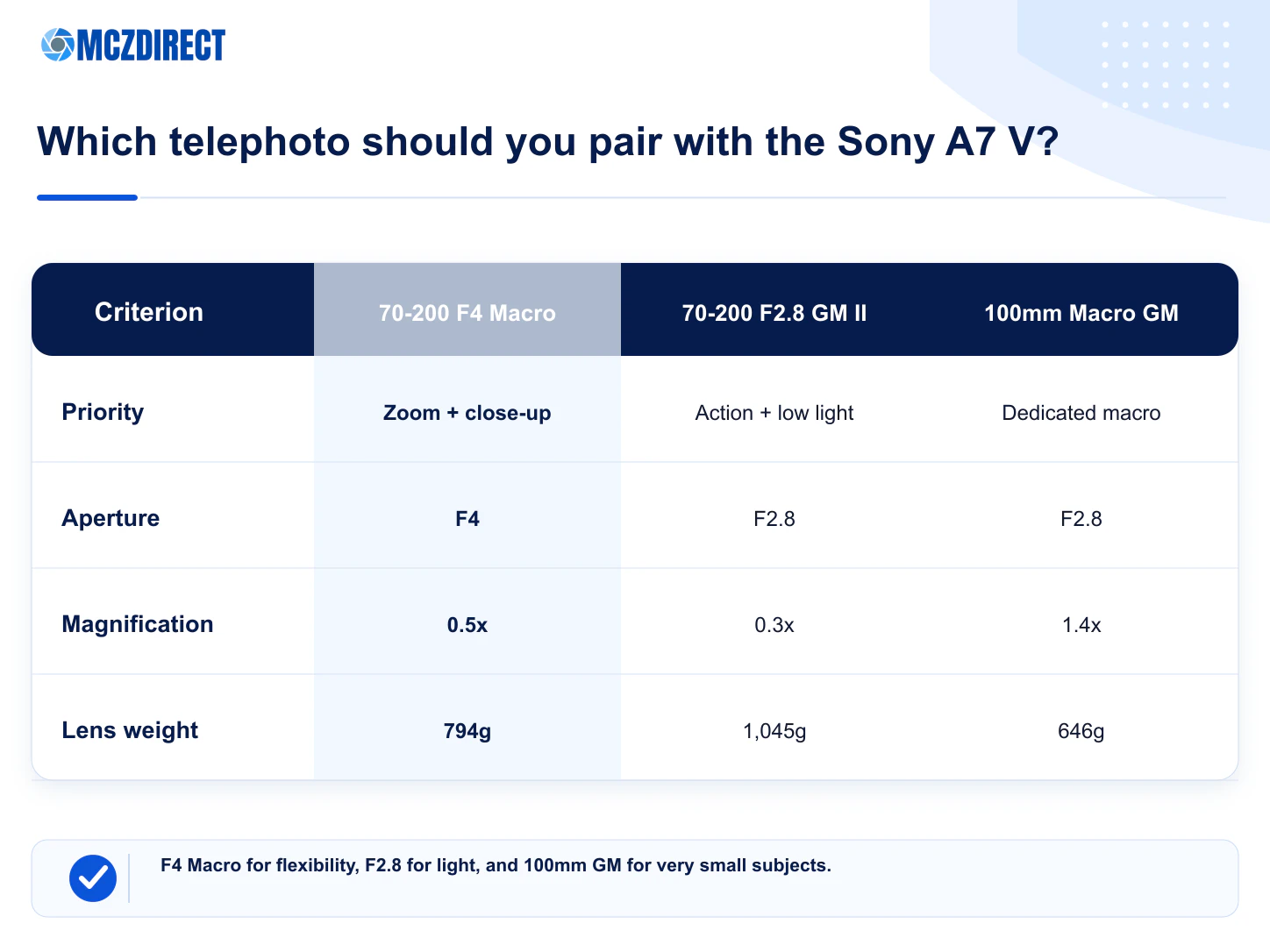
70-200mm F4 Macro or 70-200mm F2.8 GM II?
This is not simply a G versus G Master decision. F2.8 gathers twice as much light at maximum aperture, making fast shutter speeds easier indoors and giving stronger background separation. The F4 Macro answers with closer focusing, 0.5x magnification throughout the range and a more travel-friendly setup.
Wedding and indoor sports photographers may prefer the A7 V with 70-200mm F2.8 GM OSS II. Hikers, nature photographers and outdoor portrait users gain more from the close-focus range and portability of this F4.
| Configuration | Choose it for | Main compromise |
|---|---|---|
| A7 V + 70-200mm F4 Macro G OSS II | Nature, travel, portraits, zoom flexibility and 0.5x close-up. | F4 in low light. |
| A7 V + 70-200mm F2.8 GM OSS II | Weddings, performance, indoor action and background separation. | Less close focus and a higher cost. |
| A7 V + 100mm F2.8 Macro GM | 1.4x macro, products, jewellery and very small subjects. | Fixed focal length with no zoom flexibility. |
Choosing the kit, body or lens separately
This page is dedicated to the A7 V and 70-200mm F4 Macro pairing. Existing Sony E camera owners should use the Sony FE 70-200mm F4 Macro G OSS II lens page. Photographers with a settled lens collection may prefer the Sony Alpha 7 V body. The Sony A7 V range compares the other active configurations.
Our verdict on the Sony A7 V with 70-200mm F4 Macro
At MCZ DIRECT, we see this as the most balanced A7 V telephoto kit for nature and travel photographers who need distant framing, portraits and close detail from one lens. Against the 70-200mm F2.8 GM II, we recommend it when close focus and portability matter more than the extra stop.
The benefit is straightforward: fewer lens changes and more possible compositions during the same outing. The limitation is equally clear. F4 needs good light for indoor action, and 0.5x does not replace a true macro lens for very small subjects. For a photographer who mainly works outdoors and wants to travel with one telezoom, it is an easy choice to justify.

SONYA7VFE70200F4MACROOSSII
9504822335315
Technical specifications
General
Brand
Sony
Product type
Full-frame mirrorless camera with constant-aperture telephoto macro zoom kit
Camera type
Interchangeable-lens digital camera
Product line
Sony Alpha
Product series
Alpha 7
Specific model
ILCE-7M5 + SEL70200G2
Release date
2025-12-02
Available languages
Multilingual, including English
Camera
Level
Advanced / enthusiast
Processor
BIONZ XR2
Image ratio
3:2
Image stabilization
Yes
Autofocus
Yes
Lens mount
Sony E
RAW
Yes
File formats
JPEG (DCF Ver. 2.0, Exif Ver. 2.32, MPF Baseline compliant), HEIF (MPEG-A MIAF compliant), RAW (Sony ARW 6.0 format compliant)
Max burst speed
30 fps
Lens included
Yes
Kit configuration
Sony Alpha 7 V with FE 70-200mm F4 Macro G OSS II
Included lens count
1
Included lens 1
Sony FE 70-200mm F4 Macro G OSS II
Lens 1 model
SEL70200G2
Lens 1 mount
Sony E
Lens 1 format
Full Frame
Lens 1 focal length
70-200 mm
Lens 1 max aperture
Constant F4
Uses
All-round use
Yes
Architecture
No
Landscape
Yes
Portrait
Yes
Travel
Yes
Reportage
Yes
Sports
Yes
Wildlife
Yes
Photo / video
Yes
Vlogging
No
Sensor
Sensor type
35 mm full frame (35.9 x 23.9 mm), Exmor RS CMOS sensor
Sensor size
35.9 x 23.9 mm
Crop factor
1.0x
Autofocus points
759
Resolution
33 MP
Maximum resolution
7008 x 4672
Sensor cleaning
Yes
Standard ISO range
ISO 100-51200
Maximum native ISO
ISO 51200
Expandable ISO
ISO 50-204800 photo / ISO 100-102400 video
Exposure
Metering modes
1200-zone evaluative metering
Metering zones
1200
Exposure compensation
± 5.0 EV (1/3 EV, 1/2 EV steps selectable)
Fastest shutter speed
1/16000 s E / 1/8000 s M
Slowest shutter speed
30 s, Bulb
Bulb mode
Yes
Manual exposure
Yes
White balance settings
Colour temperature range 2500 K-9900 K
Aperture priority
Yes
Shutter priority
Yes
Display
Display type
3.15" (3.2-type) type TFT
Display size
3.2
Display resolution
2095104
Touchscreen
Yes
Live View
Yes
Viewfinder
Viewfinder
Yes
Viewfinder type
0.51" electronic viewfinder (Quad-VGA OLED)
Viewfinder coverage
100%
Viewfinder magnification
Approx. 0.78x (with 50 mm lens at infinity), -1 m-1)
Diopter range
-4.0 to +3.0 m
Flash
Built-in flash
No
Flash sync speed
1/250 s (35 mm full frame)
Flash modes
External Sony Alpha System Flash via Multi Interface Shoe
Flash technology
Sony Multi Interface Shoe
Accessory shoe
Yes
Video
Video function
Yes
Full HD
Yes
4K UHD
Yes
6K video
No
7K video
No
8K video
No
Internal RAW recording
No
Clean HDMI output
Yes
Maximum video resolution
3840 x 2160
Video frame rates
Video up to 3840 x 2160 depending on Sony recording modes
Video compression
XAVC S: MPEG-4 AVC/H.264, XAVC HS: MPEG-H HEVC/H.265
Video file formats
XAVC S HD, XAVC S 4K, XAVC S-I HD, XAVC S-I 4K, XAVC HS 4K
Audio
Built-in microphone
Built-in stereo
Storage
Internal memory
No
Dual card slot
Yes
Memory types
SLOT1: Multi slot for SD (UHS-I/II compliant) memory card / CFexpress 2 Type A card, SLOT2: Slot for SD (UHS-I/II compliant) memory card
Card types
SD, SDHC, SDXC, CFexpress Type A
SD speed classes
Depending on compatible SD/CFexpress card
Connectivity
HDMI
Yes
HDMI type
HDMI Type-A
Microphone input
Yes
Microphone input type
3.5mm stereo minijack or Multi Interface Shoe digital audio depending on model
Headphone output
Yes
USB
Yes
USB type
SuperSpeed USB 10 Gbps (USB 3.2) compatible, PORT2: Hi-Speed USB 480 Mbps (USB 2.0) compatible)
Ethernet
No
Wireless
Wi-Fi
Yes
Bluetooth
Yes
NFC
No
GPS
No
Physical properties
Weight
610 g
Depth
8.24 cm
Width
13.03 cm
Height
9.64 cm
Colour
Black
Waterproof
No
Splash resistant
Yes
Shockproof
No
Dust resistant
Yes
AF assist light
Yes
Minimum operating temperature
0 °C
Maximum operating temperature
40 °C
Battery
Battery
NP-FZ100
Photo battery life
Approx. 630 shots (Viewfinder) / Approx. 750 shots (LCD monitor) (CIPA standard)
USB charging
Yes
USB power delivery
Yes
Charger included
No
Buying guidance
Best for
Nature, travel, outdoor portraits, lighter wildlife, outdoor sport, landscapes and close-up detail.
Less suited to
Very low-light indoor action, extremely distant small birds and native 1:1 macro without a teleconverter.
Compatibility
The included SEL70200G2 is a full-frame Sony E-mount lens directly compatible with the A7 V and Sony 1.4x and 2x teleconverters.
Note
F4 requires more light than F2.8 for fast indoor action; native magnification is 0.5x rather than 1:1.
Included lens
Lens type
Full-frame constant-aperture telephoto macro zoom
Lens series
Sony G
Focal range
70-200 mm
APS-C equivalent
105-300 mm
Optical construction
19 elements in 13 groups
Optical stabilisation
Yes, Optical SteadyShot with MODE3
AF drive
XD Linear Motor
Minimum focusing distance
26 to 42 cm depending on focal length
Maximum magnification
0.5x throughout zoom / 1.0x with optional 2x teleconverter
Minimum aperture
F22
Diaphragm blades
9 circular blades
Lens weight
794g without tripod mount
Filter diameter
72 mm
Lens length
14.9 cm
Lens diameter
82.2 mm
Dust/splash resistance
Dust and moisture-resistant design
Sony A7 V with 70-200mm F4 Macro frequently asked questions
What does this Sony A7 V kit include?
It combines the Sony Alpha 7 V body and FE 70-200mm F4 Macro G OSS II lens.
Who is this configuration for?
It suits nature, travel, portrait, outdoor sport and close-up photographers who want a versatile telezoom.
Does the Sony 70-200mm F4 Macro provide true 1:1 macro?
It reaches 0.5x without accessories. A compatible Sony 2x teleconverter raises it to 1:1.
Is 0.5x magnification available at 70mm and 200mm?
Yes. Sony specifies 0.5x maximum magnification throughout the zoom range.
What is the minimum focus distance?
It ranges from 0.26m at 70mm to 0.42m at 200mm.
Is F4 sufficient for sport?
Yes outdoors in sufficient light. Indoors or at night, a 70-200mm F2.8 makes fast shutter speeds easier.
Is this kit suitable for wildlife?
Yes for wildlife at moderate distances. Very small distant birds may need a longer focal length.
Can this zoom be used for portraits?
Yes. Focal lengths from 85 to 200mm suit outdoor portraits and tighter framing.
How much does the FE 70-200mm F4 Macro G OSS II weigh?
Sony specifies approximately 794g without the tripod mount.
Which teleconverters are compatible?
Sony SEL14TC 1.4x and SEL20TC 2x teleconverters are compatible.
Does F4 remain constant while zooming?
Yes. The maximum aperture remains F4 from 70 to 200mm.
Does stabilisation replace a fast shutter speed?
No. OSS reduces photographer movement but cannot freeze subject movement.
70-200mm F4 Macro or 100mm Macro GM?
Choose the zoom for flexibility and the 100mm Macro GM for very small subjects and 1.4x magnification.
Should I choose this kit or separate components?
Choose this kit for the complete A7 V and 70-200mm F4 Macro pairing; choose the lens alone if you already own a Sony E body.
Reviews Sony Alpha 7 V + FE 70-200mm f/4 Macro G OSS II
0 Rating
Customer photos
No customer photos yet
Tap to zoom
ALEX (In testing phase)