

Shopping Cart

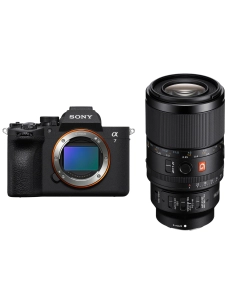
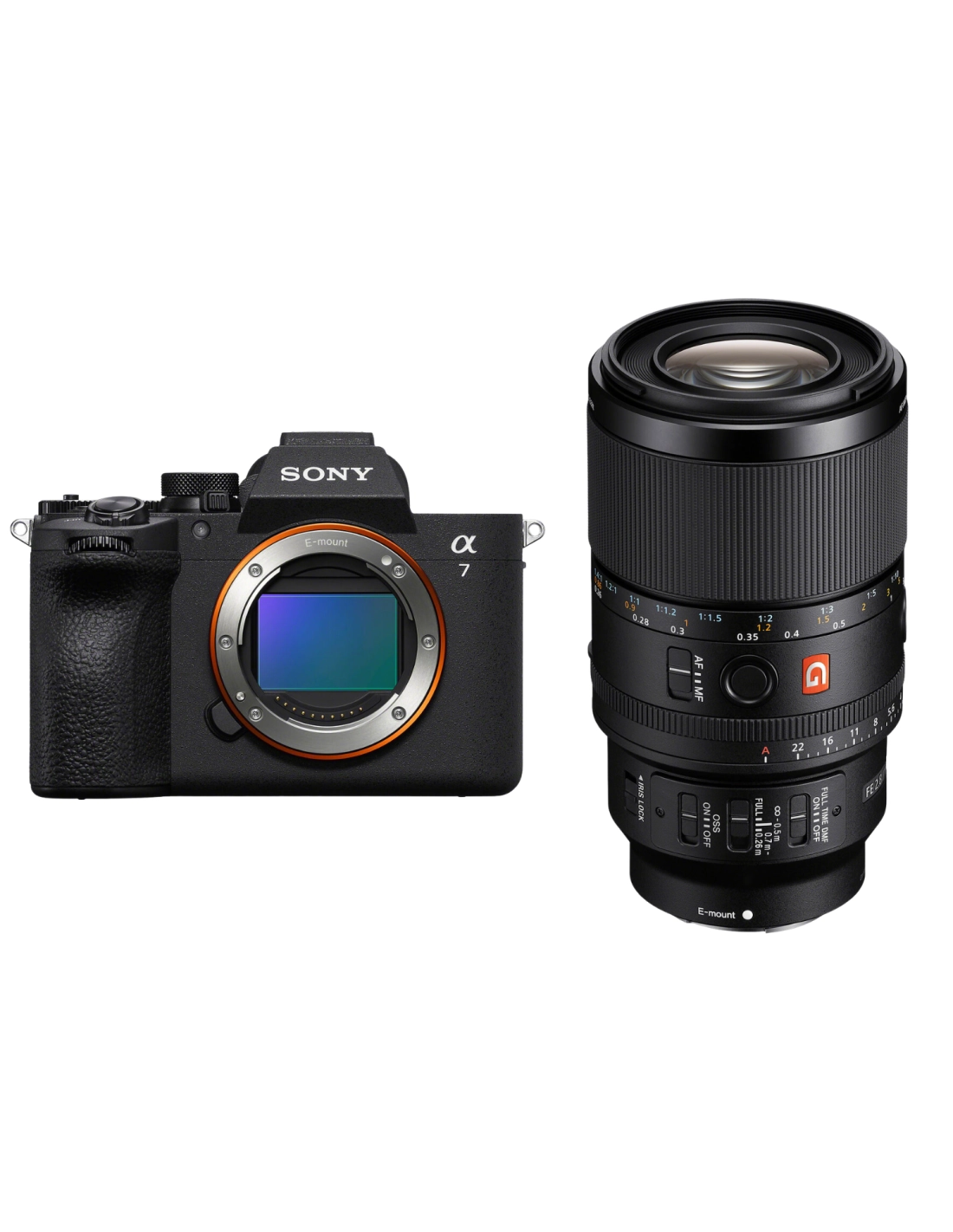
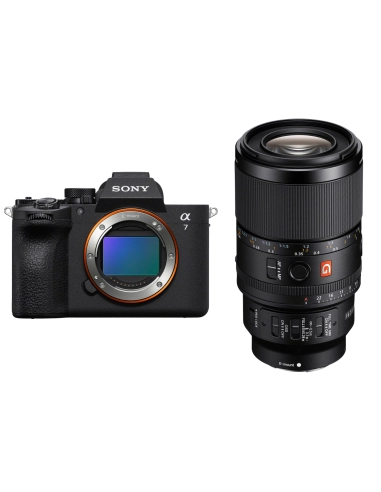
Sony Alpha 7 V + FE 100mm f/2.8 Macro GM
IN STOCK
€3,155.90
€3,322.00-5%
- 100% newBrand-new and authentic product
- Final priceNo unpleasant surprises! The displayed price is the final amount paid for your purchase.
- Estimated delivery Thu 30 - Fri 31 JulEstimate based on available stock, order time, business days and carrier delivery times.
- 3-year MCZ DIRECT warranty
- Free delivery with insurance includedYour order is protected from dispatch to delivery: in case of loss, theft or damage during transport, your parcel is insured up to its value.
The Sony Alpha 7 V with FE 100mm F2.8 Macro GM OSS is a full-frame kit recommended for photographers who need high magnification without giving up responsive handling or wider creative use. The lens reaches 1.4x magnification, revealing details beyond a conventional macro lens limited to 1:1. Four XD Linear Motors and optical stabilisation support careful work with insects, flowers, jewellery and commercial products. The camera contributes a 33MP sensor, advanced subject recognition, electronic shooting up to 30fps and five-axis stabilisation. This combination also works well for tight portraits and detailed video sequences. We recommend it when macro precision, useful subject distance and fast focusing matter more than the framing flexibility of a zoom, making it a particularly coherent choice for photographers building a dedicated close-up system around one capable body.
Sony A7 V with 100mm Macro GM: higher magnification without a slower camera
This kit combines a versatile 33MP body with a macro lens that moves beyond the usual 1:1 reproduction ratio. The Sony FE 100mm F2.8 Macro GM OSS reaches 1.4x without an accessory, so a small mechanism, insect eye or surface texture occupies more of the frame before cropping.
The Alpha 7 V contributes responsive autofocus and practical subject recognition, valuable when the camera-to-subject distance changes unexpectedly. It is not an everyday standard zoom. It is a focused system for photographers who take close-up work seriously while still needing one body for portraits, documentary assignments and detailed video.
Key strengths of the Sony A7 V with 100mm Macro GM
- 1.4x maximum magnification for details beyond a conventional 1:1 macro lens.
- 0.26m minimum focusing distance with useful space for lighting and sensitive subjects.
- Four XD Linear Motors for fast, accurate and quiet stills or video focus.
- Macro-optimised OSS working alongside the camera's five-axis stabilisation.
- 33MP full-frame Exmor RS sensor for fine texture, controlled cropping and demanding output.
- Subject-recognition autofocus to support moving insects, animals and human eyes where applicable.
- F2.8 aperture and 11-blade diaphragm for controlled separation and smooth transitions.
- Two XA and two ED elements with Nano AR Coating II to manage aberrations and flare.
- 646g lens with a 67mm filter thread, reasonable for a high-magnification 100mm macro.
- 1.4x and 2x teleconverter support, with up to 2.8x magnification using the optional 2x converter.
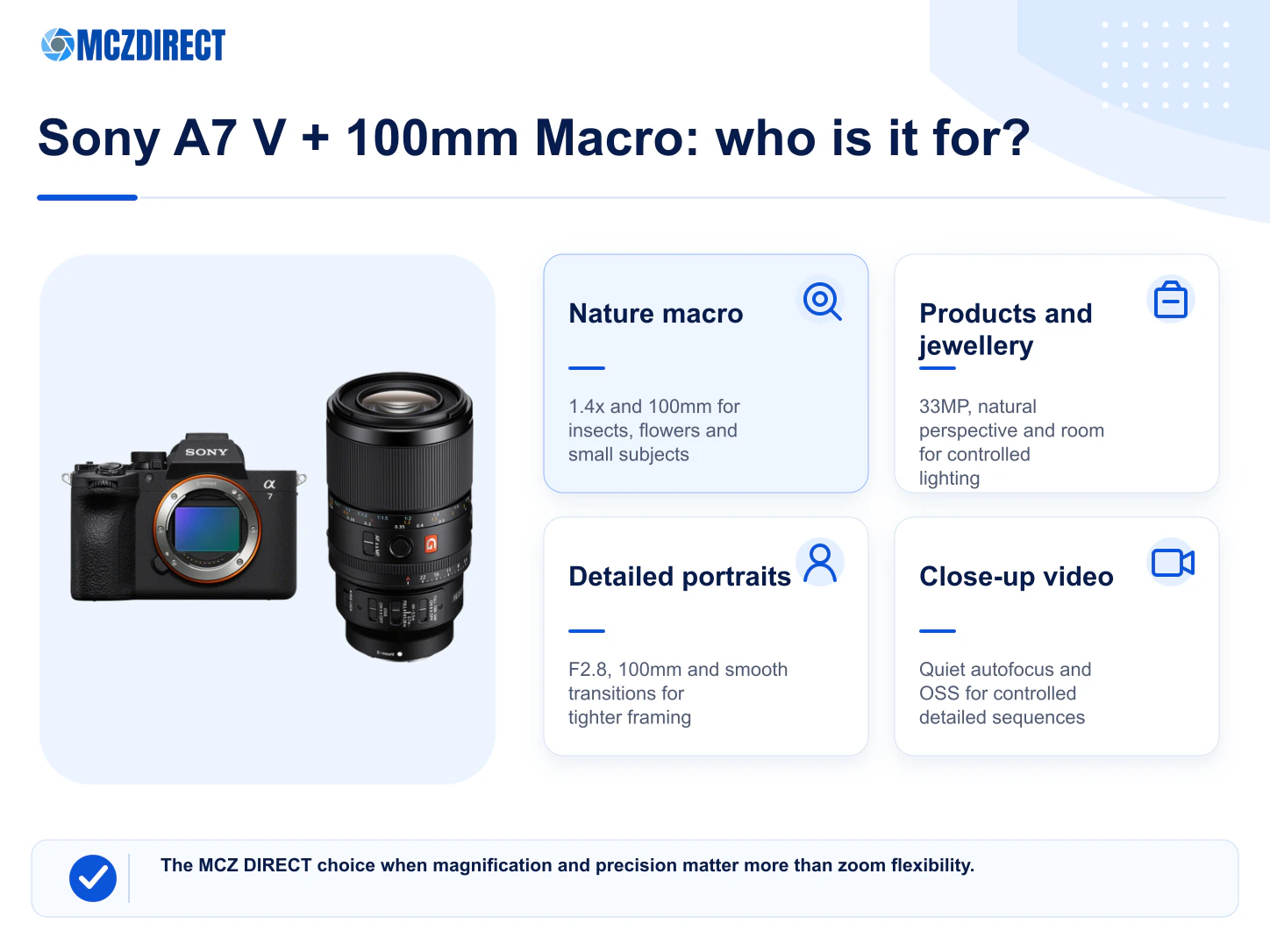
What 1.4x magnification means in real subjects
At 1:1, a 10mm subject projects a 10mm image on the sensor. At 1.4x it projects 14mm. That difference is meaningful for jewellery, watch movements, tiny botanical structures and small wildlife. It does not replace careful lighting or focus, but it reduces the need for heavy cropping.
| Subject | Practical advantage | What to plan for |
|---|---|---|
| Insects and small wildlife | 1.4x magnification, 100mm working perspective and responsive focus. | Depth of field becomes extremely shallow. |
| Jewellery and watches | Fine detail, useful working space and natural perspective. | Stable support and controlled reflections remain essential. |
| Flowers and textures | Smooth transitions and magnification beyond 1:1. | Wind may demand a faster shutter speed. |
| Tight portraits | 100mm perspective, F2.8 and clean subject separation. | High detail can be unforgiving on skin. |
| Close-up video | Quiet focus, OSS and precise reframing. | Camera moves need to remain gentle at close distance. |
Minimum focus and working distance are not the same
Sony measures the 0.26m minimum focus distance from the sensor plane, not from the front element. Actual working distance is shorter, yet the 100mm focal length still leaves more room than a short macro lens. That space makes lighting easier, helps avoid shading the subject and can be less intrusive around insects.
At high magnification, a few millimetres of movement can shift the plane of focus. Autofocus is useful with moving subjects; manual focus and a controlled camera position often provide greater consistency for a static product. Neither method removes the need to manage shutter speed and support.
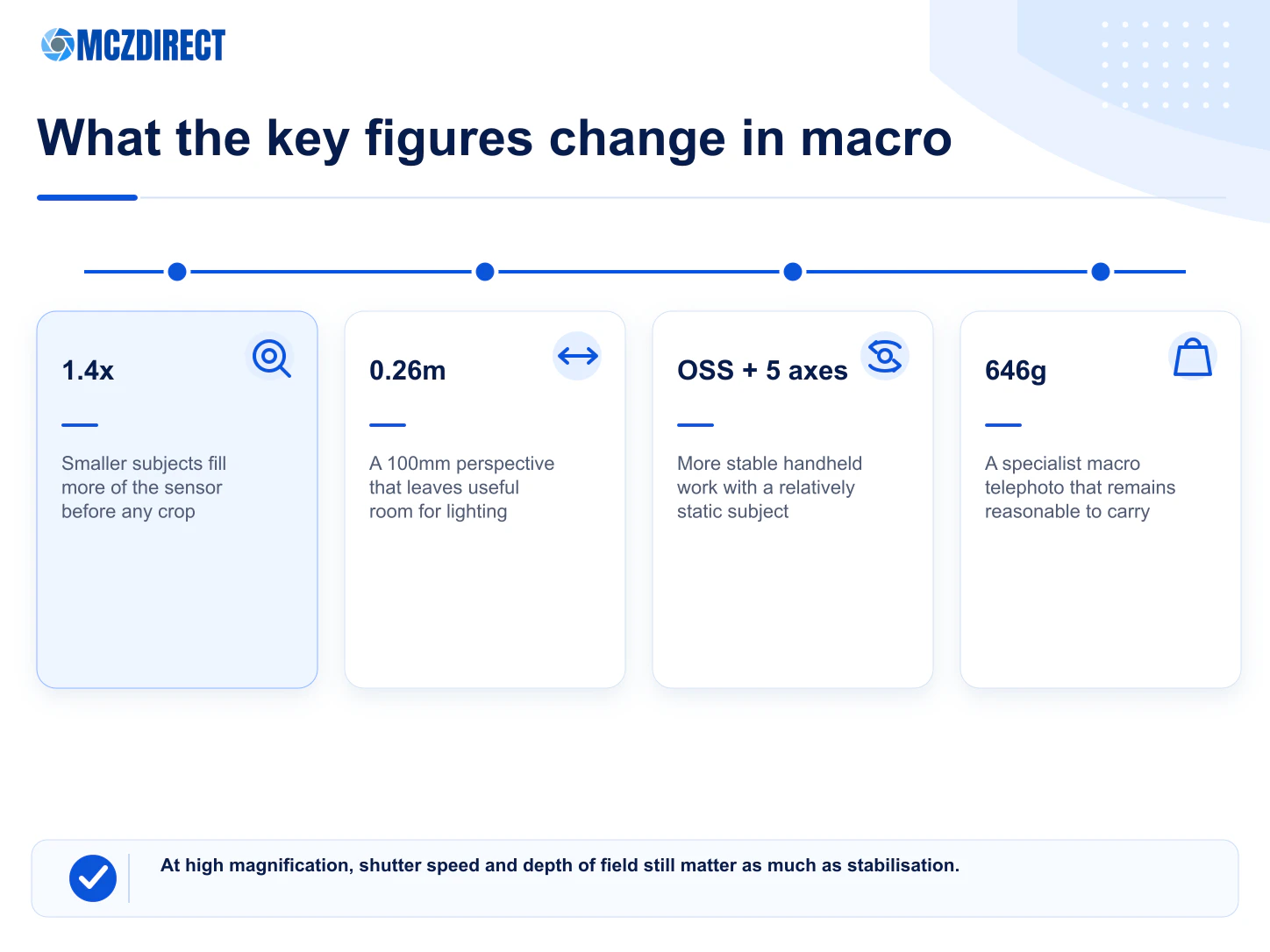
Autofocus, stabilisation and shooting rhythm
Four XD Linear Motors matter when subject distance changes quickly. The lens focuses more decisively than a traditionally slow macro design, while the camera can recognise supported subject types. Electronic shooting up to 30fps gives more choice during a brief movement, within the camera's supported formats and settings.
Optical stabilisation is tuned for close-up work and complements in-body stabilisation. It reduces photographer movement but cannot freeze a live subject. For an insect or flower in motion, shutter speed still takes priority. For a watch or product on a table, a tripod and contact-free release remain the more repeatable solution.
| Feature | What it adds | Honest limitation |
|---|---|---|
| 33MP sensor | Fine detail and moderate cropping without the heaviest files. | The A7R VI retains the resolution advantage for static subjects. |
| 1.4x magnification | Smaller subjects fill more of the frame at capture. | Depth of field becomes extremely narrow. |
| Four XD motors | Fast and quiet photo or video autofocus. | Low contrast and poor light can still affect acquisition. |
| OSS plus five axes | More stable handheld work with relatively static subjects. | Stabilisation cannot stop subject movement. |
| 100mm F2.8 | Working perspective and smooth backgrounds for macro or portraits. | A fixed focal length requires repositioning. |
Product photography and a repeatable workflow
For commercial product work, this pairing strikes a sensible balance. The 33MP files are detailed enough for ecommerce, catalogues and many print uses without creating an unnecessarily heavy session. A 100mm perspective limits distortion and leaves physical room for diffusers. Nano AR Coating II helps control flare, but polished surfaces still depend on careful light shaping.
For consistent output, lock exposure and white balance, keep the subject plane aligned and use a colour target when colour accuracy is critical. The lens does not have to be used at 1.4x: at a longer distance it also gives a natural perspective for complete objects, food details and portraits.
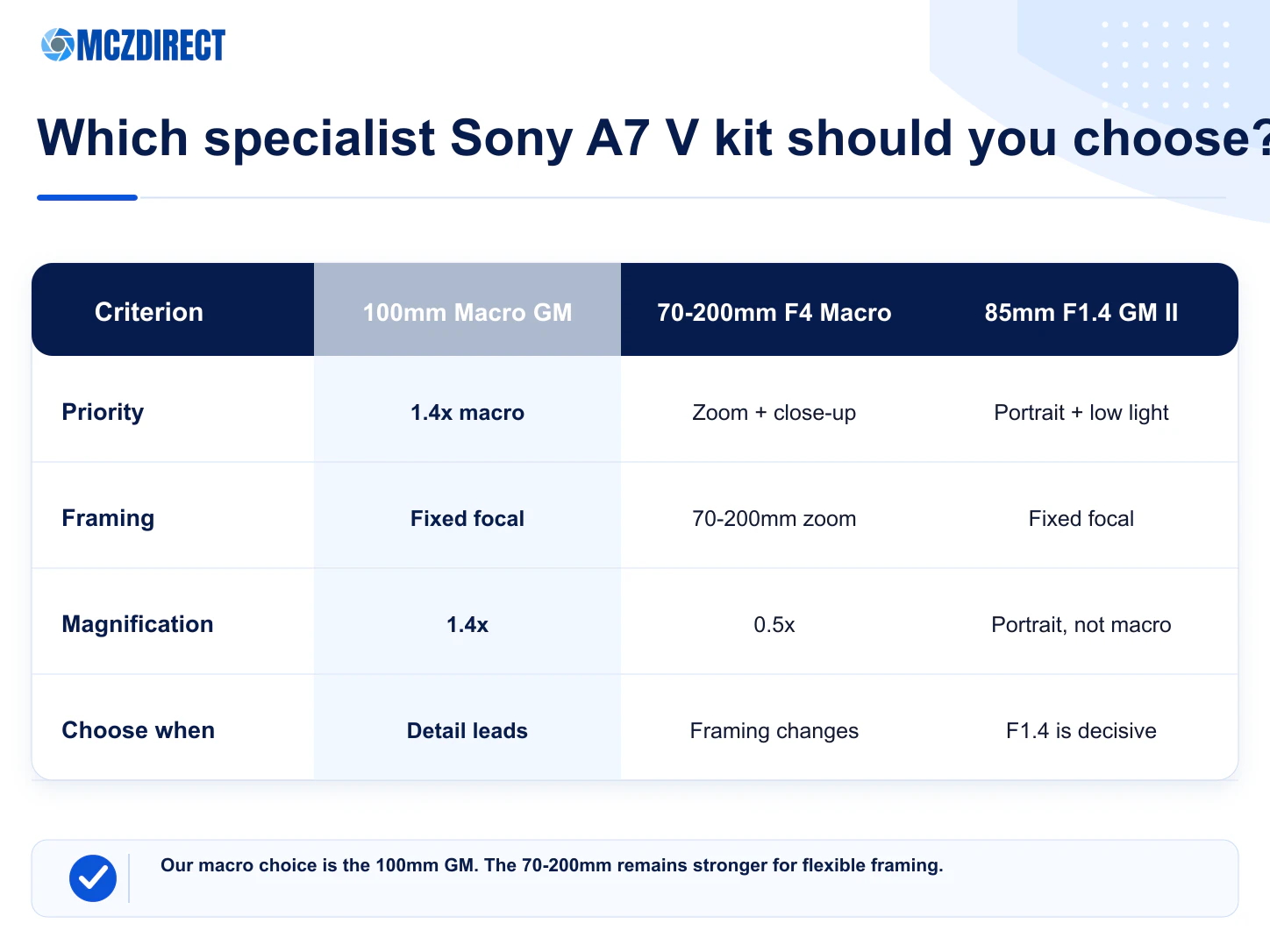
100mm Macro GM, 70-200mm F4 Macro or 85mm F1.4?
The Sony A7 V range includes configurations for different priorities. The 100mm Macro GM maximises magnification and close-up precision. The 70-200mm F4 Macro G OSS II favours zoom flexibility and reaches 0.5x. The 85mm F1.4 GM II is primarily a portrait and low-light choice.
| Configuration | Choose it for | Main compromise |
|---|---|---|
| A7 V + 100mm F2.8 Macro GM | 1.4x macro, products, nature and precise portraits. | Specialist fixed focal length. |
| A7 V + 70-200mm F4 Macro G OSS II | Nature and documentary work with zoom flexibility. | 0.5x maximum magnification. |
| A7 V + 85mm F1.4 GM II | Portraits, low light and very shallow depth of field. | No true macro reproduction. |
| A7R VI + 100mm F2.8 Macro GM | Maximum resolution in studio and static reproduction work. | Larger files and a stronger high-resolution bias. |
Limitations worth understanding
This kit does not replace a standard zoom. A 100mm view is too tight for interiors and general documentary work, while a fixed focal length requires deliberate positioning. At 1.4x, depth of field is tiny; stopping down, adding light or focus stacking may be necessary for a static subject.
The lens also reveals skin texture, dust and support vibration very clearly. That is an optical strength, but it makes preparation more important. The optional 2x teleconverter can raise magnification to 2.8x, with a corresponding loss of light and more demanding focus. It is a specialist extension rather than an automatic upgrade.
Choosing the kit or separate components
This page is dedicated to the Alpha 7 V and 100mm Macro GM pairing. Existing A7 V owners should use the Sony FE 100mm F2.8 Macro GM OSS lens page. Photographers with an established Sony E lens set may prefer the Sony Alpha 7 V body. Keeping those destinations separate prevents the body, lens and kit from competing for the same purchase intent.
Our verdict on the Sony A7 V with 100mm Macro GM
At MCZ DIRECT, we see this as the most convincing A7 V kit for nature, product and detail photographers who want to move beyond 1:1 without adopting a manual-only system. Against the 70-200mm F4 Macro G OSS II, we recommend it when magnification and close-up precision matter more than zoom flexibility.
The 100mm perspective leaves useful space around the subject and 1.4x capture reduces dependence on cropping. Its limitation is equally clear: it is not the only lens for travel or general assignments. For a committed macro practice built around a responsive body that remains capable elsewhere, the combination is unusually coherent.

SONYA7VFE100F28MACOGM
9504747496139
Technical specifications
General
Brand
Sony
Product type
Full-frame mirrorless camera with high-magnification macro prime kit
Camera type
Interchangeable-lens digital camera
Product line
Sony Alpha
Product series
Alpha 7
Specific model
ILCE-7M5 + SEL100M28GM
Release date
2025-12-02
Available languages
Multilingual, including English
Camera
Level
Advanced / enthusiast
Processor
BIONZ XR2
Image ratio
3:2
Image stabilization
Yes
Autofocus
Yes
Lens mount
Sony E
RAW
Yes
File formats
JPEG (DCF Ver. 2.0, Exif Ver. 2.32, MPF Baseline compliant), HEIF (MPEG-A MIAF compliant), RAW (Sony ARW 6.0 format compliant)
Max burst speed
30 fps
Lens included
Yes
Kit configuration
Sony Alpha 7 V with FE 100mm F2.8 Macro GM OSS
Included lens count
1
Included lens 1
Sony FE 100mm F2.8 Macro GM OSS
Lens 1 model
SEL100M28GM
Lens 1 mount
Sony E
Lens 1 format
Full Frame
Lens 1 focal length
100 mm
Lens 1 max aperture
F2.8
Uses
All-round use
No
Architecture
No
Landscape
No
Portrait
Yes
Travel
No
Reportage
No
Sports
No
Wildlife
Yes
Photo / video
Yes
Vlogging
No
Sensor
Sensor type
35 mm full frame (35.9 x 23.9 mm), Exmor RS CMOS sensor
Sensor size
35.9 x 23.9 mm
Crop factor
1.0x
Autofocus points
759
Resolution
33 MP
Maximum resolution
7008 x 4672
Sensor cleaning
Yes
Standard ISO range
ISO 100-51200
Maximum native ISO
ISO 51200
Expandable ISO
ISO 50-204800 photo / ISO 100-102400 video
Exposure
Metering modes
1200-zone evaluative metering
Metering zones
1200
Exposure compensation
± 5.0 EV (1/3 EV, 1/2 EV steps selectable)
Fastest shutter speed
1/16000 s E / 1/8000 s M
Slowest shutter speed
30 s, Bulb
Bulb mode
Yes
Manual exposure
Yes
White balance settings
Colour temperature range 2500 K-9900 K
Aperture priority
Yes
Shutter priority
Yes
Display
Display type
3.15" (3.2-type) type TFT
Display size
3.2
Display resolution
2095104
Touchscreen
Yes
Live View
Yes
Viewfinder
Viewfinder
Yes
Viewfinder type
0.51" electronic viewfinder (Quad-VGA OLED)
Viewfinder coverage
100%
Viewfinder magnification
Approx. 0.78x (with 50 mm lens at infinity), -1 m-1)
Diopter range
-4.0 to +3.0 m
Flash
Built-in flash
No
Flash sync speed
1/250 s (35 mm full frame)
Flash modes
External Sony Alpha System Flash via Multi Interface Shoe
Flash technology
Sony Multi Interface Shoe
Accessory shoe
Yes
Video
Video function
Yes
Full HD
Yes
4K UHD
Yes
6K video
No
7K video
No
8K video
No
Internal RAW recording
No
Clean HDMI output
Yes
Maximum video resolution
3840 x 2160
Video frame rates
Video up to 3840 x 2160 depending on Sony recording modes
Video compression
XAVC S: MPEG-4 AVC/H.264, XAVC HS: MPEG-H HEVC/H.265
Video file formats
XAVC S HD, XAVC S 4K, XAVC S-I HD, XAVC S-I 4K, XAVC HS 4K
Audio
Built-in microphone
Built-in stereo
Storage
Internal memory
No
Dual card slot
Yes
Memory types
SLOT1: Multi slot for SD (UHS-I/II compliant) memory card / CFexpress 2 Type A card, SLOT2: Slot for SD (UHS-I/II compliant) memory card
Card types
SD, SDHC, SDXC, CFexpress Type A
SD speed classes
Depending on compatible SD/CFexpress card
Connectivity
HDMI
Yes
HDMI type
HDMI Type-A
Microphone input
Yes
Microphone input type
3.5mm stereo minijack or Multi Interface Shoe digital audio depending on model
Headphone output
Yes
USB
Yes
USB type
SuperSpeed USB 10 Gbps (USB 3.2) compatible, PORT2: Hi-Speed USB 480 Mbps (USB 2.0) compatible)
Ethernet
No
Wireless
Wi-Fi
Yes
Bluetooth
Yes
NFC
No
GPS
No
Physical properties
Weight
610 g
Depth
8.24 cm
Width
13.03 cm
Height
9.64 cm
Colour
Black
Waterproof
No
Splash resistant
Yes
Shockproof
No
Dust resistant
Yes
AF assist light
Yes
Minimum operating temperature
0 °C
Maximum operating temperature
40 °C
Battery
Battery
NP-FZ100
Photo battery life
Approx. 630 shots (Viewfinder) / Approx. 750 shots (LCD monitor) (CIPA standard)
USB charging
Yes
USB power delivery
Yes
Charger included
No
Buying guidance
Best for
Macro nature, insects, flowers, jewellery, watches, product photography, close-up video and detailed portraits.
Less suited to
Interiors, general documentary, one-lens travel and photographers who need zoom framing flexibility.
Compatibility
The included SEL100M28GM is a full-frame Sony E-mount lens directly compatible with the A7 V and compatible with Sony 1.4x and 2x teleconverters.
Note
A fixed 100mm lens is too tight for interiors and does not provide zoom framing flexibility.
Included lens
Lens type
Full-frame high-magnification macro prime lens
Lens series
Sony G Master
Focal range
100 mm
APS-C equivalent
150 mm
Optical construction
17 elements in 13 groups
Optical stabilisation
Yes, macro-optimised OSS
AF drive
Four XD Linear Motors
Minimum focusing distance
26 cm
Maximum magnification
1.4x / up to 2.8x with optional 2x teleconverter
Minimum aperture
F22
Diaphragm blades
11 circular blades
Lens weight
646 g
Filter diameter
67 mm
Lens length
14.79 cm
Lens diameter
81.4 mm
Dust/splash resistance
Dust and moisture-resistant design
Sony A7 V with 100mm Macro GM frequently asked questions
What does this Sony A7 V kit include?
It combines the Sony Alpha 7 V body and FE 100mm F2.8 Macro GM OSS lens.
Who is this kit for?
It suits macro, nature, product, detail and portrait photographers who want responsive autofocus and more than 1:1 reproduction.
What does 1.4x macro magnification mean?
A 10mm subject projects a 14mm image on the sensor, compared with 10mm at 1:1.
Can the lens reach 2.8x magnification?
Yes. Sony specifies up to 2.8x with the compatible optional 2x teleconverter.
What is the minimum focusing distance?
It is 0.26m, measured from the sensor plane rather than the front of the lens.
Does stabilisation replace a tripod?
Not in every situation. It reduces photographer movement but cannot freeze the subject; support remains preferable for maximum precision.
Is autofocus suitable for moving insects?
Four XD motors and camera subject recognition support tracking, without guaranteeing every frame when movement is unpredictable.
Is this kit suitable for jewellery photography?
Yes. The 1.4x ratio, 33MP sensor and 100mm perspective suit jewellery, watches and small products with controlled lighting.
Can the 100mm Macro GM be used for portraits?
Yes. Its 100mm focal length and F2.8 aperture suit tight portraits, with very high detail.
Is the kit suitable for macro video?
Yes. Quiet autofocus, OSS and the camera's 4K modes help, although movement should remain controlled at high magnification.
100mm Macro GM or Sony 90mm Macro G?
The 100mm GM prioritises 1.4x magnification, newer XD motors and teleconverter support; the 90mm is limited to 1:1.
100mm Macro GM or 70-200mm F4 Macro G OSS II?
Choose the 100mm for 1.4x detail; choose the 70-200mm for zoom flexibility with 0.5x maximum magnification.
How much does the lens weigh?
The Sony FE 100mm F2.8 Macro GM OSS weighs approximately 646g according to Sony.
Should I choose this kit or the body only?
Choose this kit to begin directly with 1.4x macro; choose the body only if you already own a suitable lens.
Reviews Sony Alpha 7 V + FE 100mm f/2.8 Macro GM
0 Rating
Customer photos
No customer photos yet
Tap to zoom
ALEX (In testing phase)