
Shopping Cart
Nikon Z6 III vs Nikon Z8: which should you buy in 2026?

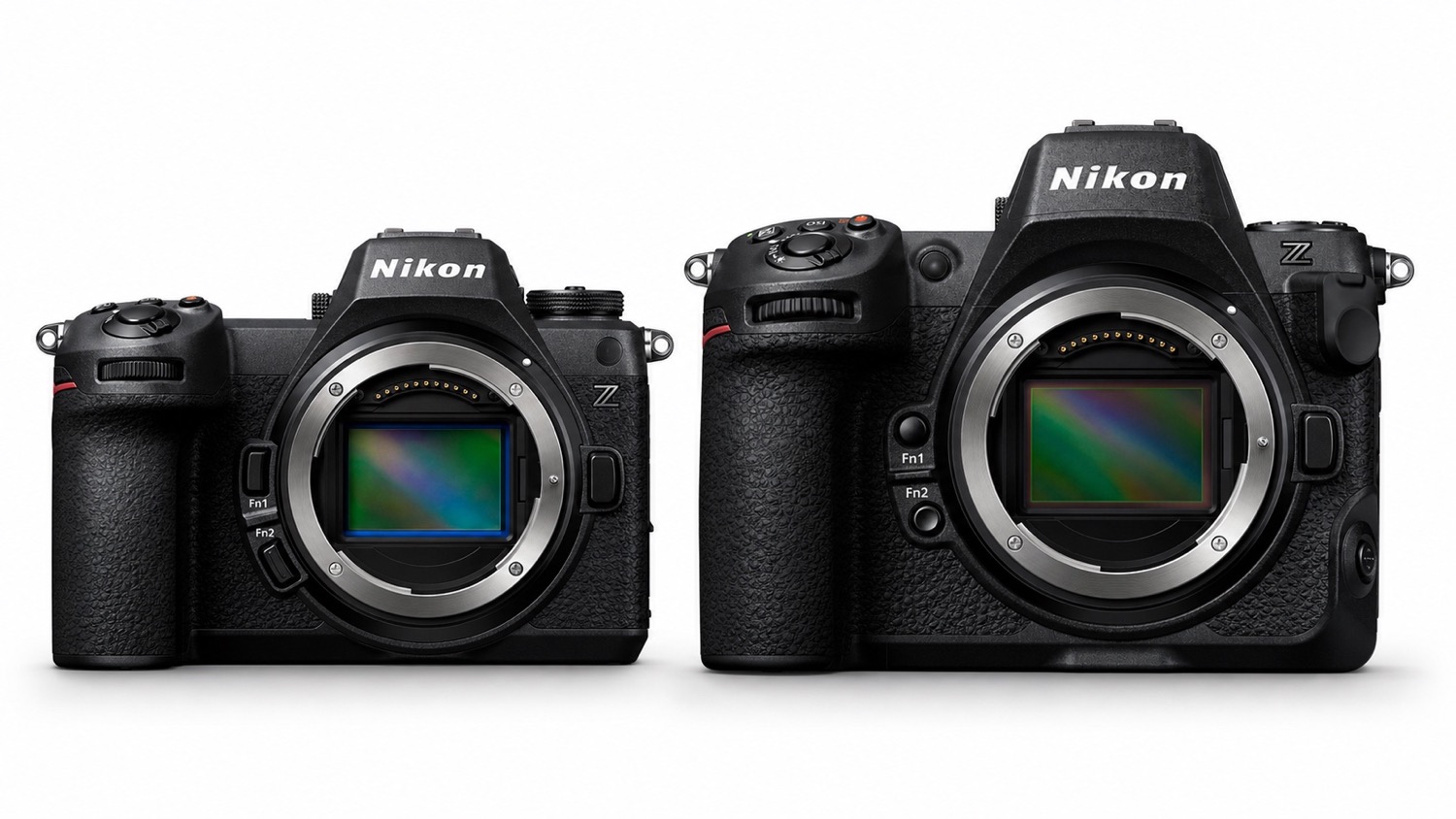
Picture two working days. The first ends with 3,000 wedding photographs to import, back up, select and deliver. The second begins beside a pitch, with a subject you cannot bring closer or ask to repeat the moment. On the first day, lighter RAW files make everything after the shoot easier. On the second, the Z8's extra pixels and uninterrupted view can rescue a composition.
The short answer. The Nikon Z6 III is the better-balanced choice for most photographers and filmmakers. It is lighter to carry, its 24.5MP files are quicker to process and it already records 6K RAW video. Choose the Nikon Z8 when its 45.7MP resolution, blackout-free viewfinder, faster sensor readout or full-frame 4K/120p solves a recurring problem. It is particularly well suited to distant wildlife, sport, detailed landscapes, studio work and productions that use 8K. For weddings, reportage, travel or a 4K delivery, the Z6 III leaves more of the budget for the lens that will change the image.
That is the real difficulty in this comparison. The Z8 is the more capable camera, but that capability has a cost: you carry it, store it and process it. The Z6 III places fewer demands on the rest of the system. The right choice is not the camera that wins the most rows in a table. It is the one whose compromises fit the way you work.
Nikon Z6 III or Nikon Z8: the one-minute answer
| Your situation | Useful reference point | Choice | What it changes in practice |
|---|---|---|---|
| One camera for stills and video | 24.5MP, 20 fps RAW, 6K/60p RAW, 760g | Nikon Z6 III | It covers varied deliverables without imposing the Z8's data volumes. |
| Weddings, reportage and travel | 760g versus 910g | Nikon Z6 III | Both the bag and the files stay lighter through a long day. |
| Sport and silent action | 20 fps RAW on both; faster stacked-sensor readout and a blackout-free view on the Z8 | Nikon Z8 | You keep sight of the subject and fast movement is less likely to distort with the electronic shutter. |
| Distant wildlife and birds | 45.7MP versus 24.5MP | Nikon Z8 | A heavy crop retains more detail. At a fixed budget, however, a longer lens can reverse the decision. |
| Landscape, architecture and studio | 45.7MP and native ISO 64 | Nikon Z8 | Large prints and detailed retouching benefit from the resolution; web output benefits far less. |
| YouTube, interviews and wedding films | 6K RAW and a forward-facing screen | Nikon Z6 III | The kit stays compact and 6K already provides room for a 4K delivery. |
| Full-frame slow motion and an 8K master | 4K/120p FX and 8.3K/60p N-RAW | Nikon Z8 | Wide-angle coverage is preserved in slow motion, but the cards and computer must keep up. |
| Keeping the whole system on budget | €860.70 difference recorded on 9 August 2026 | Nikon Z6 III | The saving can pay for a lens, cards or a sound backup plan. |
One rule resolves many close decisions. If you cannot explain how 45.7MP or full-frame 4K/120p would change a specific project, start with the Z6 III. If you can name several recent jobs where either feature would have removed a compromise, the Z8 is unlikely to be excessive.
The differences you can see on the shoot and in the edit
Both cameras use the Nikon Z mount, the EXPEED 7 processor, five-axis in-body stabilisation and Nikon's current subject-detection modes. Both record RAW video internally and pair one CFexpress Type B/XQD slot with one UHS-II SD slot. That shared foundation explains why the Z6 III is enough for so many projects.
Their priorities separate as soon as the action speeds up or the files become larger. The Z6 III's 24.5MP partially stacked sensor retains a mechanical shutter and keeps copying, selection and backup times down. The Z8's 45.7MP stacked sensor works with an electronic shutter only, but its faster readout and Real-Live viewfinder maintain a continuous visual reference during a burst. For video, the decision is mainly 6K versus 8.3K and DX-cropped 4K/120p versus full-frame FX.
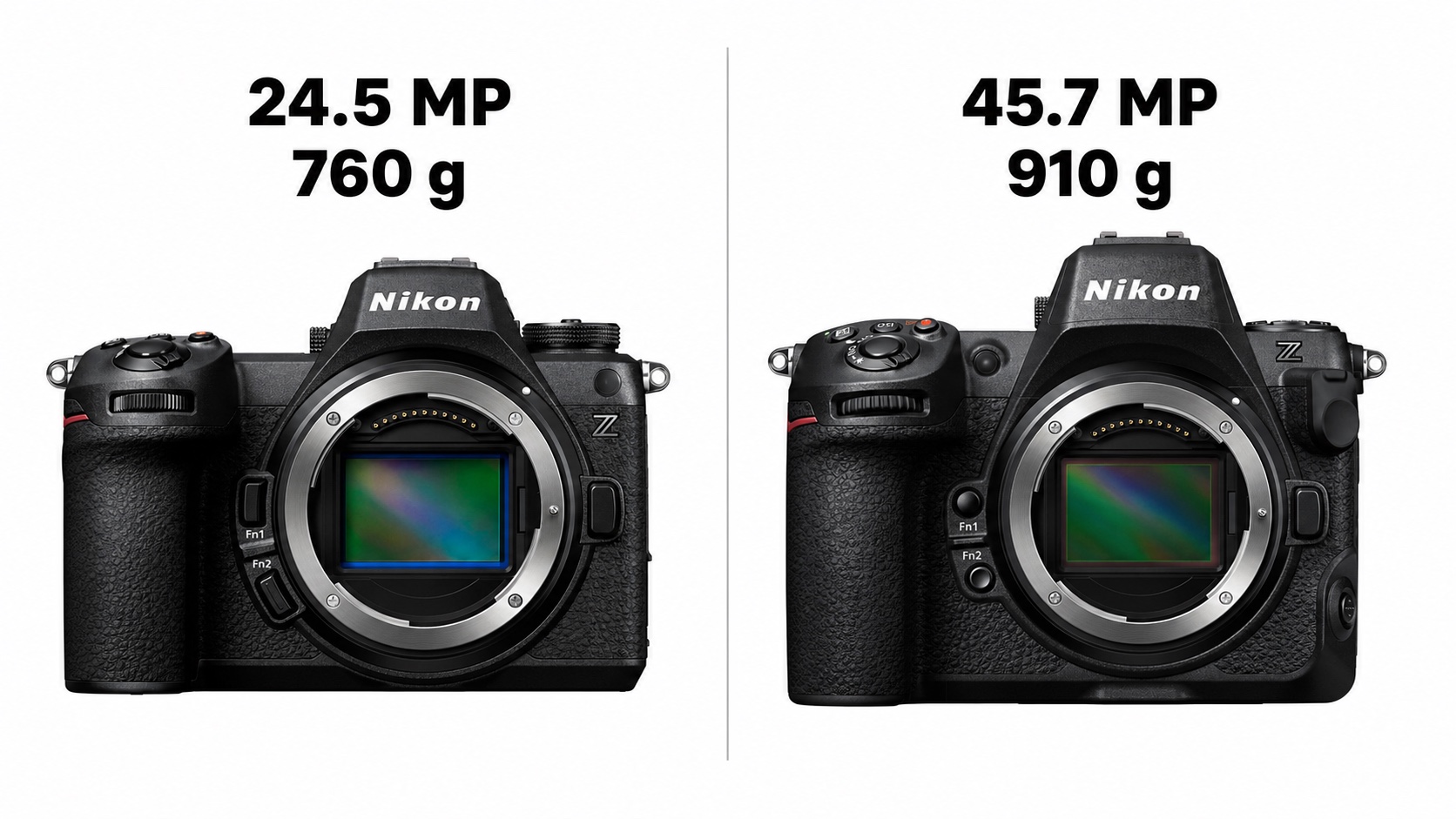
The Z8 adds 21.2MP, but the body also weighs 150g more and produces substantially larger files.
Image quality: how many pixels do you need?
When 45.7MP becomes visible
A bird remains tiny in the viewfinder. A ceremony forces you to work from the back of the room. A campaign needs one photograph to supply a poster, a banner and several vertical crops. In these situations, the Z8 has a straightforward advantage: its file contains almost twice as many pixels.
A DX crop leaves about 19MP on the Z8 and roughly 10.6MP on the Z6 III. That reserve can separate a comfortable file from one that falls short of the intended print. It also helps with landscape, architecture and studio work, provided the lens, focus and camera stability are good enough to use it.
For an album, an online gallery, editorial reportage or an everyday print, 24.5MP is hardly a consolation prize. It already provides a large file and reasonable room to crop. The Z8 adds visible quality only when the final output is printed large enough or cropped hard enough to show it. At the same display size, a sharp Z6 III image does not become worse because another camera has more pixels.
The Z8 also starts at native ISO 64, which is useful under controlled lighting. You can open the aperture further or use a slower shutter before reaching for a filter, while retaining strong highlight latitude. Measurements from Photons to Photos show that advantage at low ISO, followed by much closer performance as sensitivity rises. Fewer pixels do not automatically make the Z6 III the better low-light camera.
At a concert or in a dark church, lens aperture and the shutter speed needed for the subject often matter more. At the same final output size, downsampling narrows visible noise differences; the Z8's 45.7MP file still helps when a heavy crop is required. There is no universal night-time winner.
What higher resolution adds after the shutter is pressed
The difference continues after capture. Nikon's tables give roughly 27.3MB for a 14-bit lossless RAW from the Z6 III and 51.6MB for the equivalent Z8 file. Across 4,000 photographs, that is approximately 109GB versus 206GB before the backup copy. Exact file sizes vary, but the practical effect does not: cards, imports, previews, backups and archives all grow together.
The Z8 offers High Efficiency RAW options that reduce this burden substantially. You still need to confirm that your software handles them properly and decide whether that is the format you want to archive. The Z6 III remains simpler for photographers who shoot in volume and deliver quickly.
Pixel Shift does not alter this comparison for moving subjects. The camera shifts its sensor across 4, 8, 16 or 32 exposures, which Nikon NX Studio then combines. The result can reach about 96MP on the Z6 III and 180MP on the Z8, but both camera and scene must remain still. A moving leaf, an animal or changing light can create artefacts. This is a tool for reproduction, product photography or a static interior on a tripod, not the camera's everyday resolution.
Autofocus and action: the same headline speed, different behaviour
Compare autofocus with current firmware
Firmware C 2.00 added a dedicated bird-detection mode, Auto Capture, a focus-distance limiter and C15 to the Z6 III. The Z8 is assessed here on C 3.10. Both recognise people, dogs, cats, birds and several types of vehicle. There is no like-for-like test on these current versions that supports a clean percentage difference in autofocus success.
Results depend on the lens, the subject's speed and size in the frame, the AF-area mode and depth of field. The Z8's clear advantage is its much faster full-resolution electronic readout and blackout-free viewfinder. The Z6 III counters with a higher-resolution viewfinder, 20 fps RAW shooting, current subject detection and the option to return to a mechanical shutter.
Following a bird that changes direction without warning shows what the Z8 can do. The view does not disappear between frames, which makes it easier to hold the subject in the right part of the composition. For a runner crossing a clear zone or a short wedding burst, the Z6 III's 20 fps and tracking already cover the job. The Z8's hardware advantages matter most when fast action sits at the centre of your work.
At 20 fps, the RAW format determines burst length
Both cameras reach 20 fps in compatible RAW modes. The Z6 III also offers about 14 fps with its mechanical shutter. C15, C30, C60 and C120, as well as pre-release capture, record Fine or Normal JPEGs; the fastest modes may also reduce resolution or change the image area. Before the action starts, you must decide whether RAW flexibility or capturing the moment before a full shutter press matters more.
The buffer tells the rest of the story. In Nikon's published configuration, the Z6 III can exceed 1,000 lossless RAW files. The Z8 lasts for fewer frames in that heavy format, but also passes 1,000 frames in High Efficiency RAW. These are not perfectly matched tests. Their useful lesson is how strongly card performance and compression affect a high-resolution burst.
Open measurements from TestCams/Horshack show that the Z8 reads its full-resolution electronic stills image almost four times faster. A golf club, a wing or a vertical line during a pan is less likely to bend. When silence is not essential, or artificial lighting produces bands, the Z6 III lets you try its mechanical shutter instead. That will not eliminate every kind of flicker.
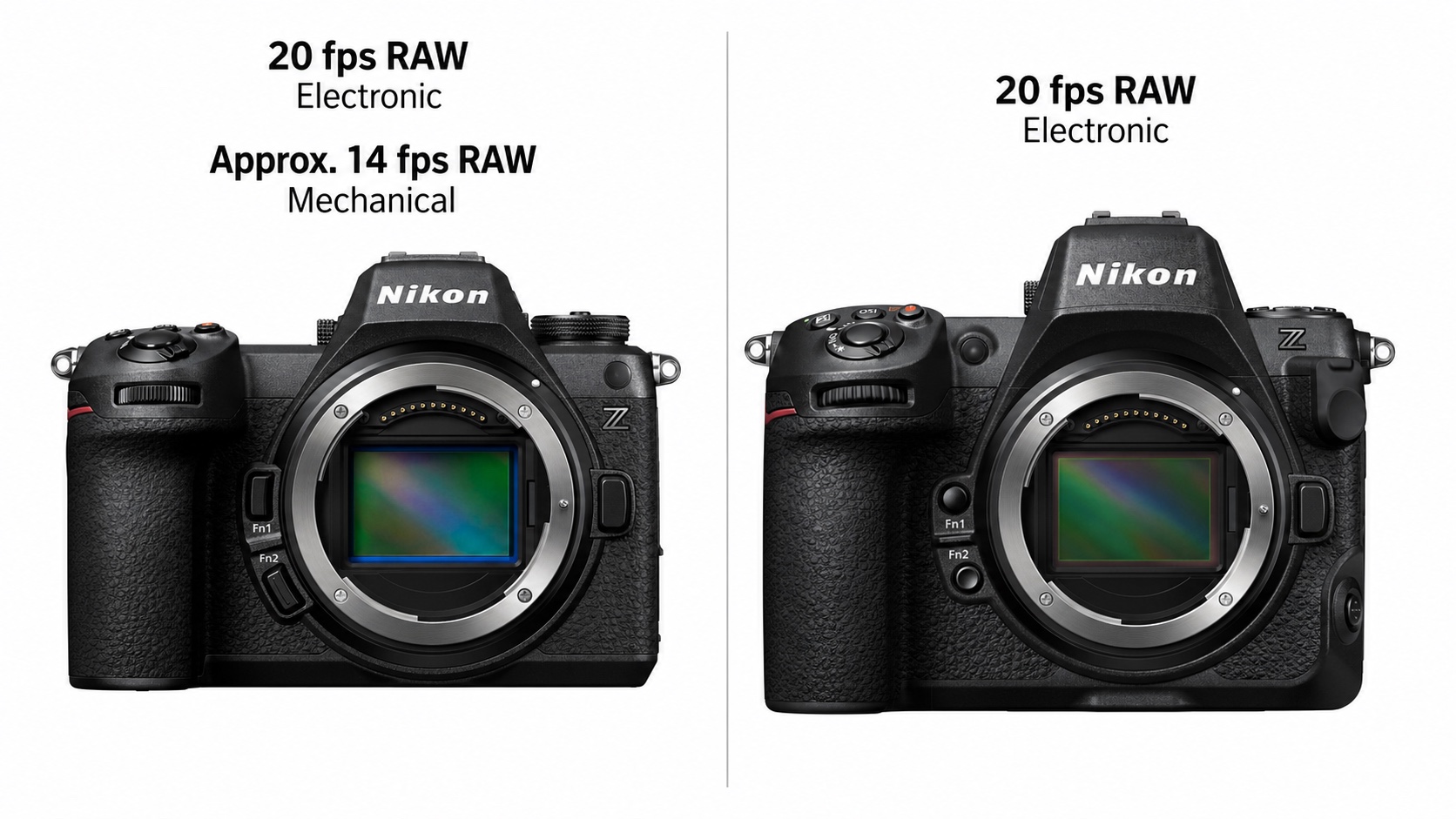
Both cameras reach 20 fps in electronic RAW. The Z6 III also offers about 14 fps RAW with its mechanical shutter; the Z8 adds faster readout and a blackout-free view.
Video: start with the file you need to deliver
What 6K and 8.3K change in the edit
A YouTube interview, a wedding delivered in 4K and an advertising shot that will be reframed three times do not need the same source file. The Z6 III records up to 6K/60p 12-bit N-RAW and 6K/30p ProRes RAW HQ. The Z8 reaches 8.3K/60p N-RAW. Both can retain substantial grading latitude without an external RAW recorder.
For a 4K delivery, the Z6 III's 6K already leaves room to stabilise, make a modest crop or create a second composition. The Z8's 8.3K earns its place when a production needs several shots from one take, a highly detailed master or a major crop. If none of those steps exists in the edit, 8K mainly adds data.
The Z8 does not win every video-readout comparison. Independent measurements show that the Z6 III can read faster in some full-frame video modes, even though the Z8 is clearly ahead for electronic stills. Resolution and frame rate change how the sensor data is read.
Full-frame 4K/120p may be the more important difference
The Z6 III records 4K/120p slow motion from a DX area. A 24mm lens then gives roughly the field of view of a 36mm lens. In a small room, on a gimbal or when filming yourself, that crop can force you to change lens or step back, and either may be impossible.
The Z8 retains the FX area at 4K/120p. For a wide-angle music video, an advert or sport filmed regularly in slow motion, that is often more useful than the 8K badge alone. If 120p appears twice a year to isolate one movement and the DX composition works, the Z6 III is enough.
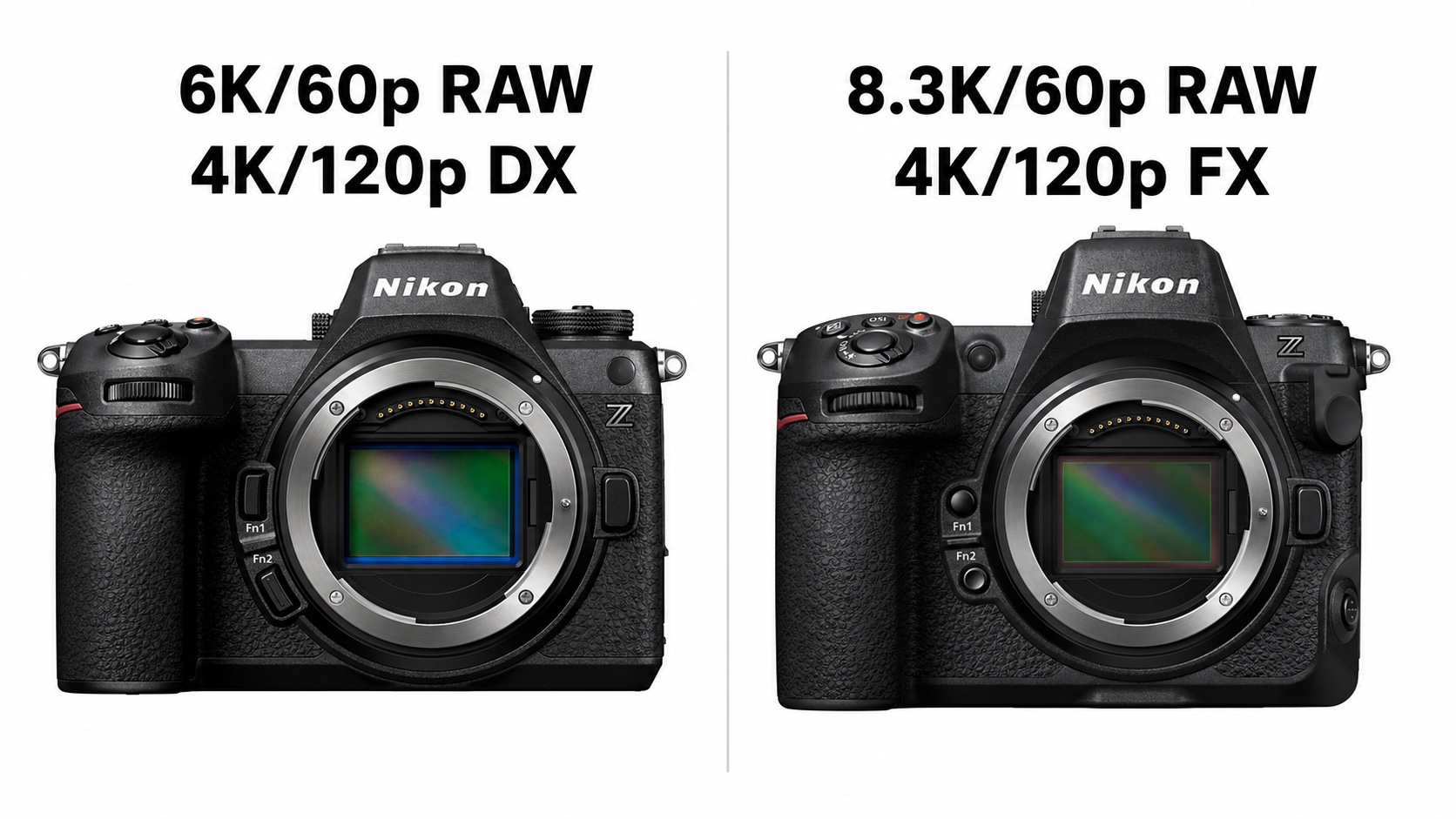
The Z6 III already covers a demanding 4K production. The Z8 adds room for full-frame slow motion, heavier reframing and an 8K master.
Choose the codec, card and computer together
N-RAW and ProRes RAW preserve wide grading latitude, but they require compatible software, fast cards and plenty of space. For a lighter production, 10-bit H.265 with N-Log retains useful flexibility at smaller file sizes. The right format is one that the entire chain can read, back up and deliver without improvisation.
Nikon's longest quoted recording times apply to specific 8-bit H.265 conditions, not 6K or 8K RAW. For a long interview or performance, test the exact mode with the card, power supply and expected temperature, then keep a less demanding fallback setting ready.
With the firmware checked here, person, animal and vehicle detection also work in video. No matched comparison supports a universal success-rate winner; for a moving interview subject, the AF area and transition speed matter as much as the body. The Z6 III's forward-facing screen and lower weight simplify a small rig, while the Z8's separate USB-C data and power ports suit a powered, connected setup. On both cameras, IBIS settles small movements but does not replace a tripod for a long interview or a gimbal for smooth walking shots.
Handling: the camera you will still want to carry at 6pm
150g less and a smaller grip
The Z6 III weighs about 760g with battery and card, compared with 910g for the Z8. One hundred and fifty grams sounds modest beside a 180-600mm lens. You feel it again on every walk, every move to a gimbal and every hour spent with two bodies on your shoulders.
The Z8 answers with a taller grip and more room around its controls. That shape provides more support behind a large telephoto lens. The Z6 III fits more easily into a travel bag and makes a lighter combination with a standard zoom. Handle both first if you have very large hands or regularly work in gloves.
The viewfinders serve different priorities. The Z6 III has 5.76 million dots, a high quoted brightness and DCI-P3 coverage. The Z8's 3.69-million-dot specification is lower, but its Real-Live display remains blackout-free during bursts. One prioritises display detail; the other, continuity while tracking.
Flip-out, four-axis tilt and long working days
The Z6 III's screen turns forwards. It suits solo filming, vertical compositions and unusual angles, although the picture sits to the side of the camera. The Z8's monitor tilts on four axes and remains behind the optical axis in both horizontal and vertical shooting; it does not face the subject. This keeps composition aligned with the lens when the camera is held low.
Nikon documents illuminated controls on the Z8, which are helpful at a performance or before dawn. On the Z6 III, Nikon documents illumination for the top control panel. The Z8 also has a sensor shield that closes when the camera is switched off.
Nikon describes both cameras as resistant to dust and moisture and specifies operation down to -10°C. Neither carries a published IP rating: resistant does not mean waterproof. A rain cover and sheltered lens changes remain sensible in heavy rain.
Both use the EN-EL15c, with a small official advantage for the Z6 III: up to about 410 shots using the monitor and 100 minutes of video, compared with 370 shots and 85 minutes for the Z8 in Nikon's protocols. A spare battery is still necessary for a long day. The Z6 III's MB-N14 and the Z8's MB-N12 battery grips extend endurance, but they are not interchangeable.
Which Nikon suits the way you shoot?
Portraits, weddings, reportage and concerts
For a wedding, our starting point is the Z6 III. Its files are faster to select after a long day, the body is lighter and its mechanical shutter provides another option when artificial lighting causes bands. Its 24.5MP files are ample for albums, online galleries and everyday prints. The Z8 becomes the better choice if you often crop a ceremony from a fixed position, take several compositions from one portrait or regularly supply very large displays. A NIKKOR Z 24-70mm f/2.8 S can cover preparations, ceremony and reception without changing aperture.
For street photography and reportage, the Z6 III draws less attention and fills cards more slowly. The Z8 remains useful when you need silent capture of fast gestures or expect to rebuild a composition afterwards. A 35mm or 50mm prime makes the kit still more discreet; a 24-120mm prioritises versatility and fewer lens changes.
At a concert, pixel count alone does not decide the high-ISO winner. The Z6 III's bright viewfinder and mechanical option provide flexibility under difficult LED lighting, although they cannot guarantee freedom from banding. The Z8 is better suited to absolute silence and fast performers because of its electronic readout. A NIKKOR Z 70-200mm f/2.8 VR S mainly provides the speed and framing needed from a pit or balcony.
Sport, wildlife and birds
The balance changes at the track or touchline. For sport, the Z8 better controls electronic-shutter distortion, keeps the view live during a burst and preserves cropping room when the action stays distant. The Z6 III is ample for occasional sport and leaves more of the budget for the telephoto lens. Check the focal length before upgrading the body: a higher-resolution sensor cannot compensate for a lens that is too short.
That logic is even clearer with wildlife. A DX crop retains nearly 19MP on the Z8 and about 10.6MP on the Z6 III. Firmware 2.00, dedicated bird detection and lower weight nevertheless keep the Z6 III firmly in contention. On a fixed budget, the NIKKOR Z 100-400mm f/4.5-5.6 VR S favours mobility, while the 180-600mm is better suited to subjects that remain far away.
Landscape, architecture, studio and product work
On a tripod, with a stable scene and demanding output, the Z8 makes full use of its 45.7MP and native ISO 64. Fine textures, large prints and perspective correction all benefit. The Z6 III is easier to carry on a hike and quicker to back up each evening. Pixel Shift can provide an occasional high-resolution file when nothing moves. A NIKKOR Z 14-30mm f/4 S, accurate focus and stable support all come before the camera-body decision.
In the studio, the Z8 supplies more material for a campaign, a reproduction or several crops from one frame. The Z6 III can produce an equally clean web catalogue with less storage and faster previews. Lighting and control of reflections remain the priorities. The NIKKOR Z MC 105mm f/2.8 VR S becomes relevant when 1:1 reproduction, rather than resolution alone, solves the problem.
Travel and everyday photography
For a trip without one specialist purpose, the Z6 III is the easier companion: less weight, faster backups and enough latitude for both stills and video. The NIKKOR Z 24-120mm f/4 S reduces lens changes while covering anything from landscape to portrait. The Z8 earns its place when a trip is built around large prints, detailed architecture or a safari. In that case, plan card capacity and two backup copies before departure, not on the first evening when the drive is full.
What moving up to the Z8 really costs
On 9 August 2026, the MCZ DIRECT listings showed the Nikon Z6 III body at €1,648.25 and the Nikon Z8 body at €2,508.95, both marked in stock. The difference was €860.70. These figures are a dated snapshot, not a price promise.
The Z8 does not require a different card architecture: both cameras combine CFexpress Type B/XQD with UHS-II SD. It simply makes a fast, high-capacity CFexpress card more valuable, especially for high-resolution bursts or demanding video modes. Backup copies, archive drives and the time needed to build previews all add to the bill.
EN-EL15c batteries can move between the two bodies, which limits the cost for an existing Nikon user. The grips, by contrast, are different. An older computer can still process Z8 RAW files by generating previews or proxies, but time gained on the shoot may then be lost at the desk.
The useful question is: 'What would the difference fund elsewhere in my system?' A longer wildlife lens, an f/2.8 reportage zoom, studio lighting or reliable backup may produce a more visible benefit. If all of those are already in place and resolution or electronic readout remains the constraint, the Z8 becomes a sound investment.
Should you replace your current camera?
| Your current camera | The move that makes sense | What you gain | When to wait |
|---|---|---|---|
| Nikon Z6 II | Z6 III if AF, action or video is holding you back | EXPEED 7, faster readout, current subject detection, a better viewfinder, flip-out screen and 6K RAW, with the same resolution. | If you mainly shoot posed portraits or landscapes and deliver at the same size. |
| Nikon Z6 II | Z8 if you also need more pixels | 45.7MP, a continuous view, faster silent action and more advanced video. | If autofocus is the only frustration: the Z6 III is the more direct upgrade. |
| Nikon Z7 II | Z8 for action, AF and video | The same 45.7MP resolution, with newer readout, burst, tracking and viewing. | If you mostly work slowly from a tripod. |
| 24MP Nikon DSLR | Z6 III for the lighter transition | In-body stabilisation, an electronic viewfinder, subject detection and modern video. | If your main lenses lose an important function or the DSLR still meets every deliverable. |
| Nikon D850 or another high-resolution DSLR | Z8 if you want to retain the pixel count | Familiar resolution with current speed, AF and video. | If the purchase would force you to compromise on lenses or lighting. |
With the FTZ II adapter, Nikon lists compatibility with roughly 360 F-mount lenses. Automatic exposure remains available with hundreds of them, while 94 AF-S, AF-P or AF-I lenses deliver Nikon's stated optimum AF/AE performance. Older AF and AF-D lenses without an internal motor work without autofocus. Before replacing a DSLR, list the exact lenses, flashes and teleconverters you own. A Nikon badge alone does not guarantee every function.
An upgrade is worthwhile when it removes a limitation that returns regularly. If you cannot name that limitation in one sentence, hiring the camera for your most demanding assignment will teach you more than another specification comparison.
Final verdict: Nikon Z6 III or Nikon Z8?
Choose the Nikon Z6 III if 24.5MP covers your deliverables, you move between stills and video, you travel or work long days, and the saving would improve your lens or backup. You accept less room to crop, DX-only 4K/120p and slower electronic stills readout. It is our recommendation for most people.
Choose the Nikon Z8 if you crop regularly, make large prints, often photograph fast action in silence or use full-frame 4K/120p and 8.3K RAW. Allow for more weight, larger cards and more storage, as well as a body with no mechanical shutter whose screen does not face forwards. For these jobs, the extra cost buys files and framing options that the Z6 III cannot always reproduce.
Do not change cameras yet if your current equipment already produces the files you need, most missed shots come from a lens that is too short or an AF setting that needs work, or the purchase would weaken the rest of the system. The best camera is not the one you might exploit one day. It is the one that removes your most frequent compromise now.
Nikon Z6 III vs Nikon Z8 frequently asked questions
Is the Nikon Z6 III suitable for a professional photographer?
Yes. Its 24.5MP resolution, two card slots, current autofocus, RAW burst shooting and 6K video cover weddings, reportage, portraits and many hybrid productions. The Z8 becomes more useful when heavy cropping, large prints, a blackout-free viewfinder or full-frame 4K/120p is part of your regular work.
Does the Nikon Z8 always produce a better image than the Z6 III?
No. The Z8 records more detail and offers greater latitude at ISO 64 when the lens, focus and final output can use it. At high ISO and the same output size, the difference is much smaller. A good lens, an appropriate shutter speed and accurate focus matter more than resolution alone.
Which camera should I choose for low light?
There is no automatic winner. The Z6 III combines a bright viewfinder with a mechanical shutter, which provides another option under some kinds of artificial lighting. The Z8 retains the advantage for fast subjects photographed silently. Lens aperture, shutter speed, cropping needs and light flicker often have a greater effect on the result.
Is the Nikon Z6 III suitable for wildlife and birds?
Yes, particularly with firmware C 2.00 and its dedicated bird-detection mode. The Z8 remains stronger when the subject occupies a small part of the frame, thanks to its 45.7MP resolution and continuous view. At a fixed budget, however, a Z6 III with a longer lens may be a better combination than a Z8 with a lens that is too short.
Is the Nikon Z8 worth the extra cost?
Yes, if you regularly use its 45.7MP files, faster electronic readout, blackout-free viewfinder, full-frame 4K/120p or 8.3K RAW. Otherwise, the Z6 III leaves more money for lenses, cards, batteries and backup, while often producing the same final deliverable.
Which camera is better for video?
The Z6 III is usually the better-balanced choice for YouTube, weddings, interviews and productions delivered in 4K. The Z8 better suits projects that use full-frame 4K/120p slow motion, major reframing or an 8K master. On both cameras, the heaviest RAW modes require suitable cards, storage and computing power.
Do the Nikon Z6 III and Z8 use the same lenses?
Yes. Both use the Nikon Z mount and accept full-frame NIKKOR Z lenses. Nikon F-mount lenses can be adapted with the FTZ or FTZ II, but available functions depend on the lens generation. Older AF and AF-D lenses without a built-in motor do not regain autofocus.
Should I replace a Nikon Z6 II with a Z6 III or a Z8?
The Z6 III is the direct upgrade if you want better autofocus, more speed, a more advanced viewfinder and internal RAW video without changing resolution. The Z8 makes sense when a lack of resolution is part of the problem too. If the Z6 II still produces every file you need, a lens or lighting may be the better investment.
Sources and editorial verification
Sources reviewed and checks completed before publication.
Documentary MCZ DIRECT analysis checked on 9 August 2026 against Nikon manuals and firmware, attributed independent measurements and public MCZ DIRECT listings. Prices and availability are a dated snapshot and may change. MCZ DIRECT sells the products mentioned; this article does not claim an in-house field comparison.
Leave a comment