Shopping Cart
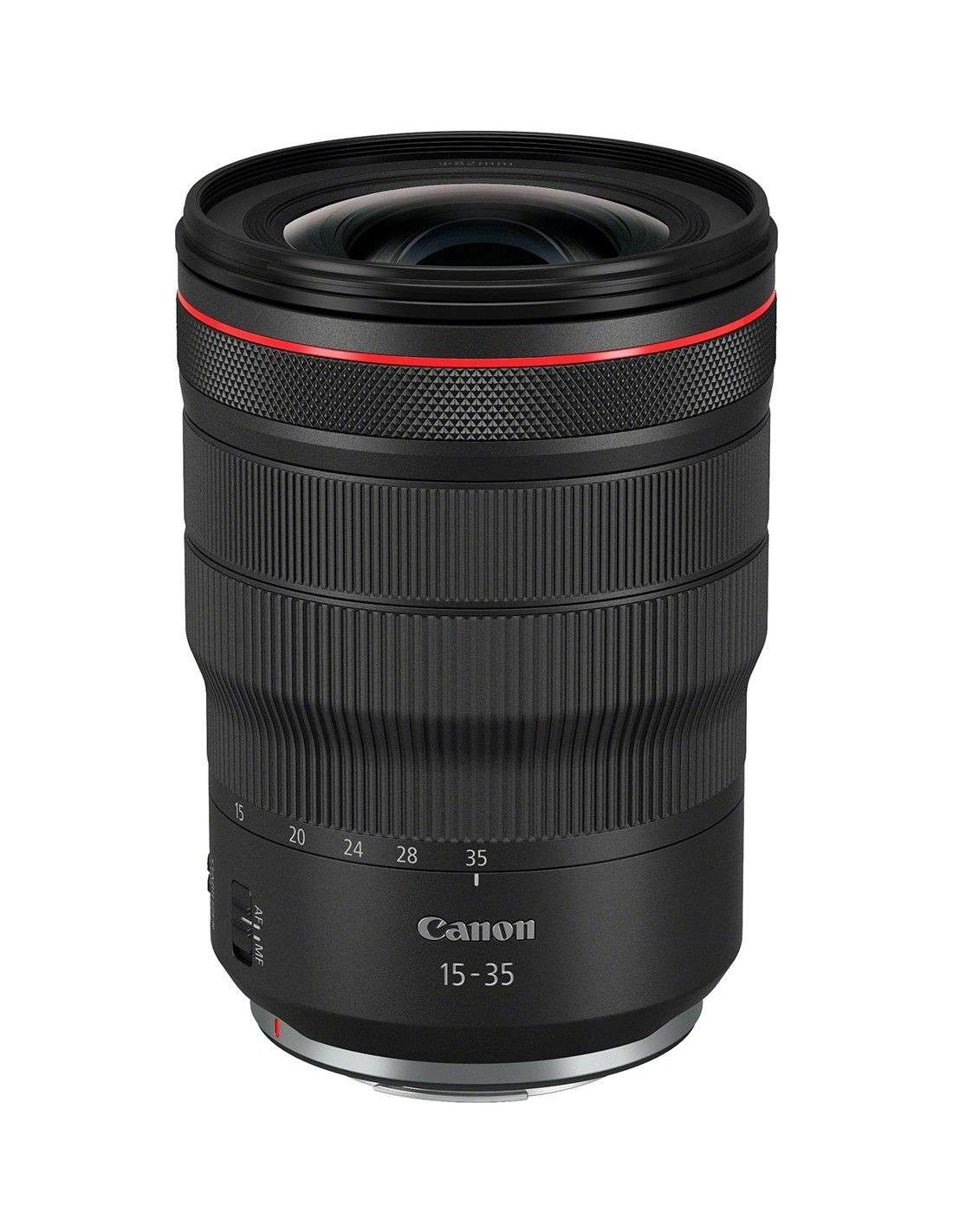

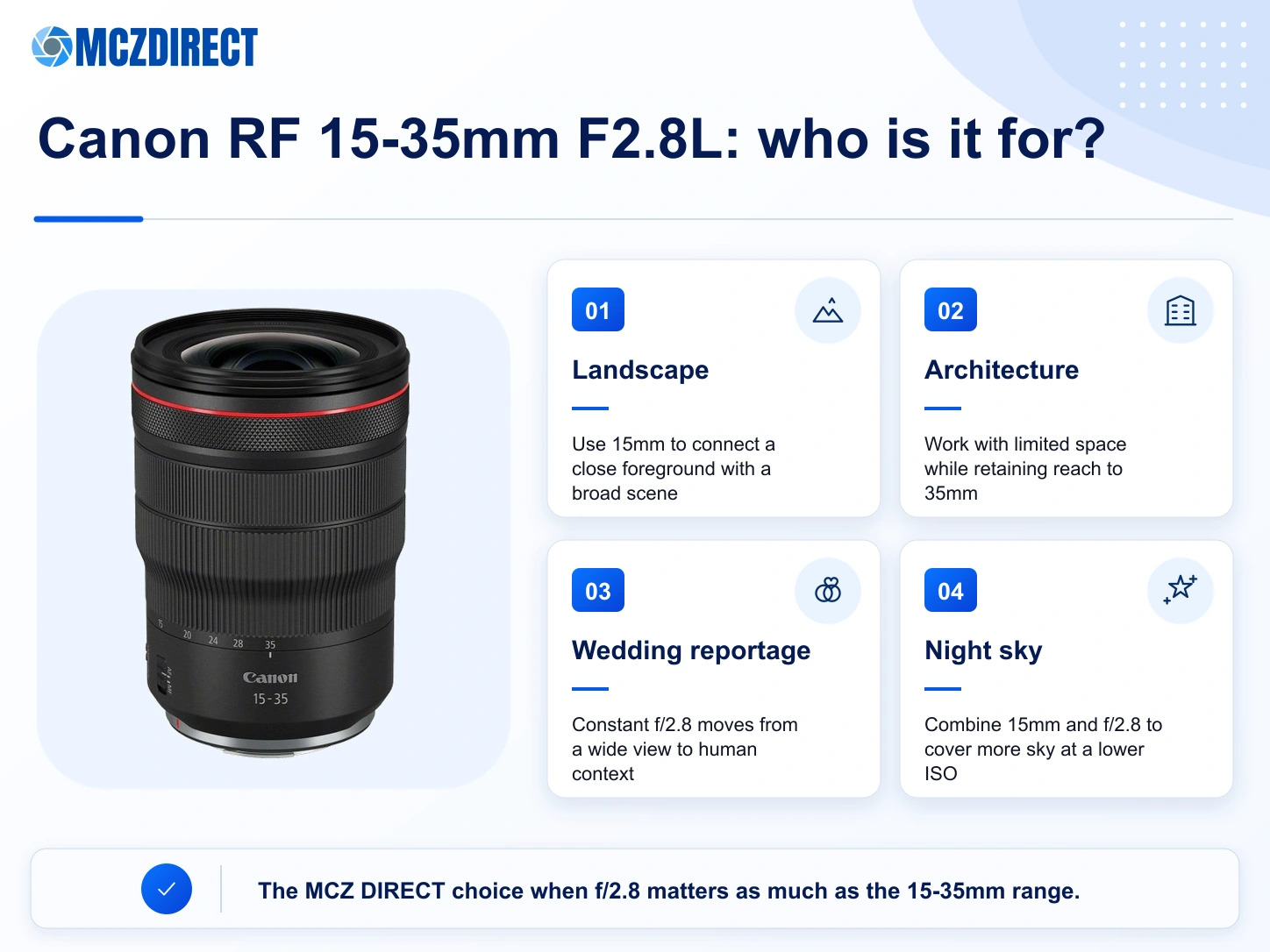
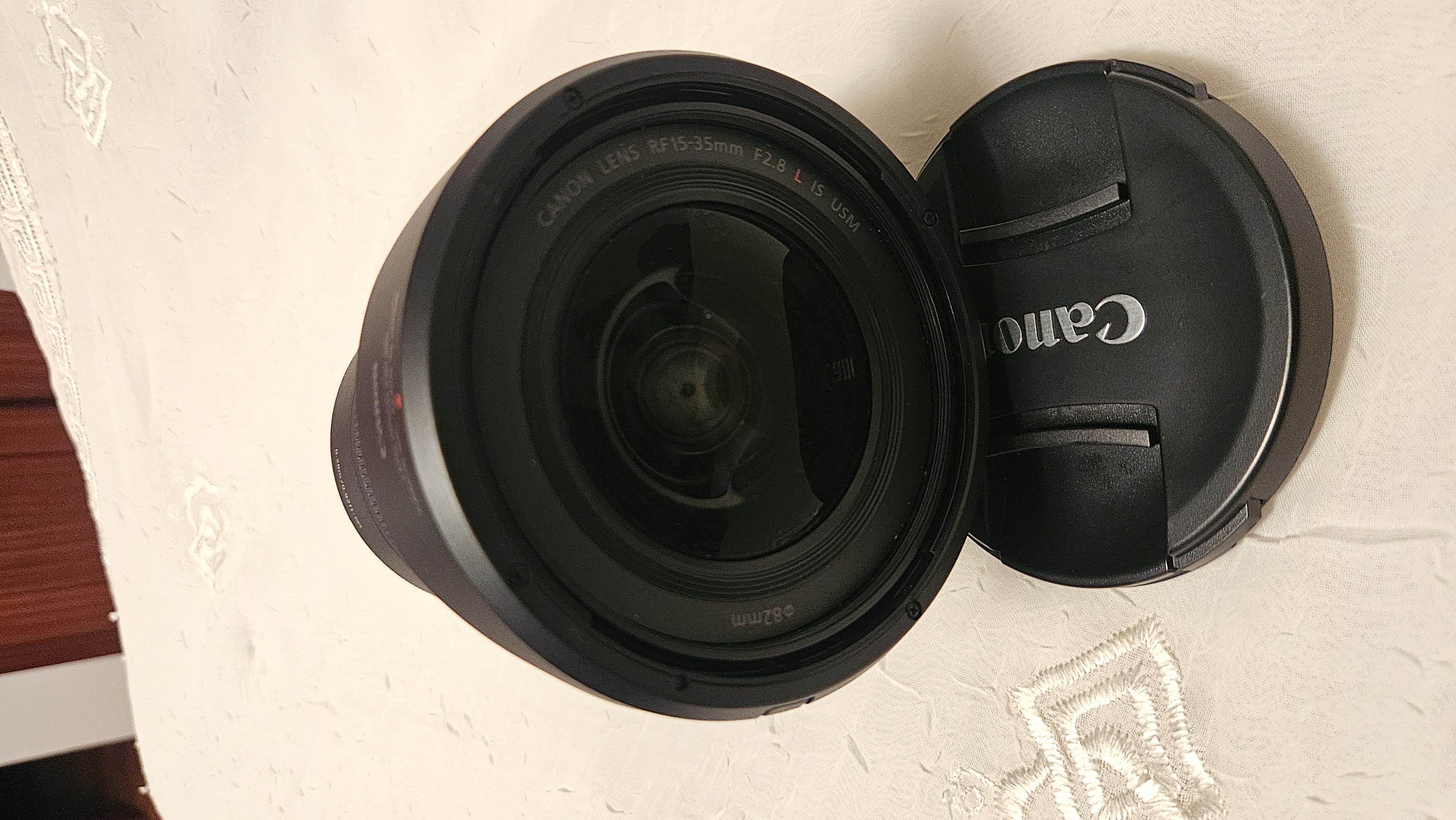
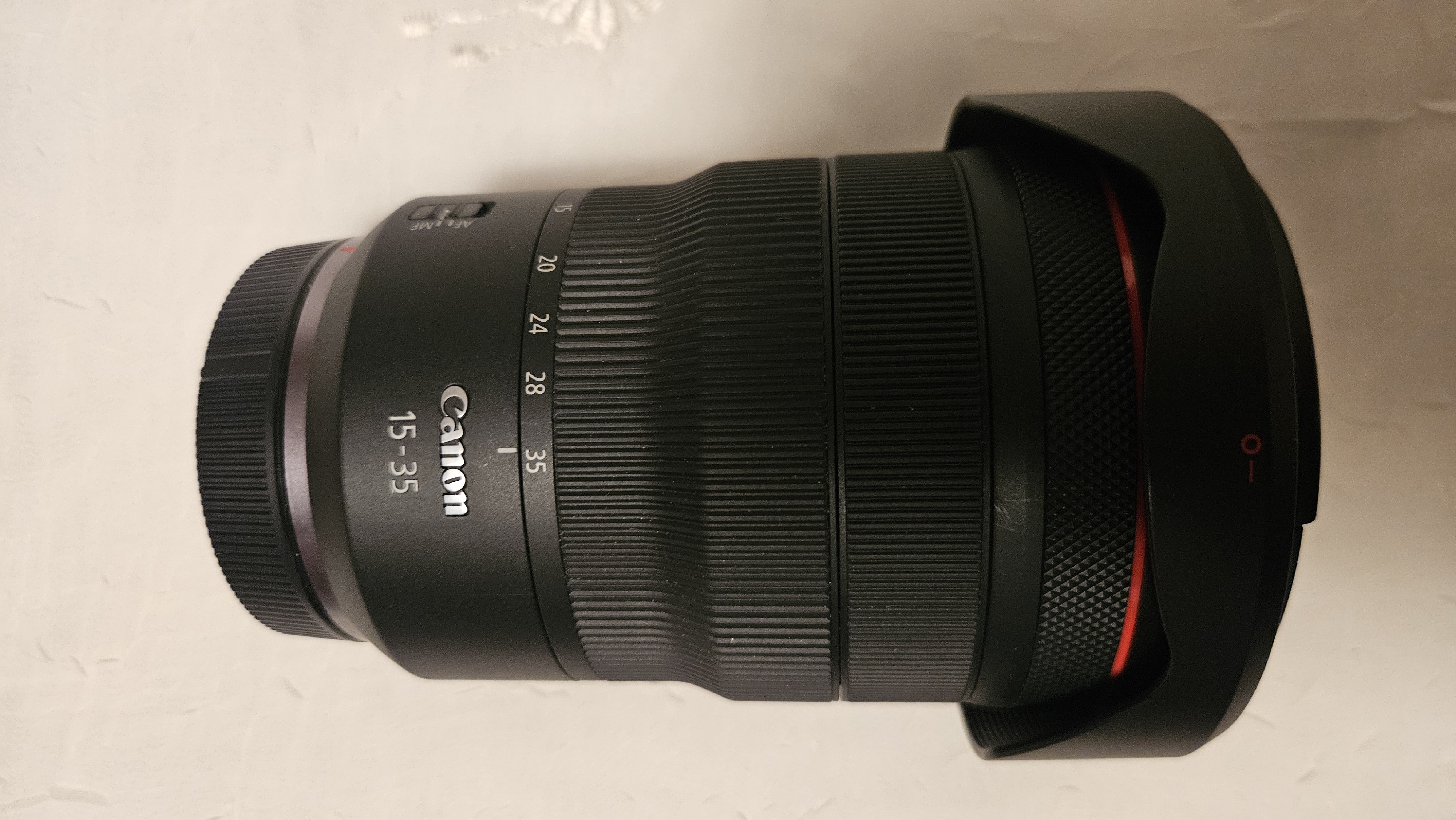
The Canon RF 15-35mm F2.8L IS USM is a professional ultra-wide zoom for landscape, architecture, wedding and reportage photographers who need a constant f/2.8 aperture, and we recommend it when available light matters as much as framing range. Its 15-35mm coverage moves from an immersive wide view to natural-looking reportage without a lens change. Canon-rated 5-stop optical stabilisation supports handheld work, while Nano USM provides fast, discreet focusing. At 840g with an 82mm filter thread, it favours robust L-series construction and brightness over low weight. It is a strong choice for EOS R photographers who will genuinely use f/2.8 and want one lens to move from an immersive view to a more restrained 35mm composition.
Combine compatible accessories and save. The more items you add, the bigger the discount.
memory card

warranty extension
The Canon RF 15-35mm F2.8L IS USM is designed for landscape, architecture, interior, wedding and reportage photographers who want to retain an f/2.8 aperture throughout the zoom range. At 15mm it can take in a broad scene or work within a confined room. At 35mm it returns to a more natural reportage perspective without exaggerating depth. That continuity is the lens’s defining advantage: it removes the need to choose between a specialised ultra-wide and a documentary focal length. The trade-off is equally clear. At 840g, it can be felt over a long assignment, so it should be selected for its light gathering and range rather than because it is the smallest Canon RF option.
| Feature | Practical benefit | Consideration |
|---|---|---|
| 15-35mm | Move from a confined interior to reportage framing without changing lens | At 15mm, elements near the frame edges require careful placement |
| Constant f/2.8 | Retain exposure while zooming and work more easily as available light falls | The bright aperture contributes to the 840g weight |
| 5-stop IS | Reduce camera shake when photographing a relatively still scene handheld | Stabilisation cannot freeze a moving person or subject |
| Nano USM | Focus quickly and make discreet transitions during video recording | Tracking performance also depends on the camera and AF setup |
| 0.28m and 0.21x | Place a close detail within its wider environment | Magnification remains below that of a dedicated macro lens |
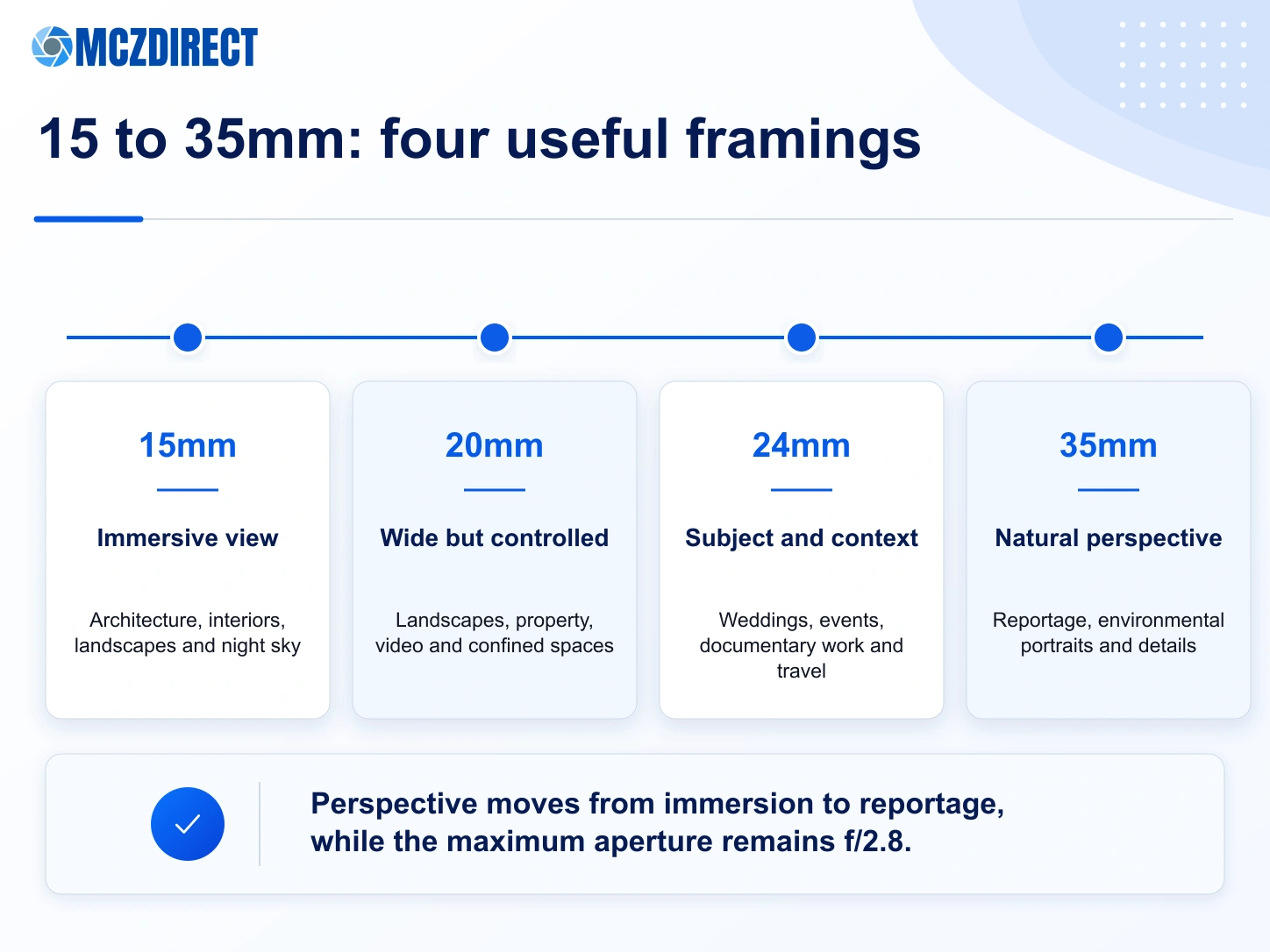
At 15mm, space feels expansive: a close foreground becomes prominent and leading lines carry the viewer into the frame. Around 20mm, the view remains very wide but is easier to balance for an interior or landscape. At 24mm, perspective feels more restrained for documentary work, weddings or video. The 35mm end can isolate a person within the setting without looking like an ultra-wide lens. In practice, the zoom changes perspective and visual emphasis as much as it brings the subject closer.
| Focal length | Suitable situation | Effect on the image |
|---|---|---|
| 15mm | Architecture, interiors, immersive landscape, night sky | Include a broad scene and emphasise leading lines |
| 20mm | Landscape, property, video, confined-space reportage | Keep a wide view that is easier to organise |
| 24mm | Weddings, events, documentary work, travel | Show the subject in context without excessive exaggeration |
| 35mm | Reportage, environmental portraits, architectural details | Tighten the frame and return to a natural-looking perspective |
An f/2.8 aperture gathers twice as much light as f/4. At the same ISO, that allows a faster shutter speed for a moving person at a wedding or event. Stabilisation addresses another problem by compensating for some of the photographer’s movement. It helps with interiors, landscapes at dusk and handheld video, but it does not replace a shutter speed matched to the subject. For astrophotography, f/2.8 can reduce exposure time or ISO; for deliberate long exposures, a tripod remains the more dependable solution.
In architecture and interiors, 15mm helps when space is limited, although verticals still need to be controlled at capture. In landscape work, its value lies in the relationship between a nearby foreground and the distance rather than width alone. A wedding photographer can use 24-35mm for preparations, groups and the dance floor, while f/2.8 preserves a more comfortable shutter speed. For video, the range covers establishing shots, camera movement in confined spaces and restrained 35mm framing. The 840g weight is the point to plan for on a gimbal.
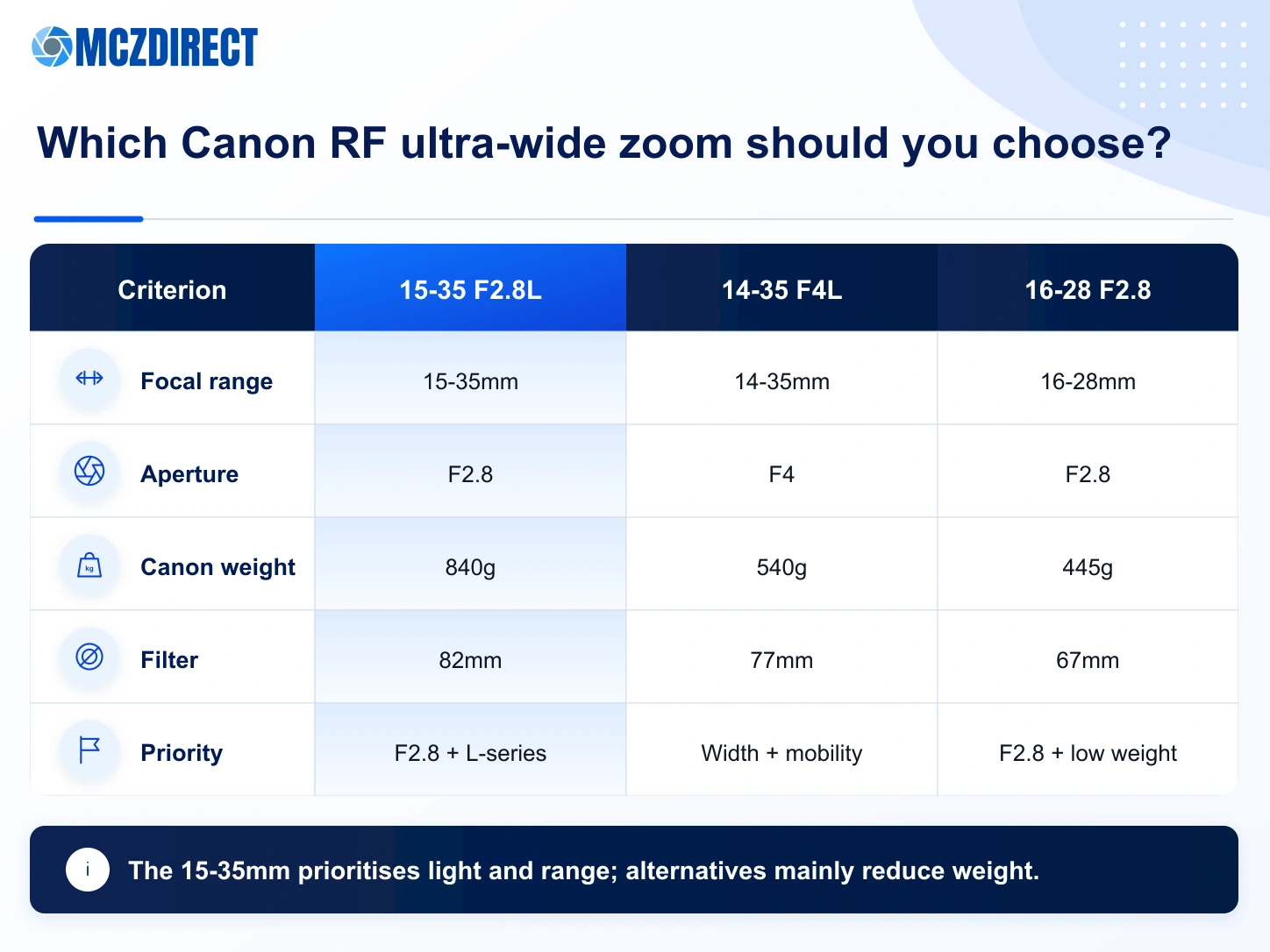
| Lens | Choose it when | Main compromise |
|---|---|---|
| RF 15-35mm F2.8L IS USM | F2.8, L-series construction and reach to 35mm matter more than weight | 840g and an 82mm filter thread |
| RF 14-35mm F4L IS USM | Travel, hiking and the extra millimetre at the wide end are priorities | F4 is one stop slower |
| RF 16-28mm F2.8 IS STM | F2.8 must fit into a much lighter and smaller kit | Shorter range, 16mm wide end and non-L construction |
| RF 10-20mm F4L IS STM | Framing must begin far beyond 14mm for architecture or interiors | F4, specialised coverage and no conventional front filter thread |
On a Canon APS-C body such as the EOS R7, the RF 15-35mm frames like a 24-56mm lens on full frame. It becomes a bright standard zoom rather than a true ultra-wide. That pairing can suit reportage, events and video, but it loses the very coverage sought for architecture and interiors. A full-frame body is the logical choice when the 15mm end is the reason for buying the lens.
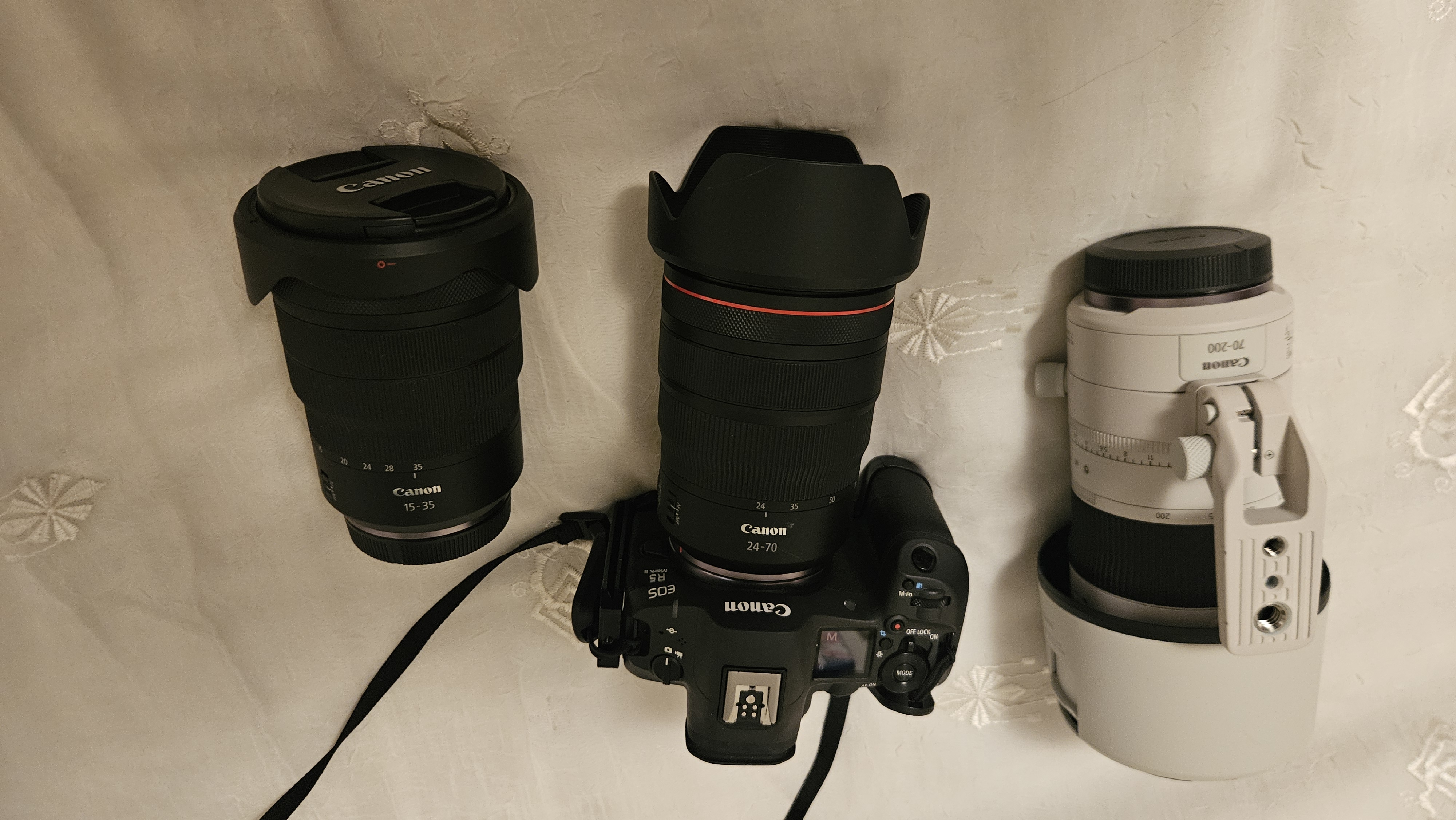
The RF mount makes the lens compatible with the Canon EOS R range. An EOS R5 Mark II suits detailed landscapes, architecture and hybrid production. The EOS R6 Mark III makes a versatile wedding, event and video pairing, while the EOS R1 is aimed at more intensive professional work. A ready-made EOS R5 Mark II and RF 15-35mm F2.8L kit is also available. Browse the Canon RF lens category to compare other active focal lengths.
At MCZ DIRECT, we see the RF 15-35mm F2.8L as the choice for a wedding, architecture or landscape photographer who genuinely uses f/2.8, rather than the default recommendation for every EOS R owner. Its range is particularly coherent when a single assignment must move from an expansive view to 35mm reportage framing without a lens change.
Against the RF 14-35mm F4L, we recommend it when available light, astrophotography or moving subjects justify the extra stop. Against the RF 16-28mm F2.8, it retains L-series construction and longer 35mm reach. Its weakness is straightforward: 840g becomes demanding for travel or gimbal work. If low weight matters more than this exact combination, one of those alternatives is the more rational choice.

It suits landscape, architecture, interior, wedding, event, reportage and astrophotography users who need a constant f/2.8 aperture.
Yes. The 15mm end can combine a close foreground with a broad view, while 35mm provides more natural framing for details.
Yes, especially when working space is limited. Verticals and objects near the frame edges still require careful control at 15mm.
Yes. F2.8 can reduce exposure time or ISO, while the 15mm end covers a large area of the night sky.
Yes. The 24-35mm range suits reportage and groups, while 15-20mm helps in confined rooms or on a busy dance floor.
Choose the 15-35mm for f/2.8 and low light. The RF 14-35mm F4L is lighter and begins one millimetre wider.
The 15-35mm provides a longer range and L-series construction. The 16-28mm retains f/2.8 in a much lighter package.
It reduces blur caused by the photographer when the subject is relatively still. It cannot freeze a moving subject.
Canon lists 840g. That is reasonable for an f/2.8 L-series zoom, but it matters for travel and gimbal use.
It accepts conventional 82mm screw-in filters, including suitable polarising and neutral-density filters.
Minimum focus is 0.28m, with maximum magnification of 0.21x at the 35mm end.
On APS-C it frames like a 24-56mm lens on full frame, becoming a bright standard zoom rather than an ultra-wide.
At MCZ DIRECT, we recommend it to wedding, architecture or landscape photographers who will genuinely use f/2.8 and want to move from 15 to 35mm without changing lenses. Its stabilisation and L-series construction add versatility, but the 840g weight deserves consideration for travel or gimbal work. The RF 14-35mm F4L is the more rational choice when low weight comes first, while the RF 16-28mm F2.8 IS STM better suits photographers who want f/2.8 in a compact kit.
Generated by AI from customer reviews.