Shopping Cart
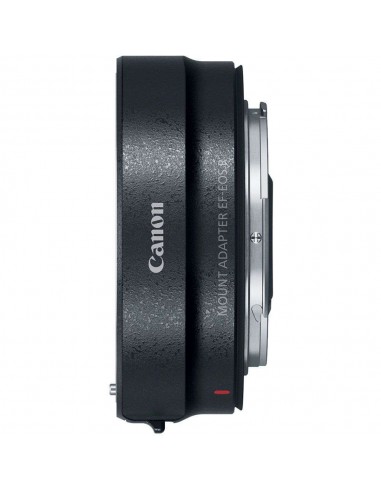
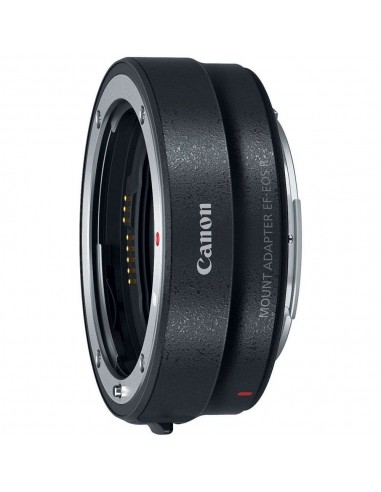




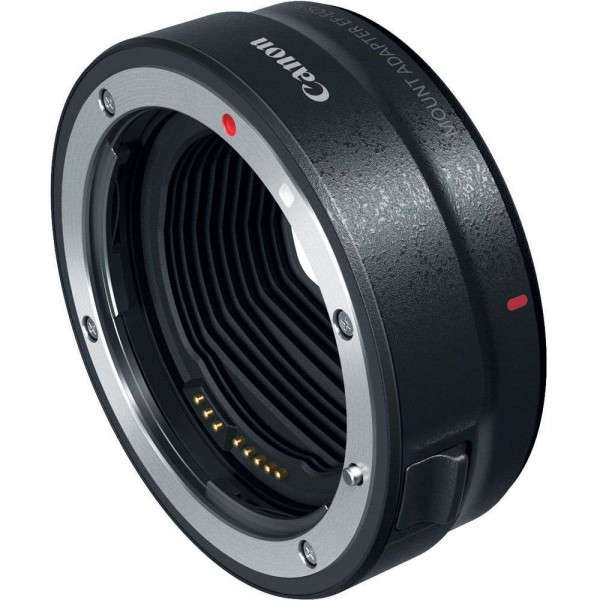
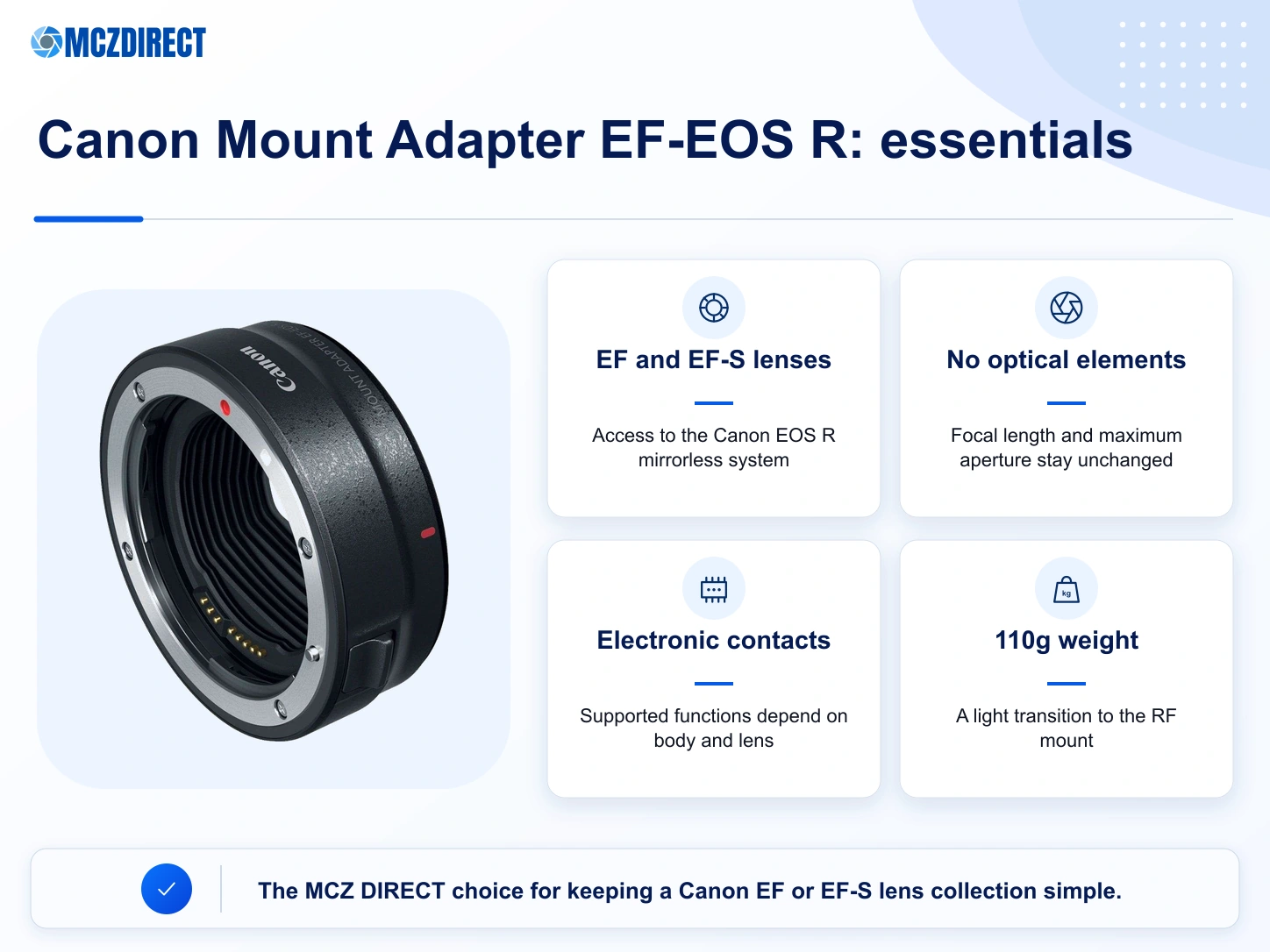
The Canon Mount Adapter EF-EOS R is the official accessory for photographers moving to an EOS R mirrorless camera while keeping Canon EF or EF-S lenses, and we recommend it for a gradual change of system without replacing an entire lens collection at once. With no optical elements, it preserves the mounted lens’s focal length, maximum aperture and rendering. Electronic contacts maintain communication for autofocus, aperture control, stabilisation and supported corrections. It adds only about 110g to the setup. An EF-S lens on a full-frame EOS R camera does, however, trigger a 1.6x crop. This standard version therefore suits photographers who want a dependable, lightweight EF-to-RF adapter for regular professional or enthusiast use, without a control ring or drop-in filter holder.
Combine compatible accessories and save. The more items you add, the bigger the discount.
memory card

warranty extension
The Canon Mount Adapter EF-EOS R connects a Canon EF or EF-S lens to an RF-mount mirrorless camera. It is most relevant to photographers who already own several DSLR lenses and want to enter the EOS R system without rebuilding their kit in one purchase. There are no optical elements, so the adapter does not alter focal length or maximum aperture. Its electronic contacts carry supported commands between lens and camera. This standard version is deliberately straightforward: approximately 110g, no extra control and little added bulk. The main point to anticipate is an EF-S lens on a full-frame EOS R body, where the camera automatically applies a 1.6x crop.
The direction matters: this adapter places an EF or EF-S lens on an RF-mount EOS R camera. It cannot fit an RF lens to an EF DSLR. TS-E and MP-E models also use the EF mount and can be attached, subject to the functions supported by the specific lens and camera. EF-M, RF, RF-S and CN-E cinema lenses are not intended for this adapter.
| Lens type | Compatible | Practical behaviour |
|---|---|---|
| Canon EF | Yes | Focal length and aperture unchanged; electronic functions depend on lens and camera |
| Canon EF-S | Yes | Normal use on APS-C EOS R cameras; automatic 1.6x crop on full-frame EOS R bodies |
| Canon TS-E and MP-E | Yes | Mechanical fit and communication according to each model’s own functions |
| Canon RF or RF-S | Not required | These lenses attach directly to EOS R cameras |
| Canon EF-M | No | Different mount, not supported by this adapter |
| Canon CN-E | Not supported | Canon excludes CN-E cinema lenses from the stated compatibility |
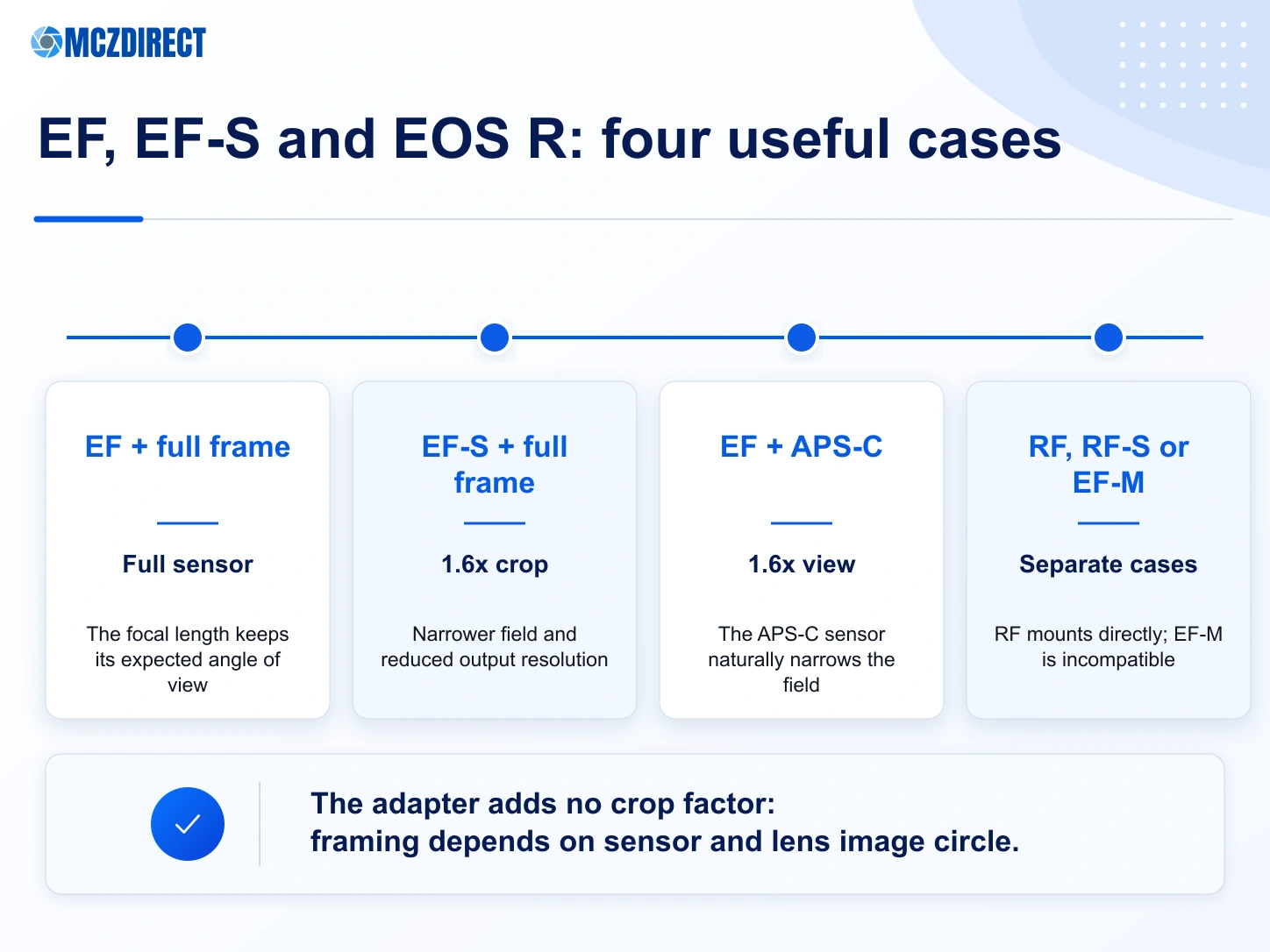
With an EF lens, the adapter adds no crop factor. Framing is determined by the camera sensor, as it is with any lens used on that format. A Canon EOS R1, Canon EOS R5 Mark II, Canon EOS R6 Mark III or Canon EOS R8 therefore uses the full-frame image circle of an EF lens. On a Canon EOS R7 or Canon EOS R10, the APS-C sensor naturally gives an angle of view equivalent to 1.6x the marked focal length.
| Combination | Recorded area | What it means in practice |
|---|---|---|
| EF lens + full-frame EOS R | Full sensor | Angle of view matches the marked focal length |
| EF-S lens + full-frame EOS R | APS-C area, 1.6x crop | Narrower field of view and reduced output resolution |
| EF lens + APS-C EOS R | APS-C sensor | Angle of view equivalent to 1.6x the focal length |
| EF-S lens + APS-C EOS R | APS-C sensor | Uses the image circle for which the lens was designed |
The adapter restores the flange distance required by DSLR lenses and passes the electrical contacts to the RF mount. On a supported combination, aperture control, autofocus, optical stabilisation and shooting information remain available. Because there is no glass, the adapter does not introduce an optical conversion that directly reduces sharpness. That does not mean every older lens gains every feature of a recent camera: support can vary with the EF lens generation, and some third-party lenses may depend on their firmware. Final performance is still determined by the lens-and-camera pairing.
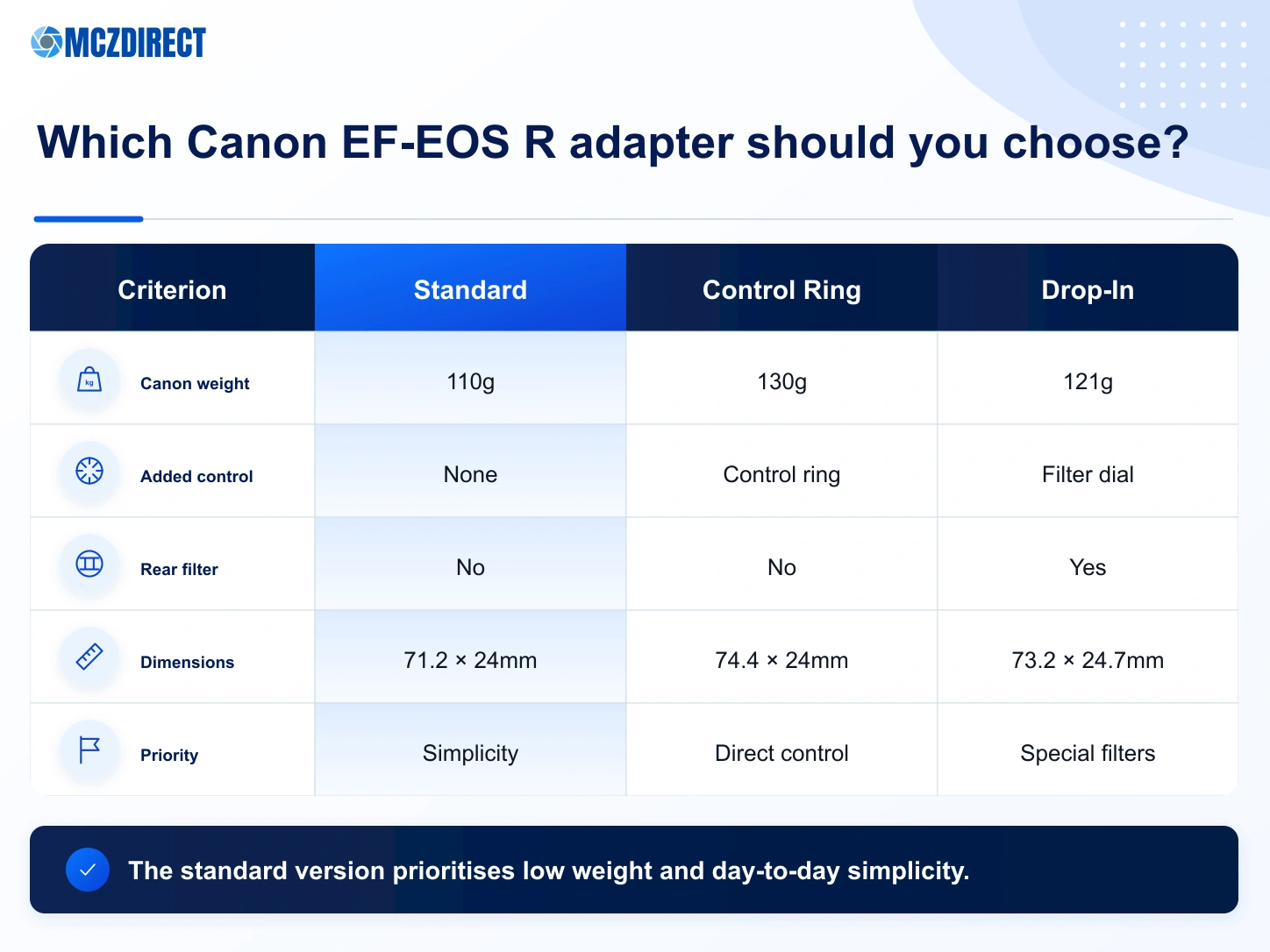
Canon offers three approaches. The product on this page is the simplest and lightest. The Control Ring version adds a customisable control similar to the ring fitted to many RF lenses. The Drop-In version positions a filter behind the lens, which is useful with bulbous-front ultra-wide lenses or when several different front-filter sizes would otherwise be needed.
| Version | Main advantage | Most suitable need | Trade-off |
|---|---|---|---|
| Standard EF-EOS R | 110g and maximum simplicity | Reuse EF/EF-S lenses without an added function | No control ring or drop-in filter |
| Control Ring EF-EOS R | Customisable control | Quick access to ISO, aperture, shutter speed or exposure compensation | Heavier and more expensive than the standard version |
| Drop-In Filter EF-EOS R | Filter behind the lens | Polarisation, video, long exposures or lenses without a front filter thread | A compatible filter must remain installed |
It makes particular sense when an EF collection still includes specialist, bright or expensive lenses whose immediate RF replacement would bring little practical benefit. It also lets the migration happen in stages: choose the camera first, then replace lenses only when a native RF option solves a genuine need. For professional use where simplicity matters, the standard version avoids another control that can be moved inadvertently. If you are starting without EF lenses, however, a native RF lens will generally make a more compact combination designed around the system from the outset.
Canon advises attaching the adapter to the lens first, then mounting the complete assembly on the camera. With a heavy lens, support the lens rather than the camera; the adapter does not replace a telephoto lens collar. Its 24mm length restores the difference between EF and RF flange distances, while the 110g weight remains discreet in a bag. Before choosing the body for an existing lens collection, compare the active models in our Canon EOS R camera category; our Canon lenses category then helps plan any gradual move towards native RF optics.
At MCZ DIRECT, we see the standard Canon EF-EOS R as the sensible choice for a photographer with a useful EF collection who would rather invest in the camera body than replace every lens immediately. It is more relevant than the Control Ring version when low weight, reliability and an uncluttered interface matter most. On a full-frame EOS R it is at its strongest with EF lenses; on an APS-C EOS R it also extends the life of an EF-S collection very effectively.
Its honest limitations are that it adds 24mm to every adapted lens and cannot turn an older design into a modern native RF lens. Available features remain tied to the lens and camera generation, while EF-S lenses crop the image on a full-frame body. Once those points are understood, it is a clean, light and durable way to move systems at your own pace.

It attaches a Canon EF or EF-S lens to an RF-mount Canon EOS R mirrorless camera. It is most useful for keeping a DSLR lens collection while moving to mirrorless.
Yes. EF-to-RF adapter, EF-RF mount adapter and Mount Adapter EF-EOS R all describe the same direction here: an EF or EF-S lens on an EOS R camera.
Yes. They work on APS-C EOS R cameras and automatically trigger a 1.6x crop when used on a full-frame EOS R body.
No. EF-M is a different mount and is not supported. RF and RF-S lenses attach directly to EOS R cameras and do not need this adapter.
Yes with supported lenses and cameras. Canon maintains electronic communication, although some functions can vary with lens generation or the firmware of a third-party lens.
Yes when the lens has compatible stabilisation and the camera supports it. The adapter passes the required electronic information between them.
It contains no optical elements and therefore introduces no optical conversion. Image rendering and sharpness remain primarily dependent on the lens, camera and shooting conditions.
No. An EF 50mm f/1.8 remains a 50mm f/1.8. Framing is narrower on an APS-C sensor or when an EF-S lens triggers crop mode on a full-frame body.
Its image circle is designed for the smaller APS-C sensor. The camera therefore uses a central sensor area to avoid recording edges that the lens does not cover.
The Control Ring version adds a customisable control for ISO, aperture, shutter speed or exposure compensation. The standard version is lighter and simpler.
The Drop-In version accepts a rear filter, useful for ND or polarising effects and lenses without a front filter thread. The standard version has no filter holder.
It is designed for RF-mount EOS R system cameras, whether full frame or APS-C. Functional compatibility then depends on the particular lens being used.