Shopping Cart
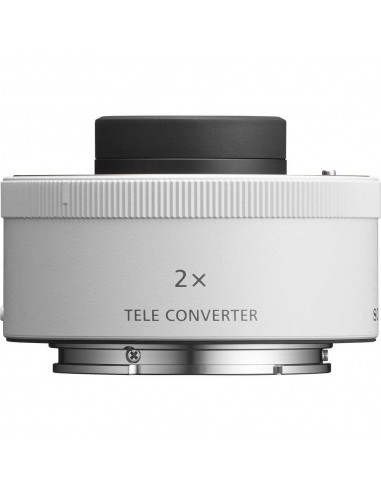



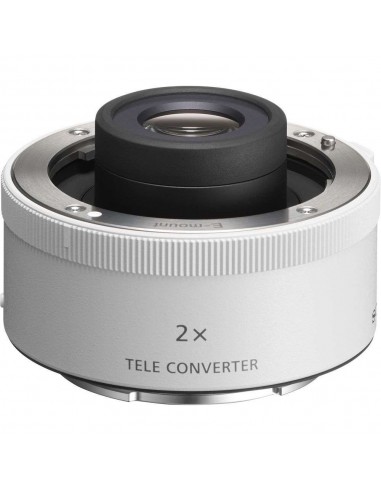
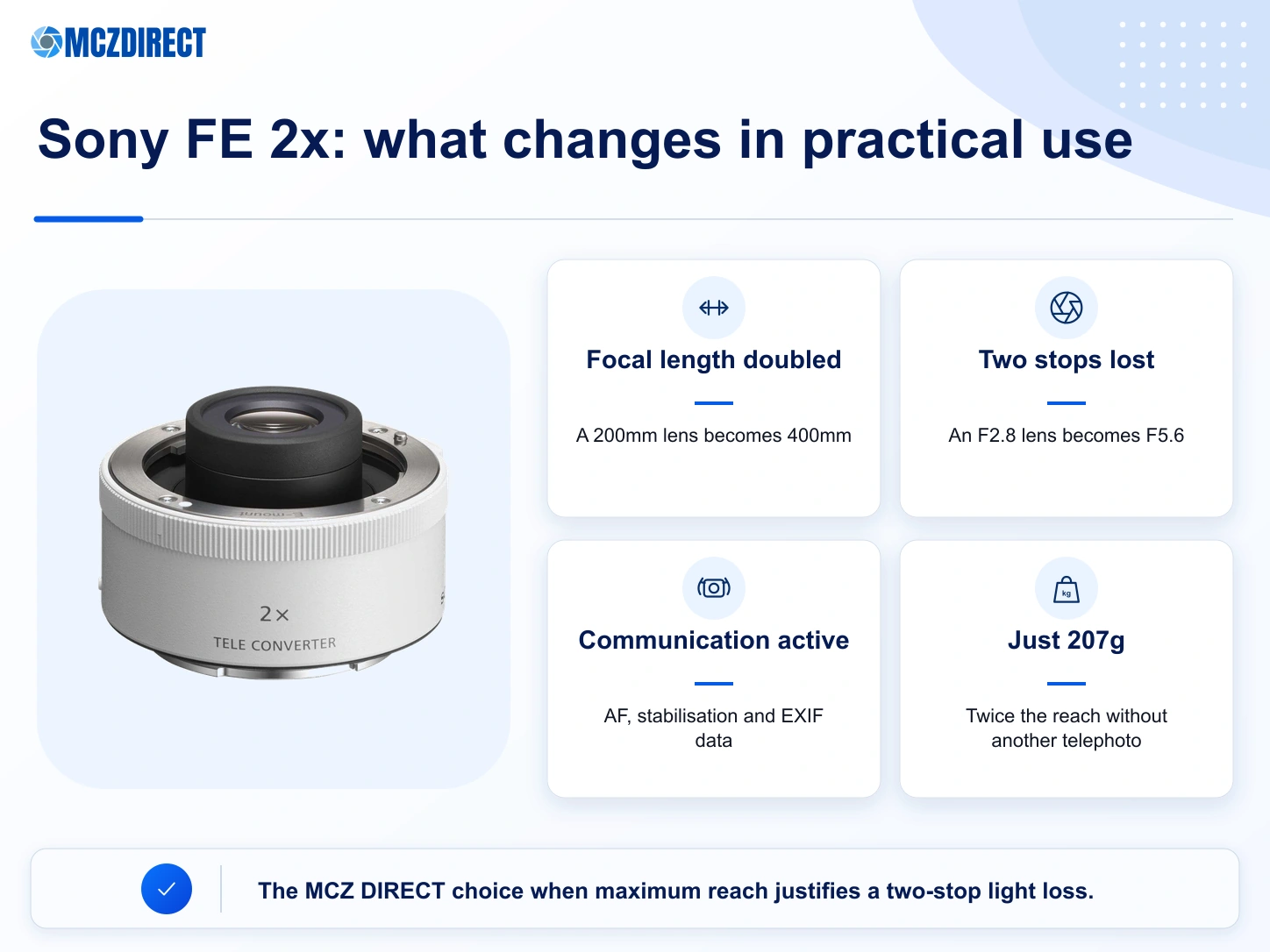
The Sony FE 2.0x Teleconverter SEL20TC is a dedicated reach extender for photographers using a compatible Sony telephoto lens and working with genuinely distant subjects. It suits wildlife, bird photography and outdoor sport when getting closer is not possible and focal length matters more than maximum aperture. It turns the 200-600mm into a 400-1200mm, while a 70-200mm F2.8 becomes a 140-400mm F5.6. The trade-off is roughly two stops of light, so shutter speed and ISO need more attention as conditions darken. At 207g, it remains practical to carry as part of a long-lens kit. It is a considered choice when your compatible Sony lens needs more reach, not a universal solution for every E-mount lens. It rewards deliberate scene selection rather than permanent use.
Combine compatible accessories and save. The more items you add, the bigger the discount.
memory card

warranty extension
The Sony FE 2.0x Teleconverter SEL20TC, often searched as the Sony 2x teleconverter or Sony SEL20TC, is made for photographers who already own a compatible Sony long lens and need to make a distant subject larger in the frame. It doubles focal length: the 70-200mm F2.8 becomes a 140-400mm F5.6, the 100-400mm F4.5-5.6 becomes a 200-800mm F9-11, and the 200-600mm reaches 400-1200mm F11-13. That is useful for birds, wary wildlife or outdoor action where the shooting position cannot be moved.
The 2x factor comes with a visible operating cost. It loses about two stops of light, so it asks more of ISO, shutter speed and support as daylight fades. Sony also limits the SEL20TC to a specific group of lenses; sharing the E mount is not enough. Used in the right conditions, it is a compact way to gain serious reach without buying or carrying another long lens.
The Sony 2x teleconverter is for photographers facing a simple field problem: the subject is too far away, and moving closer is either impossible or a bad idea. It makes most sense for bird photographers, wildlife photographers and outdoor sports shooters who already use a compatible Sony lens. From a hide, a stadium boundary or a protected trail, the additional focal length can reduce how heavily an image needs to be cropped afterwards.
It is not an all-purpose accessory for a Sony E-mount kit. The SEL20TC only fits a defined group of lenses, and it needs enough light to deliver its best results. For indoor work, dusk sessions or fast, unpredictable subjects, the bare lens or a 1.4x converter may be the more useful choice.
Doubling focal length does not replace patient positioning, but it changes framing in a meaningful way. The FE 200-600mm becomes a 400-1200mm, allowing a perched bird or distant animal to take up more of the image from a sensible observation distance. The FE 100-400mm becomes a 200-800mm, which can be valuable on a safari, from a shoreline or across a sports field where access is controlled.
The extra reach is easiest to use when the subject is already found and remains at a fairly consistent distance. At 1200mm, even a small change in direction makes locating a moving animal harder. A zoom still gives flexibility, but the 2x rewards deliberate composition more than rushed reaction.
| Compatible lens | Native configuration | With SEL20TC | What it enables |
|---|---|---|---|
| FE 70-200mm F2.8 GM OSS II | 70-200mm F2.8 | 140-400mm F5.6 | More reach for outdoor sport and events. |
| FE 70-200mm F4 Macro G OSS II | 70-200mm F4 | 140-400mm F8 | Extra distance in daylight on a compact telezoom. |
| FE 100-400mm GM OSS | 100-400mm F4.5-5.6 | 200-800mm F9-11 | Tighter wildlife framing while retaining a zoom range. |
| FE 200-600mm G OSS | 200-600mm F5.6-6.3 | 400-1200mm F11-13 | Specialist reach for distant birds and wildlife. |
| FE 300mm F2.8 GM OSS | 300mm F2.8 | 600mm F5.6 | Long-prime reach with a still useful aperture. |
| FE 400mm F2.8 GM OSS | 400mm F2.8 | 800mm F5.6 | Distant sport and wildlife in good light. |
| FE 600mm F4 GM OSS | 600mm F4 | 1200mm F8 | Very long reach where access is restricted. |
| FE 400-800mm G OSS | 400-800mm F6.3-8 | 800-1600mm F13-16 | Extreme reach for still subjects in bright conditions. |
| FE 100mm F2.8 Macro GM | 100mm F2.8 | 200mm F5.6, up to 2.8x magnification | More working distance around small subjects. |
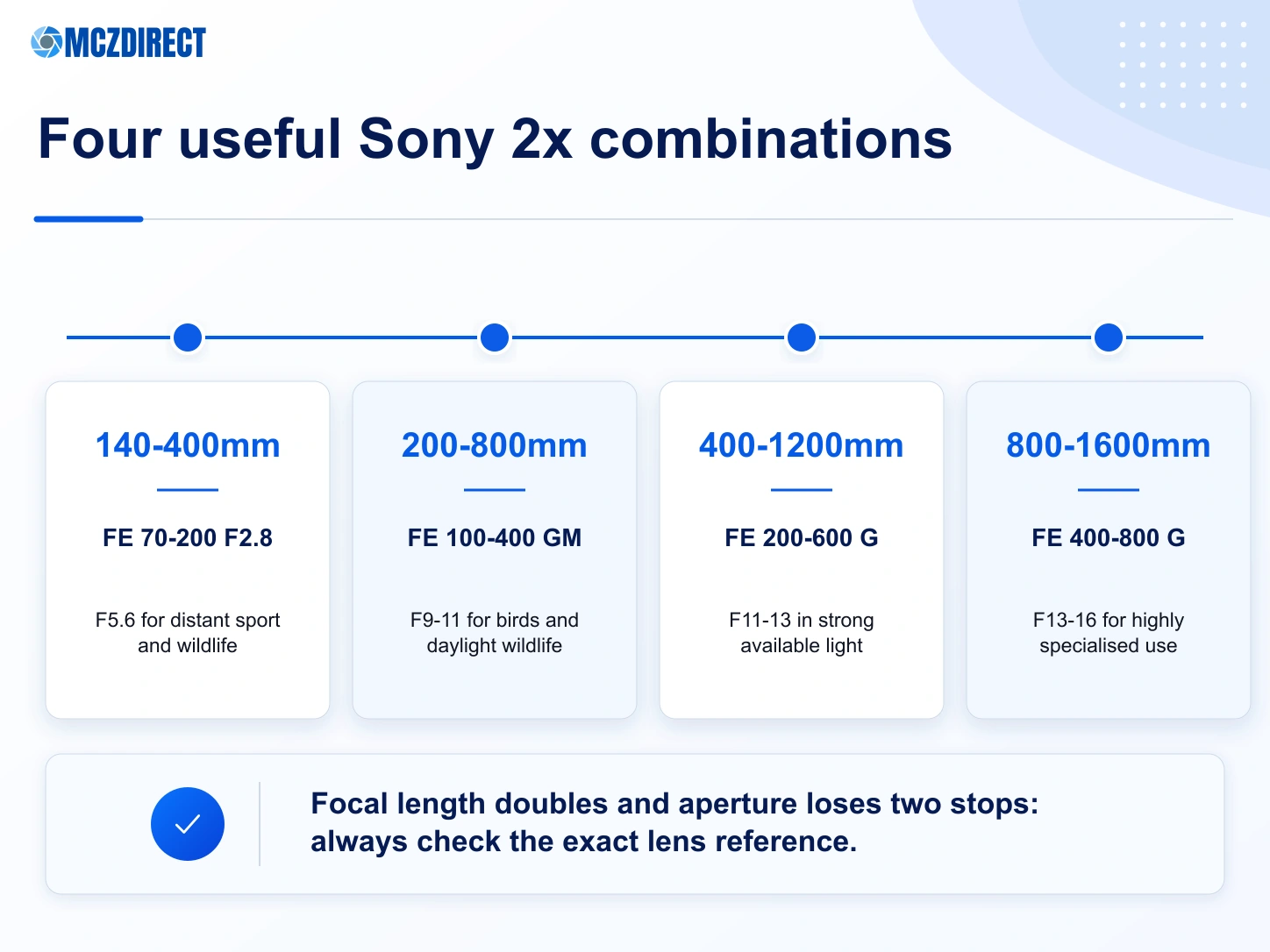
The SEL20TC loses approximately two stops of light. An F2.8 lens becomes F5.6, an F4 lens becomes F8, and the 200-600mm F5.6-6.3 becomes F11-13. This matters because a bird in flight or a fast athlete needs a shutter speed that cannot simply be wished back into the exposure. As conditions become darker, ISO rises quickly or shutter speed falls.
Sony retains autofocus, stabilisation, lens data and electronic communication with compatible combinations. That is useful, but it is not a promise that focus performance will be unchanged in every situation. Available light, contrast, camera generation, AF mode, lens choice and subject movement continue to decide how confidently the system can follow action.
The SEL20TC is not compatible with every Sony E-mount lens. Sony's current compatibility list includes the SEL100400GM, SEL100M28GM, SEL200600G, SEL300F28GM, SEL400800G, SEL400F28GM, SEL600F40GM, SEL70200G2, SEL70200GM and SEL70200GM2. These are optical combinations designed to accommodate the converter.
Check the full model reference before mounting or ordering. Product-family names can look similar while the underlying optical design differs. Sony can update support information as new lenses arrive, so current official compatibility guidance should be the final check for a specific body-and-lens setup.
| Shooting situation | What the 2x asks for | Useful combination | Watch for |
|---|---|---|---|
| Perched bird in daylight | Reach and deliberate framing. | 200-600mm plus 2x | Keep shutter speed high enough for small movements. |
| Distant mammal | Safe shooting distance and stable light. | 100-400mm or 200-600mm plus 2x | Use stable support at long effective focal lengths. |
| Outdoor sport in afternoon light | Fast shutter speed with adequate exposure. | 70-200mm F2.8 plus 2x | Monitor ISO as the light changes. |
| Bird in flight at dawn | High shutter speed in poor light. | Bare lens or 1.4x | A 2x can make exposure and AF too demanding. |
| Cautious insect | Extra working distance around the subject. | 100mm Macro GM plus 2x | Depth of field remains extremely shallow. |
| Distant wildlife under cloud | Balance reach against exposure margin. | 1.4x or bare lens | The 2x is not always the most productive option. |
With the Sony FE 200-600mm F5.6-6.3 G OSS, the 2x teleconverter creates a 400-1200mm F11-13 setup. This is a specialist wildlife and birding combination for situations where the subject remains genuinely distant. From a hide or a designated observation point, 1200mm can bring a small subject closer in the frame without disturbing it.
Its constraint is straightforward: F11-13 needs useful daylight. It is rarely the comfortable option for owls at dusk, dense forest or fast birds before sunrise. In those scenes, the bare 200-600mm can produce more keepers because it gives the camera more light to work with. The 2x earns its place when distance, not brightness, is the limiting factor.
On the compatible FE 70-200mm F2.8 GM OSS II, the SEL20TC gives a 140-400mm F5.6 zoom. That can be a useful outdoor sports, event or wildlife range when changing lenses would mean missing a moment. It retains zoom flexibility while delivering much more reach than the native 200mm end.
It is worth remembering what is lost at the near end. A 140mm starting point is less helpful when action moves close, and F5.6 is less forgiving than F2.8 once light falls. The advantage of this combination is not that it should stay on permanently; it is that you can fit it when the subject distance makes the extension worthwhile.
| Decision point | Bare lens | Sony 1.4x | Sony 2x |
|---|---|---|---|
| Focal-length gain | Native focal length | 1.4x | 2x |
| Light loss | None | About 1 stop | About 2 stops |
| With a 200-600mm | 200-600mm F5.6-6.3 | 280-840mm F8-9 | 400-1200mm F11-13 |
| Low light | Most flexible | Possible with care | Often too demanding |
| Fast action | Easiest to handle | Good daylight compromise | Best reserved for strong light and controlled technique |
| Best use | General flexibility | Birds, wildlife and sport with some exposure margin | Very distant subjects in genuinely good light |
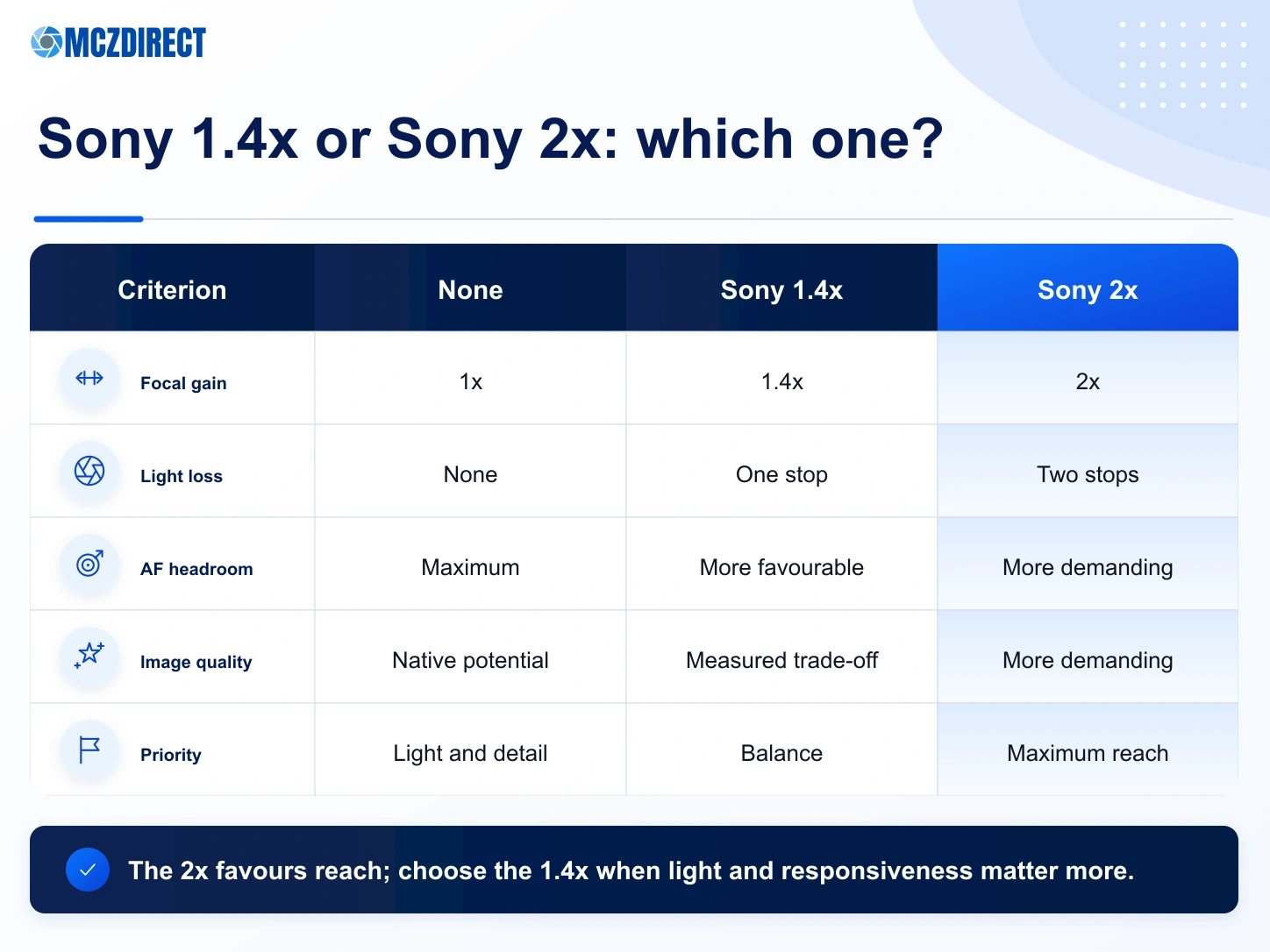
A Sony 1.4x teleconverter adds 40% focal length and costs around one stop. A Sony 2x doubles focal length and costs around two stops. The longest effective focal length is not automatically the right answer. The better choice is the one that still leaves enough shutter speed, usable ISO and manageable framing for the subject in front of you.
On the 200-600mm, a 1.4x creates a 280-840mm F8-9 combination, often easier to use as light changes or birds begin to move. The 2x takes the same lens to 400-1200mm F11-13 and becomes a more specialised tool. Choose it for distance-heavy work in good light, not simply because it delivers a larger number.
The SEL20TC measures 62.4 x 42.7mm and weighs 207g. It is small beside a super-telephoto, yet substantial enough to deserve a protected compartment when it is not in use. Its eight-element, five-group construction is dedicated to the approved Sony lens combinations rather than intended as a universal adapter.
Attach the teleconverter to the compatible lens first, then mount the completed lens-and-converter assembly to the camera. Reverse that order when removing it. At focal lengths approaching 1200mm, technique remains essential: a monopod, tripod or very stable handholding position can matter as much as the added reach.
If a two-stop light loss is too demanding for your work, the Sony FE 1.4x Teleconverter retains more flexibility. For a lens outside Sony’s compatibility list, choose the focal length you need from our full-frame Sony lenses instead.
At MCZ DIRECT, we see it as the right choice for a wildlife, bird or outdoor-sports photographer who already owns a compatible Sony lens and repeatedly meets a genuine distance limit, rather than for general photography or low-light work.
Its value is practical rather than abstract: the same long lens can become a far longer setup when the subject remains out of reach. That ability to adapt the kit is more important than the 2x figure by itself.
Compared with the Sony 1.4x, we recommend it when subject distance clearly takes priority and the available light is generous. With a 200-600mm, the 1.4x is more versatile; the 2x is the deliberate choice when 1200mm is genuinely useful.
It is less suitable at dusk, indoors or for very fast action because the two-stop loss quickly narrows exposure options. Choose it when extreme reach on an explicitly compatible lens will serve the way you actually photograph.

It is a full-frame Sony E-mount teleconverter that doubles the focal length of explicitly compatible Sony lenses. It fits between camera and lens to provide a tighter view of a distant subject.
No. The SEL20TC works only with Sony lenses specifically approved for it. Sharing the E mount is not enough; always check the exact lens model reference before mounting it.
The current list includes SEL100400GM, SEL100M28GM, SEL200600G, SEL300F28GM, SEL400800G, SEL400F28GM, SEL600F40GM, SEL70200G2, SEL70200GM and SEL70200GM2. Sony may update this list.
The SEL20TC loses approximately two stops of light. F2.8 becomes F5.6, F4 becomes F8 and F5.6-6.3 becomes F11-13.
The FE 200-600mm F5.6-6.3 G OSS becomes a 400-1200mm F11-13. It is best suited to very distant subjects in adequate daylight.
The compatible FE 70-200mm F2.8 GM OSS II becomes a 140-400mm F5.6 zoom. It can be useful for outdoor sport, events and wildlife when extra reach is needed.
The FE 100-400mm F4.5-5.6 GM OSS becomes a 200-800mm F9-11. It gives more reach for daytime wildlife when 400mm does not frame the subject tightly enough.
Sony retains autofocus, stabilisation, electronic communication and lens data with compatible combinations. Actual results still depend on light, camera body, lens, AF settings and the subject.
Yes, when lens compatibility, subject distance and light support it. The 200-600mm reaches 1200mm, but F11-13 requires enough light to preserve a suitable shutter speed.
Yes. The FE 100mm F2.8 Macro GM becomes a 200mm F5.6 with up to 2.8x magnification. The longer working distance can help around insects and cautious small subjects.
The 1.4x balances reach, light and easier handling. The 2x is the better option when distance is the priority and the available light can support the roughly two-stop loss.
The Sony FE 2.0x Teleconverter weighs approximately 207g and measures 62.4 x 42.7mm. It is compact enough to carry beside a long lens and fit only when the subject distance justifies it.
Attach the teleconverter to the compatible lens first, then mount the combined assembly to the camera. Remove it in reverse order. Never force it onto a lens that Sony has not listed as compatible.